Charles Koroneho on 45 years of art, and why legacy is overrated

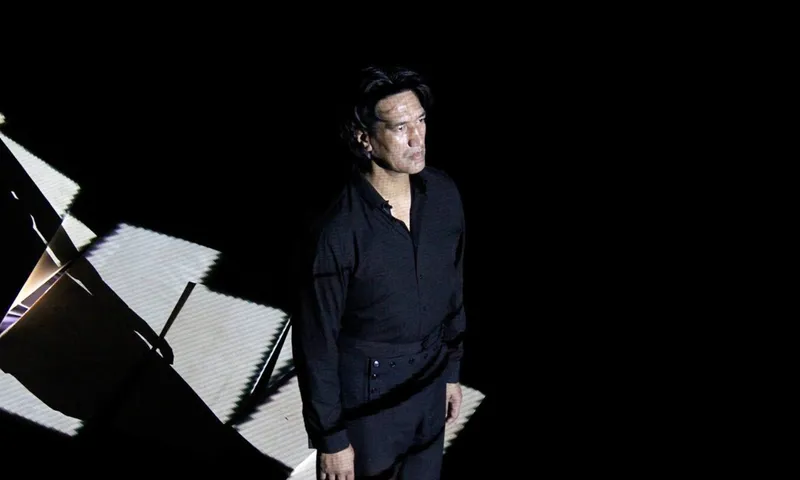
Charles Koroneho's experimental performances push the boundaries between dance, visual art and theatre. (Photo: Supplied)
Ahead of his new solo performance Bird of Passage, Charles Koroneho reflects on why learning to embrace uncertainty might be the greatest lesson of all.
Charles Koroneho has lived a life dedicated to the arts. He credits his parents with giving him the freedom to support a career as an artist – something he only realised later in life. Koronoeho has now spent decades at the intersection of performance and culture.
In 1997, Koroneho established Te Toki Haruru, a platform for exploring indigenous creativity, cultural collaboration and the intersection between dance, performance research, visual arts and design. Next month, he will debut a new hybrid solo performance, Bird of Passage, as part of the Experimental Dance Festival. The show centres around Koroneho’s lifelong experience living with epilepsy and daily seizures.
We asked Koroneho for some life advice. Here is his sage wisdom.
What bothers you most about the world right now?
This year, I traveled internationally for work projects. I saw and experienced the inequities and political injustices faced by indigenous peoples in the different countries I visited. I witnessed how arts organisations, festivals and cultural communities were forced to operate with reduced resources in an environment of financial and political uncertainty. It was a disheartening experience to see the global continuation of colonial, capitalist neoliberal political and economic ideology and its influence on the indigenous and arts communities I was working with. It was unsettling to recognise the infrastructure challenges and deficit resourcing I had experienced in Aotearoa reproduced in every context I encountered while collaborating with my colleagues in Europe and North America.
What sort of people do you avoid?
Generally, I try to avoid work and social contexts where people are drinking alcohol and engaging in arts sector small talk. It's not people I avoid, rather the anxiety of a community fortifying itself in anticipation of gathering. While these are important occasions for the communities I am a part of, I tend to wait to be with people, enjoy their energy, enthusiasm and appreciate it when I find myself in a space of interesting and topical conversations.
What makes you want to get up in the morning?
A promise of a new day is the most incredible gift I think I could receive when I wake in the morning. Sunlight and bird song can bring you from that sleepy comfort to the new possibilities of the day. The return of the sun is a great reminder that we get another chance to renew our relationships with the people we love.
How do you hold onto hope in these crazy times?
I am grateful to all the people and communities I had the good fortune to work with this year. In every location, neighbourhood, gathering place I visited the home people were inspiring, filled with love and pride for the best optimistic and hopeful outcome for their community. Offering a performance work in these communal contexts was one of the best ways I could share a gesture of hope and reassurance with my hosts.
What is the single best quality a human can have?
I am not sure there is a single human quality I could suggest, however most personalities I have encountered (including my own) would benefit from a measure of ngākau aroha – a person with empathy, compassion, who is kindhearted, caring and considerate.
What’s overrated?
About my work – after 45 years of exploring creativity, making performances and collaborative projects I have been thinking about and attempting to distance my artistic practice from the notion of legacy. It is a resistant dream I have for my life's work to ka riko te marama, wane as the moon. I think if it is possible in the age of digital technology for my work to be subject to creative decomposition, I would embrace that and I would invite those interested to rummage through the remnants for what is useful after I am gone.
What’s underrated?
The instability of performance and what insights artists, audiences and creative communities can learn about it. There is great apparatus put into service to control and stabilise performance practices, from formulaic genres, imbedded rehearsal structures, design and technical proficiencies. I employ all of these devices and more in my work, however, they are constantly challenged and tested when in performance. It is a humbling experience to make a companion of instability.
If you could have a do-over, what would you change?
I wonder what it would be like to have an experience where I would be content to stay in one location, place or community from birth, through life to death.
What brings you joy?
My mother would often open her address book and call her siblings at least once a week. Dad would bring her cups of tea and biscuits as she talked into the late evening. From her calls we found out how our aunties, uncles and cousins were doing and Mum updated the whānau about our journey as children. This is one of the most joyous memories of my childhood and mother.
What’s the best advice you’ve ever been given?
My parents were always supportive of my aspirations to be an artist. They said that if I loved what I was doing and committed to it, I could achieve a life and career pathway unlike anyone in our whānau. I realised many years later that my family had allowed me to become an artist, and for that I will be forever grateful.
What advice do you wish you’d never followed?
I have never explicitly followed the advice of others. In practice, I more so try to honour and appreciate the advice I have received.
Tell us about a controversial opinion you hold.
For the last 20 years, my artistic practice has moved beyond the disciplinary confines of dance to develop a questioning framework to research the predominant cultural positioning of storytelling and representation. I am resistant to storytelling as the primary mode of knowledge transmission and creative exchange for indigenous artists. I imagine it is a difficult position for most to see any relevance or value. I have learnt to present ideas without the need for representation or narrative structure. A clearly defined pathway appears when I refrain from telling stories.
When you’re feeling low, what helps?
The combination of movement and voice work helps when I am feeling low on energy, troubled or restless. Movement expression and training are the places where I monitor my energy. I include voice work in my daily schedule and usually practice intoning, waiata, karakia for calmness and balance.
In what ways is public-facing Charles different from private Charles?
The public and private spheres of my life are defined by my work and how I relate with whānau, friends and people. Public-facing, I am nearly always in the company of people, which includes collaborative exchanges during projects, workshops, research exchanges and performances. Privately, I spend a lot of my time alone, resting, in reflection, enjoying domestic life and when the space is right, I engage in research and project preparations.
Give us some life advice.
The people that will help shape your life are already present. They will provide a foundation and others will join you. Be respectful, observant, cultivate listening and when your life opens to others, let yourself be seen. Celebrate your uniqueness and prioritise your health and wellbeing.


