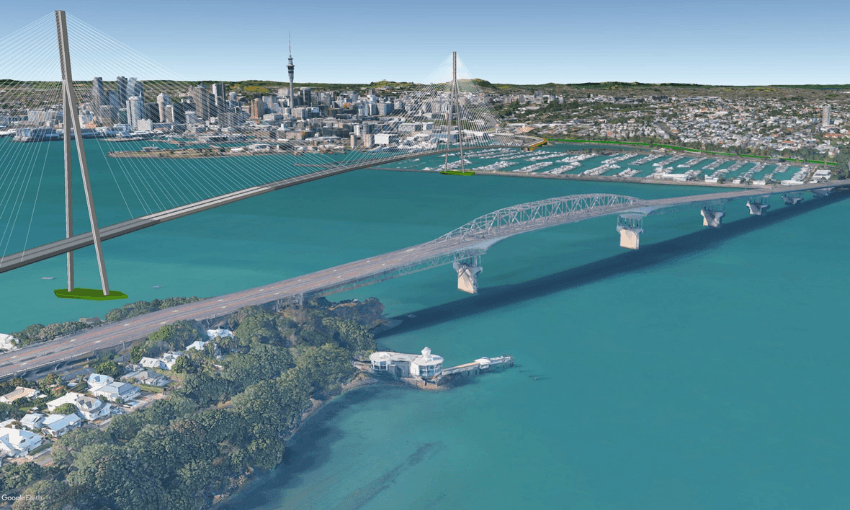



Major construction firms told NZTA they would prefer to build a tunnel under Waitematā harbour, which is more expensive but less risky than a bridge.
Any hopes the government had of using private funding on the second Waitematā crossing have hit a snag after major construction firms warned that a second Auckland harbour bridge built using a public-private-partnership would be “unlikely to achieve value for money” for the government.
An NZTA market sounding report completed in 2025 and released to The Spinoff under the Official Information Act found there was “strong interest from the market” with a general preference for the tunnel option, which is expected to be more expensive but comes with fewer construction risks.
Transport minister Chris Bishop is expected to announce the government’s preferred option – either a tunnel or a bridge – within the coming months.
Government ministers have repeatedly signalled their enthusiasm for public-private partnerships (PPPs), where business consortiums finance, build and operate infrastructure for 30 years and the government pays for the asset over time. PPPs require less upfront government spending than traditional construction contracts, but they have a controversial history in New Zealand – particularly around the much-delayed Transmission Gully motorway in Wellington.
The Waitematā crossing report shows some of the largest civil contractors, equity investors and debt financiers in Australasia balked at the idea of using a PPP if the government opted for the bridge. “The market has limited appetite to take a lot of risk on [the old bridge] because of the elevated risk profile and challenges with appropriately identifying and pricing the level of residual risk in the asset,” the report said.
The core issue is that the old and new bridge would likely need to be operated by the same organisation in order to properly manage traffic flows and co-ordinate maintenance – which means the business would have to take on the risks of managing the old bridge, opened in 1959. The report warned that contractors would want to charge a significant risk premium to manage both bridges and that the government would be “unlikely to achieve value for money”.

It found there would be serious risks with consenting, approvals and land acquisition. “The market expects this to be highly challenging for the project, particularly under the bridge option,” the report found, adding that businesses indicated they “wouldn’t accept any risk associated with these activities”.
The tunnel option could more easily be managed as a separate piece of infrastructure to the original bridge, which made it the “most appropriate package of work for a PPP”, the report said, however it warned that there “wasn’t any appetite to accept risks” involving ground conditions. The government has already begun drilling in the harbour for geotechnical analysis.
The report signalled that the government is unlikely to find a contractor who can offer a fixed price for the project, whether it is a tunnel or a bridge. It said $7.5bn was “likely to be the upper limit” of a fixed-price offer – well short of the expected cost of either option – though some international businesses indicated they could consider a fixed-price offer for the tunnel option.
There was “strong support” among contractors for an “open-book” contract known as Incentivised Target Cost (ITC), especially for the riskier parts of the project. An ITC contract would mean the contractor charges based on its actual costs for the project rather than a set figure – that would mean cost uncertainty for the government but potentially a more reliable timeline without having to re-negotiate or go to court every time there was an unexpected cost blowout.
Both business and government agencies had a clear preference for the government to maintain ownership of any toll booths that might be built on the bridge. This was due to “concern about the litigious nature of tolling concession operators and how this could impact the delivery and operations of the scheme”. Contracts for privately-operated road tolling often prohibit public investment that discourages people from using their cars or requires the state to compensate the tolling operator.
Auckland mayor Wayne Brown is a supporter of the bridge option. His preference is to build it on Meola Reef, a natural existing lava flow which extends 2km into the harbour. A directive from then transport minister Simeon Brown in 2023 told NZTA not to consider any options which provide for walking, cycling or rail transport.