‘He asked me. And I said, yeah, why not?’ Bill Birch on a life in politics

Bill Birch in Pukekohe, 2025. Photo: Te Aihe Butler for the Spinoff
The former National minister of everything, who has died at 92, spoke to the Spinoff at length in 2025.
Bill Birch’s work ethic was the stuff of legend. One time, goes the story, an official turned up at his Beehive office for a midday appointment, only to be told that the 12 o’clock meeting had in fact been scheduled for midnight. “That’s a true story,” he told us in an interview last year for the second season of the Juggernaut podcast, though he did wonder if it might have been 10pm rather than 12.
And he told us all that from the boardroom of Birch Surveying in Pukekohe one Monday afternoon. At the age of 91, he was still showing up for work at his son’s company most days. “Usually get here at eight, eight-thirty. Leave about six, sometimes later,” said Birch Sr, who has died at 92.
In governments headed by Rob Muldoon, Jim Bolger and Jenny Shipley, Birch held 17 ministerial portfolios across 15 years. He is known for playing major roles in several chapters in New Zealand politics history. He was energy minister through the 1979 oil crisis, architect of Think Big, right-hand man and close friend to Jim Bolger, the man who introduced the Employment Contracts Act, and, in New Zealand’s first MMP government, worked as finance minister alongside Winston Peters in the conjured-up role of treasurer.
Across those decades he attracted epithets including “minister for everything” – enshrined in the title of Brad Tattersfield’s fascinating Birch biography – and “cabinet hardman”.
We sat down with Birch in June 2025 for two hours, in what may have been his last long-form interview.
On standing for parliament in 1972
“They were pretty exciting years,” said Birch. “I had well established my survey practice here in Pukekohe. It was still growing, I was employing more staff. By 1972 I’d been in practice for 15 years. I was the deputy mayor of Pukekohe. I was a member of the National Party, but I wasn’t involved in the organisation in any way. But when I was approached by a group of locals to stand [in Franklin] after Alf Allen stood down, I said, Oh, no, thank you very much. I’ve got a good practice, a good living. Got young children. I think you should go and find someone else.”
They came back and talked him around. He attended a candidate college on the Kapiti Coast and met a farmer called Jim Bolger. “We found we had a huge amount in common in the way we thought. We’re both from rural backgrounds. He hadn’t been very involved in the National Party either … We were both successfully elected to parliament that year. First thing when we went to Wellington was we had to find some digs somewhere, so we joined forces and found common digs, and we became very firm friends.”
Where were those digs? “It was the Women’s Institute. Walking distance to parliament.”
On the early years as an MP
They were backbench MPs in an opposition facing a charismatic prime minister, Norman Kirk. “Kirk was a pretty formidable prime minister, and we weren’t making much progress, so there was a gradual change in sentiment.” In 1974, Jack Marshall was replaced as party leader. “I mean, everybody liked Jack and respected him, but he just wasn’t going to get us where we wanted to be after the election … Rob Muldoon was selected as the leader and he started to make really strong inroads in parliament.”
On Think Big
Muldoon defeated Bill Rowling, who had taken over after Kirk died in office, in 1975, in a campaign these days remembered for some dancing cartoon cossacks. Birch became junior whip.
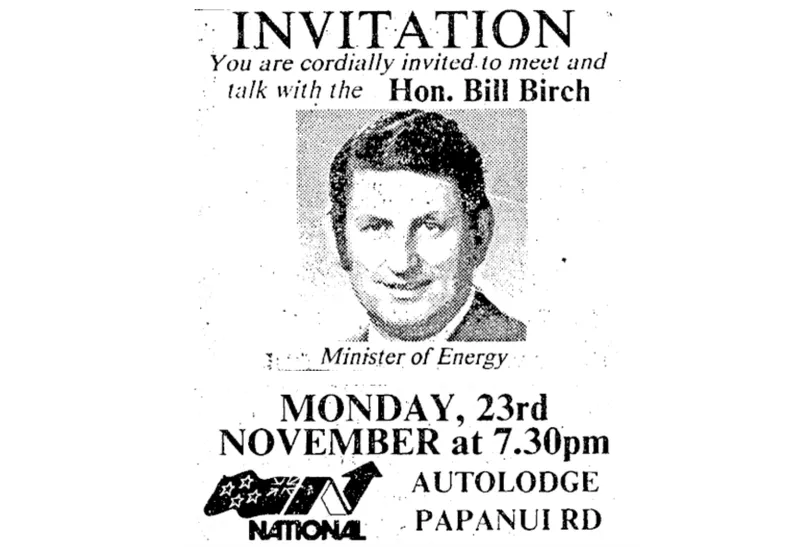
In 1978 he became energy minister and soon faced an oil crisis triggered by unrest in Iran. The response, as has been widely recalled 47 years later amid another global energy crisis, included carless days and fuel rationing. It served also to focus minds on New Zealand’s energy self-sufficiency, leading to Think Big, a vast programme of energy infrastructure projects.
He said: “There was a huge effort made to utilize our natural resources to make our energy supply more substantive and less fragile. It was, I think, a great success at the time. We’ve just lost sight of the need for that, I think, in more recent years.”
On running for the leadership
In 1984, Muldoon’s snap election led to David Lange becoming prime minister. A National opposition determined it needed a new leader. Birch put his hand up. “I had quite a lot of support from the caucus, and I just felt that I should participate. I had no great ambitions, but I just felt it was proper that I should do that. And then in due course” – Birch dropped out before the vote – “Jim McLay was elected, and Jim Bolger became deputy. I was number three.”
McLay struggled to “make inroads”, said Birch. “He’s a great guy, lots of skills, but you need a particular personality to be able to lead a political party in parliament”. George Gair and Birch, both of whom had been demoted by McLay, moved against him in 1986. “We sat down and said, I don’t think he’s going to get there. Unless we do something now, we’re not going to win the next election, or the one after that.”
How involved was Birch in rolling McLay for Bolger? “I organised it. I did a lot of the legwork. Well, somebody’s got to do it, you know, if you’re going to have success.”
On Ruth Richardson and the Employment Contracts Act
In opposition, Birch had done “a huge amount of work with the Employers’ Federation and Business Roundtable. They wanted changes to the labour market, and when in 1990 we won the election, we moved pretty fast.”
While Ruth Richardson as finance minister drove through major economic reforms, Birch was labour minister. “My role was to get the labour market reforms done.” The two ministers wanted voluntary unionism but Richardson wanted more radical reforms to the labour market. “Both Ruth and I put papers to Cabinet. She wasn’t happy with mine. I wasn’t that happy with hers, but Cabinet sort of merged them both, and I was pretty happy with the outcome,” said Birch. Richardson’s version differs; she says the resulting Employment Contract Act was closer to her version.
Looking back, did the legislation over-correct, putting too much power in the employer over the worker, I asked Birch. “I don’t think so. I think the Employment Contracts Act was a balanced piece of legislation that corrected the monopoly control that unions had.”
On replacing Ruth Richardson as finance minister
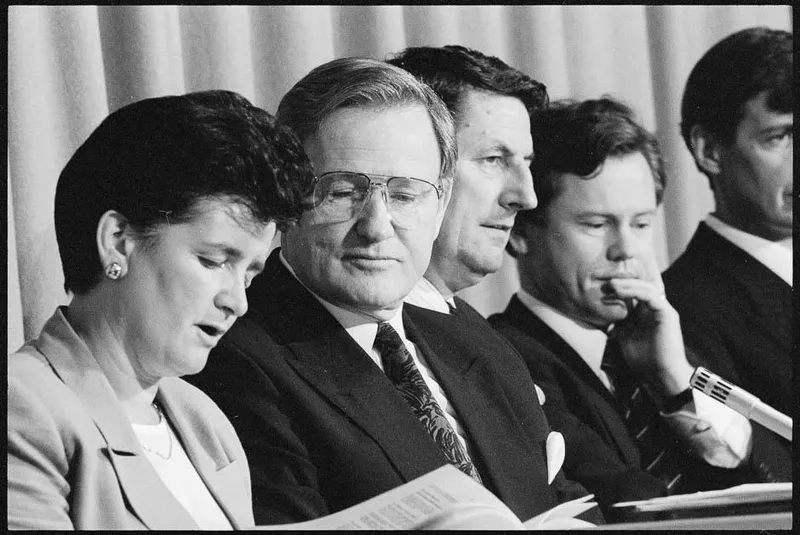
“So in 1993 when we came to the election, the Mother of All Budgets [of 1991] was, I thought, a very big dampening effect on our majority. We only scraped home quite narrowly. Clearly Jim felt that he couldn’t keep Ruth in finance because some of the policies were just a bit hard nosed and were rejected in the wider communities. So he looked around for who else could do the finance job, and he ended up asking me. And I said, yeah, why not? During that period, I did three budgets, and I managed to get all the ministers into a situation where they knew they had to work within the resources that are available they want to use, the introduction of new policy had to be the basis on merit, and had to be saving money in some other part of their allocation.”
Richardson has suggested that Birch had the good fortune to be able to deliver surpluses after her reforms had fixed the economy. “I don’t think so. Not exactly,” he said. “I mean, one would have to give her credit for doing quite a lot of the fiscal tightening up. But, I mean, it’s very important for a manager to be able to sell the budget, to be able to explain why a change is necessary, even though they may hurt, and to try to get the reasons across. Ruth wasn’t able to do that. I mean, she took the view that it had to be done, regardless of what people thought. I’m not sure whether she made the effort or not, but she didn’t succeed in getting the reasons for the hard-nosed approach accepted by the wider community.”
He added: “But she had the right focus. You had to give her credit for the determination and drive that she had.”
On Winston Peters
Peters was dismissed from the National cabinet after 1990, and subsequently booted from caucus, all the while riding high in popularity polls. “I believe that he had all the skills to be a prime minister,” said Birch. “But to be a National Party prime minister he would have to be much more willing to compromise and go for consensus, more a team person. He’s not usually a team person. He’s very firm in his views … That is what caused him problems with his National colleagues. If he wasn’t able to persuade them, he got very upset.”
On one more time
In the leadup to the first MMP election in 1996, Birch had told Bolger he thought his time was done. “By that stage, I had been in parliament for 24 years, and my wife thought it was time that I returned home, and so I indicated to the prime minister that I think this will be my last term.”
In the recess before the election, while walking the Abel Tasman track with their families, Bolger sat Birch down. “We were staying in a hut, and he raised the subject with me. He was very concerned. He said he didn’t think it was wise for me to retire from parliament. I was a senior minister. He was the prime minister. We were a good team. And I could see his point. It’s just that domestic responsibilities were sort of starting to affect my conscience a wee bit. So I said, OK, I’ll do one more. One more time … Rosa was not very happy, I can tell you. Gave me a hard time that last day of the walk.”
On playing finance minister to Peters’ treasurer
As leader of the newly formed NZ First party, Peters negotiated with National and Labour in the 1996 election, our first under MMP. Part of what sealed the deal for Bolger was granting Peters the office of treasurer.
“We didn’t have a treasurer position on those days. However, the Australians do have a treasurer and a minister of finance, so we conceded that we could run the same sort of system. He would be the treasurer, but we agreed that I should draw up the budgets. That was the key. Although he was the senior of the two ministers, and he presented the budget while he was there … he didn’t interfere. I did all the interviews with ministers, getting agreement on the allocation of resources. I kept him informed. We worked closely together.”
On the coup that replaced Bolger with Jenny Shipley
“I was terribly upset about it, really, because I didn’t think we’d reached that point. I was absolutely amazed. But in politics, you’ve got to accept a few of the majority … I thought, if that’s what they want, that’s no point in upsetting their ambitions if they think they could do it … Jenny started to talk about some overseas posting for him. And I said, Well, is that going to be part of the deal? Can you make sure of that? And so we firmed up on exactly what that would be – I thought he would thoroughly enjoy being ambassador of the United States … So he just wasn’t going to be just dumped. He was going to be on another chapter in his life.”
On friendship with Jim
Birch was unable to make it to Kapiti for Jim Bolger’s funeral last year, but he had attended, a few months earlier, his old friend’s 90th birthday.
After Bolger’s death in October 2025, I called Birch. “He was a mate. A good mate,” he said. “When he was prime minister, at the end of the day he would often come down to my office and kick the door down and pour a Scotch before we’d go home – talk about the events of the day. We had absolutely nothing between us – we were very close colleagues, we’d just work our way through the issues. We’d share confidence right through those 60 years. About the only thing we had difference on was the royalty … James remembers the potato famine and didn’t forgive the English for it.”
He said: “Our families were very close. We used to holiday together at our cottage up in Snell’s Beach – me and Rosa and Jim and Joan and the kids. The kids would go fishing together. It leaves a big gap in my life, and a big gap in New Zealand.”

Toby Manhire
Toby Manhire is editor-at-large at The Spinoff. He loves to cast a pod, whether it's Gone By Lunchtime, At Large or Juggernaut. He is a former editor of The Spinoff and has worked as a journalist in NZ and the UK since the last millennium.


