Meet the tiny indie publisher behind the New Zealand novel of the year

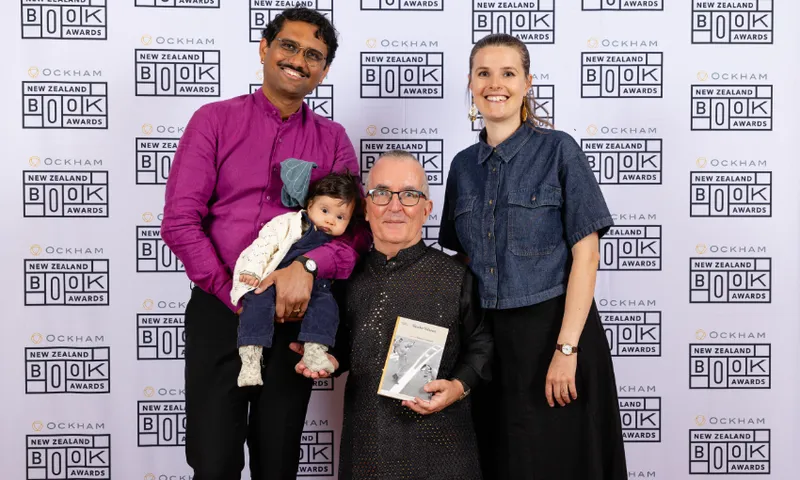
Spoor Books: Erena Shingade with baby Shingade; Balamohan Shingade with Mishti Boy. (Image design: The Spinoff)
Spoor Books is a part-time, two-person, artist-led publishing house whose name is inspired by a whippet called Mishti Boy. Claire Mabey talked to Spoor's Balamohan and Erena Shingade about the big effort it takes to do small well.
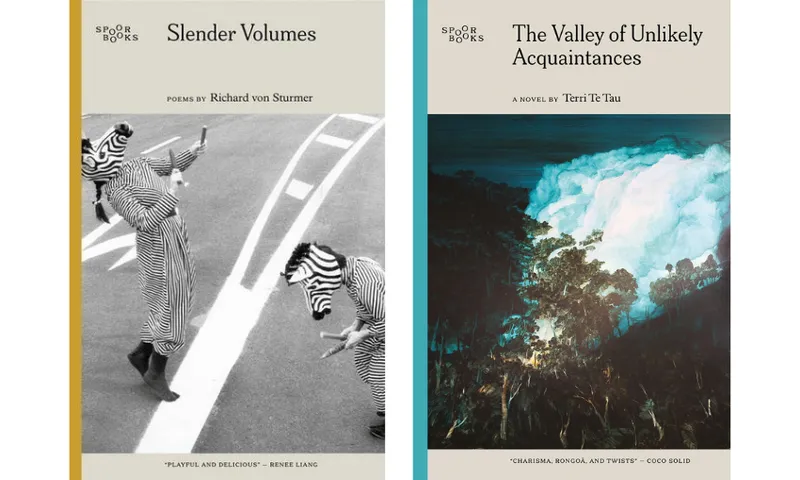
The Valley of Unlikely Acquaintances by Terri Te Tau is my favourite Aotearoa novel of 2026. Vivid, funny and thought-provoking, it's a profoundly Aotearoa sci-fi that plays with time, tech and Te Taiao. Te Tau's characters – Tīria, Oreo, Mele and Lydia – are distinctive, three-dimensional, curious, complex; they ground us in an Aotearoa of the past and future in a way that resonates powerfully with us in the present. What I loved about Te Tau's storytelling was the spark of tech optimism; an antidote to the intense tech-related doom that haunts the internet on a daily basis. Te Tau's blend of canny sci-fi, evocative historical fiction and rich, reverent descriptions of the ngahere made for a unique experience, and one that will continue to resonate as we hurtle towards the years Te Tau has imagined Aotearoa into.
Once upon a time you'd expect such an astute novel to come out of a traditional, multi-national publishing company. Not any more. The Valley of Unlikely Acquaintances is published by Spoor Books, a tiny independent publisher founded and run by Balamohan and Erena Shingade. Come January 2027 I fully expect to see Terri Te Tau and Spoor Books' first published novel on the longlist for the fiction prize in the Ockham New Zealand Book Awards. Spoor has been there before, after all, with Richard von Sturmer's mesmerising poetry collection Slender Volumes, which was shortlisted for the Ockham award for poetry in 2025. Spoor is among a clutch of artist-run indie presses – including Āporo Press, Lawrence & Gibson, Ngā Pukapuka Pekapeka, Dead Bird Books, Compound Press and Gloria – offering readers some of the most exciting literary voices in the country.
But what does it take to run a small press? And why do it now, at a time where arts funding is pitiful, AI is threatening almost every aspect of the industry and people are forgetting how to read for pleasure?
I talked with Balamohan and Erena Shingade about the origins of Spoor and what they hope to do next.
Claire Mabey: Kia ora Balamohan and Erena! First things first: I loved Terri Te Tau's novel. It's so good.
Balamohan Shingade: Yay! It's been a four-year process. It began as a series of interlinked short stories before she realised it was a novel.
CM: It's honestly reassuring to know it took that long because it's such a remarkable first book.
BS: There was a point where the first draft was done and we were thinking of editing and publishing but we were living with Dominic Hoey [author and part of Dead Bird Books publishing] at the time and he said "You only debut once. You really don't want to put out something you're not totally happy with. It's your first and potentially only stamp on what you're doing. Have another go."
CM: Great advice from one indie publisher to another, and from one author to another, too.
BS: Yes! So from there there was a lot of niggling, ensuring small details were historically accurate, that kind of thing.
CM: This is a compelling insight into your publisher-writer relationship. It's not really a thing in trad publishing to have such a loose sense of the publication date and therefore so much time to be sure everyone is happy and the thing is perfect.
Erena Shingade: I think that's the coolest thing actually. We've got good feedback on that part of it from other people in the writing and artistic community. Having a home for artist development is rare, and we really care about that. So we're slower than we often predict but for the right reasons.
CM: Sounds like a dream to me.
BS: Part of our motivation for Spoor Books is that we are ourselves practitioners. It's that sense of an artist-run press that we stick close to. It's what motivates us. So with Terri for example, I've known her for a long time from the visual arts [Terri Te Tau is part of the acclaimed collective Mataaho] and so when we began our writing project the relationship was much like a curator-artist relationship. It was gratifying for all of us to really work on the manuscript, follow the characters, figure them out, work through the drafts and identify readers at different stages.
CM: So interesting – it really does feel so solid; such meticulous world-building but fluid, too.
ES: Winning the Emerging Māori Writer category of the Sunday Star Times short story competition in 2024 showed Terri she was on the right path, because having a flourishing career in one discipline doesn't necessarily mean that you know how to translate that craft into a new one.
CM: That win must have been such a boost. It sounds like you each have different roles within Spoor Books. Can you tell me more about what you do?
BS: Erena has a deep interest in poetry, I'm more in the non-fiction world so we wanted to combine our interests as practitioners to see if we can build a space for experimentation, curiosity, independence – a place where these values could be exercised as part of our practice as editors and publishers. We don't have distribution networks for our books to travel overseas yet, but that's an aspiration. But what we do have is a network.
So for example, Terri's winning short story, 'Hīkoi Whetū', was translated into the Tamil language and published by a Chennai-based publisher, Aazhi Books, in India as part of a short story collection called காதலைப் பற்றி உனக்கு ஒன்றும் தெரியாது (You Know Nothing of Love).
CM: How did you make that happen?
BS: Over the years, before we started Spoor Books, we spent extensive time in India just meeting different publishers to get to know their ethos, how they worked, and to see if we wanted to represent or bring over some of these books to Aotearoa from South Asia. We want to bring over books that kind of align with our political and ethical aspirations: progressive literature, some of the more arts-based and experimental work.
ES: This was back in 2022 when I was studying at the Seagull School of Publishing.
CM: Tell me more about that?
ES: Seagull Books is an amazing publisher. They're based in Kolkata and started in the 80s as an artist-run press publishing play scripts. In the early 2000s they realised that there was a whole bunch of publishing happening in continental Europe that wasn't being translated into the English language in a timely way. Navin Kishore, the founder of Seagull, approached these publishers of French and German texts and said why don't you trust an Indian publisher to represent your work here: we'll take these books around the world and give the translation the respect that it requires.
Because of that approach Seagull grew to become quite massive. So they founded the school of publishing, and their interest in arts-based and rigorous, thoughtful publishing around the world is what's special about it. There's nothing like that in Aotearoa. So I was excited to study there.
What I realised was that because English is such a broadly used language, there is all of this literature that is directly accessible to New Zealand readers, and we felt that we were missing an opportunity here to not only learn about South Asia, but also bring perspectives from the Global South to readers here.
CM: How do you describe that facet of Spoor? Is that distribution? Importing?
BS: I think of it as an infrastructure, an interface.
ES: Or curatorial exercise.
BS: Yes, and what that curatorial exercise is is how to build an infrastructure where we can access the Global South. Distribution is one part of it, but the other really important part is helping readers and thinkers here make sense of these projects.
I'll give you an example. When I found out that Professor David Williams, who sits on the Waitangi Tribunal, was citing in his report Mahmood Mamdani (he is Zohran Mamdani's dad) I was thinking, yes, this is exactly the way that we want to be thinking about the relevance of these perspectives from the Global South. So we organised an event where myself and David talked about the relevance of a few specific books that are in our collection for Te Tiriti conversations.
CM: That's very cool. So when people go to your website do you provide context for the books you have there?
BS: So there's three parts to the website. There's our publishing efforts, and then there are events, and then the online bookstore. When we do an event like the pop-up bookstore we're doing at Te Tuhi right now, or that David Williams event, that's building a community around the books.
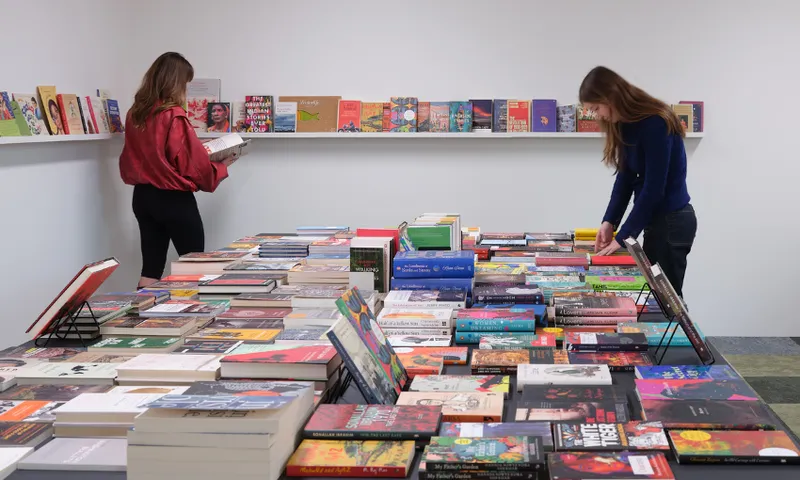
CM: So you're creating a kind of hybrid online-live cultural infrastructure where people can appreciate books from different perspectives.
BS: It's been a steep learning curve over the last two years to figure out how to build that community because people want to read what other people are reading around them, they want to make sense of things together. In Aotearoa most of the books that we can access come from European imaginaries, whether they come to us from Australia, from the UK directly, or from the US. So we knew we were building a space for books from the Global South and from non-Western imaginaries. It's a beautiful thing to be continually carving out space for people who might otherwise feel excluded from books and reading.
ES: Partnerships have been really important for us because actually the online store is only a small portion of the books we actually have. We have 1,300 titles from South Asia, the African continent and the Arab World and every month we have some event in the calendar in which we make those books available in person. So we’ve worked with places like Puku Gallery and Samoa House Library to make spaces where those books are available.
Another kind of partnership is with festivals. For example, Balamohan worked closely with Lyndsey Fineran at the Auckland Writers Festival to bring over Deepa Bhasthi, the Booker prize-winning translator, which was so exciting. We've been to Kupu Māori Writers Festival and had a table of our Indigenous writers from South Asia and we got really good feedback from that.
BS: Our current pop-up book store with Te Tuhi is about creating an extended bibliography to the exhibition by a New Delhi artist Pallavi Paul. It's got themes of political fracture, political polarisation, things like that. Another collaborator has been the Nowhere Bookstore, which is a Chinese language and Chinese diaspora book shop on Dominion Road. We did a film screening there for the Taiwan Film Festival where I was in conversation with the film director from India, and we had 30 people there for the screening and for the conversation. And then from there, of course, they picked up books.
CM: Is any kind of permanent infrastructure a goal for Spoor?
BS: We've thought about it but we're not ready. We're also publishers and so having a permanent space might take us too far into the bookselling world. We still want to be working with writers.
ES: I also think that Aotearoa has a little way to go in terms of growing readership for diaspora communities at the scale that could support a permanent home.
CM: Can I ask about the financials? How is that side of it working?
BS: We've been lucky to have books supported. Slender Volumes came out of Richard von Sturmer's residency at University of Waikato and Terri was supported to develop her manuscript with a CNZ grant. We try and get funding for the publishing side but basically we just try not to lose money. We also sustain our own freelance work, too.
CM: What's next for the publishing part of Spoor?
BS: We've got books that we're currently working on that will come out, and then it's just a matter of scaling up the capacity when it's possible. We have an essay collection by Emma Ng in the works.
CM: Love Emma Ng! When is that out?
BS: Hopefully next year. But we often don't know until the manuscript is done.
CM: Good things take time. How do you feel about Aotearoa publishing at large?
ES: I think Aotearoa does an amazing job of punching above its weight for the quality of books that we produce. It's just incredible, and it's no secret that our children's books are especially revered around the world, which is super exciting. We just feel really grateful to be part of that infrastructure in a small way.
I also think people who are involved in books and publishing are overwhelmingly supportive people. Peter Dowling of Oratia Media has been incredibly generous to us. He mentored me when we were starting Spoor Books, and he does amazing work taking books from Aotearoa to so many different countries overseas. He's probably got the biggest distribution networks around the world of any New Zealand publisher.
CM: Would you ever publish books for children?
ES: We'd love to. It would be dreamy. There's this incredible book published by Tara Books called The Night Life of Trees that we have brought over from India, which has Indian Adivasi (Indigenous) artworks, and we thought it would be so incredible to be able to do something like that but specific to here.
CM: Can't wait. But I will.
The Valley of Unlikely Acquaintances by Terri Te Tau ($38, Spoor Books) is available to purchase from Unity Books. Visit the Spoor Books pop-up at Te Tuhi, a celebration of indie publishing from beyond the Western world in collaboration with Satellites, this weekend, 10am–4pm on 3–4 October. Check out Spoor's website for more books and events.

Claire Mabey
Claire Mabey is a children's author of The Raven's Eye Runaways, The Raven's Eye Rebellion, and a picture book Cass and the Beast illustrated by Jill Calder. For a long time Claire worked on literary festivals and is the founder of Verb Wellington. She lives in Te Whanganui-a-Tara with her partner and son.


