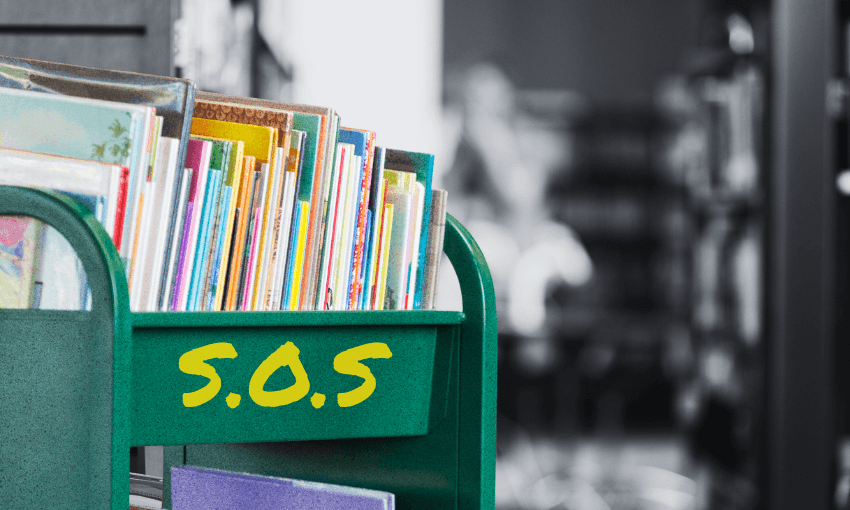



There’s a big difference between a serviced library and a ‘room full of books’. Claire Mabey speaks to school librarians about their endangered status.
You’re eight years old. It’s book week at school. Your school librarian has transformed the library into a wonderland: there are stars hanging from the ceiling, an astronaut suspended overhead, it’s all dark as the night sky because the windows have been blacked out and planets have been placed all around the space in their relative distances. Books about space exploration and planets and moon landings are displayed. There’s a cosy corner with beanbags where you can read, or work on the maths puzzle relating to the placement of the planets.
At lunchtime there’s a line out the door: students all chattering excitedly while they wait their turn to see the amazing library transformation. At home you tell your parents how awesome the space library is and how you can’t wait for tomorrow because the school librarian has arranged for authors to come and visit. You’re so inspired you start to write your own picture book about an astronaut that you’ll show to the visiting writer.
This is a real scenario that occurred because of a librarian dedicated to activating the library, analysing borrowing data to understand trends, gaps and patterns, engaging students with the wonder and potential of books and the information they hold, creating a culture of reading for the students to participate in and develop crucial literacy skills.
This scenario, however, is the exception, not the norm in Aotearoa.
The School Library Association of New Zealand (SLANZA) has estimated that less than half of Aotearoa’s students across primary, intermediate and secondary schools, have access to school library services; meaning access to a library actively curated and activated by a librarian, and not just a room with books.
It’s not mandatory for schools to have a library in New Zealand, and if they do have one, there’s no requirement to have staff dedicated to servicing it. Decisions around school libraries are left up to school boards and head teaching staff, meaning when budgets are tight, the library and library services are often one of the first costs to go. It’s not just the staff, too; library spaces are often repurposed for classrooms.
The Spinoff has seen a letter SLANZA recently sent to MPs across the country, which says: “It is no coincidence that declining literacy rates have coincided with sustained under-investment, devaluing and neglect of school libraries in Aotearoa.” The letter argues passionately for school library services as “essential infrastructure” in Aotearoa schools: dedicated staff whose research, specialised knowledge and passion for books generate and nurture a culture of reading; where the bookshelves are curated to meet students where they are; where library activations and activities are integrated in the school’s education goals; and where the physical space of the library is the heart of the school – designed to offer both education about the fast-changing world of tech and AI, and respite from it.
SLANZA’s ultimate aim is for every student in Aotearoa to have access to “a well-resourced school library and specialised librarian, to ensure that they have equitable access to the resources needed to achieve their reading and learning potential”. The letter is part of ongoing campaign for library services in schools after it was found in 2020 that one in five schools cut funding for their library the year prior.
There are 2,500 schools in New Zealand and 1,266 library staff across Aotearoa on varying contracts: some on just one hour a week, others a handful more, some on full-time hours but only during term time; a small minority are permanent full-time members of staff. Many are teacher-librarians, meaning that library services are wrapped into their teaching workload.

Sandie Fletcher is a teacher aide and librarian at Kahutara School in the Wairarapa and is only able to dedicate one hour a week to her library work. It used to be several hours more, but a few years ago when the budget got tight, Fletcher and the three other teacher aides at the school gave up a couple of days each so they could all keep their jobs. “That’s what it’s like for us.”
When a child is having a tough day, Fletcher’s library hour will evaporate, redirected to the care of that child. And when she does get to the library work? “I achieve bugger all,” she says. “I’ve got a massive backlog of books to cover and get into the library, there’s some that have been sitting there for ages because I just can’t get to them.”
Kahutara is a small school with a roll of around 85 students. While Fletcher’s work in the library has no test score to validate it, the impact can be life-changing. “When I first started I had a reasonable amount of time in the library, and we had children whose father was in the end stage of cancer. I made a teepee in the corner of the library and they would just come in there and read. I was always there, keeping an eye on them.” Another student sought out the LGBTQ+ books Fletcher had ordered and stocked for the non-fiction section of the library. “That kid came and got them out consistently, obviously saw something there, went home and told her parents that that is who she is, and they said, ‘cool!’.”
These days, it’s much harder for Fletcher to provide such a service. She says libraries aren’t valued in the way they should be. “I’ve had principals say to me, ‘Oh, haven’t you got enough books? Can we do without books for this year?'” Fletcher says they don’t realise that libraries have to be actively developed to keep up with the students. “Libraries are vital in school because we have a different relationship with the kids, and we can cater to the things that they need, and we can find that stuff that they don’t necessarily get in class or have time for in class. And the tragedy is they’re taking them out of schools.”
After SLANZA sent its letter to MPs, Craig Mallett, a senior policy manager at the Ministry of Education writing on behalf of education minister Erica Stanford, replied. “You will be pleased to know that a 2024 survey, carried out by the New Zealand Council for Educational Research [NZCER], found that around 89% of responding schools had a permanent, onsite library space. The results indicated that most schools valued and used library spaces to support teaching and learning, as well as student wellbeing.”

SLANZA president Trena Lile is extremely familiar with the research Mallett cites given it was done for SLANZA and the National Library, but she is intensely frustrated by the ministry’s reliance on that aspect of the research because, she says, it is unfortunately flawed. NZCER sent out 1,800 surveys to schools but only received 640 responses. The data might lead to an assumption that 89% of schools have a library space, but it doesn’t reveal whether that space is staffed, invested in and treated as “essential infrastructure”. The research summary states that “results may be skewed towards schools that have library spaces and paid library staff”; and the findings “reveal a range of concerning equity issues, especially for small schools, rural schools, and schools with more socioeconomic barriers”.
All librarians who spoke to The Spinoff raised the “room full of books” problem. Some schools have a room with books – the library – but that’s really all it is. They don’t have anyone to update the titles, promote them to students or generate a reading culture in the school. This results in out-dated books that don’t interest the students, and a library with none of the reading for pleasure, or wellbeing considerations that staffed libraries are now putting so much effort into. “I even know teachers who have library responsibilities as part of their title but will have zero hours actually allocated to doing that,” says Wilson.
Library space on its own does not equal a reading culture. Wilson says that there is a gap in current teacher-training qualifications around how to utilise school libraries and librarians. “So when new teachers don’t understand the value of a school library or a librarian, or how they can collaborate together for research, for reading, for creativity, you have to start from scratch building those relationships with teachers in your own workplace so they understand the value. I find it quite sad.”

When Kristy Wilson first started working as a school librarian she had 10 hours a week at a secondary school with over 500 students. It was tough. She couldn’t engage with all of the classes in the way she wanted to. She then found a new job in another school that offered more hours, although they were during term time only – “that’s what we call full-time in the field”. Finally, a few years ago, she got a full-time, permanent position at Wellington Girls’ College.
Wilson’s days are packed. She mentors the school’s student heritage team as she’s in charge of the school archives; she works with classes across the school on information literacy and research; she markets the new books that the library has bought in in consultation with students; and she curates the environment of the library itself so that students have a calm, safe place to be at lunchtimes. Wilson is constantly in conversation with the students so she is across their interests and concerns and what they’re looking for in reading material. “Conversation is vital in providing a reading culture,” she says. “We are fighting against limited attention spans and other pressures, so the more that we can do to keep connecting, the better.”
Over her years working as a librarian, Wilson has noticed a big difference between students who went to primary and intermediate schools that had an active school library and those who didn’t. Students who have come from a school with an active reading culture (usually meaning they had a staffed library) are already engaged in reading for pleasure while those who don’t are more likely to identify as non-readers.
The drop in students reading for pleasure means reading ages are falling, says Lile. “As a secondary school librarian, I’m buying a lot more middle grade now than I used to, to provide a younger level of reading, like Diary of a Wimpy Kid. I haven’t relented and bought Dog Man yet, but it’s definitely on my mind.”
One of the reasons for this, says Lile, is that adults are not role modelling reading. “Reading isn’t normalised the way it once was. Once upon a time the newspaper would be delivered every morning and parents would read it; not a book, but it’s reading. Now adults are always looking at a device and children don’t understand the difference.”
The decline in reading overall makes school library services all the more valuable, she says, and she’s baffled that the government, with its apparent focus on reading and writing, isn’t paying closer attention to school libraries as a portal to literacy.

Lucy Black works four days a week, school hours, at a primary school (up to year eight) in inner-city Wellington. Her days are “super varied” and include half an hour a week with each of the 11 classes in the school. Sometimes the half hour will take the shape of a book club where the class will read a novel together over a few sessions; sometimes the focus will be on research skills; and at the end of each session the students can browse the library and check out books. For many of the students the school library is the only library they visit.
Black feels lucky that she and the library are valued at her school and that it is understood that “beyond the library being just for books, it’s also a space that we use for sensorial downtime”. Black takes care to ensure the library is an environment conducive to quiet and calm: she considers the lighting, the furniture, the music she plays, the games she stocks. “We’re an inner city school where space is at a premium, and there’s just not many spaces that are going to be calm. So even if a kid’s not much of a reader, they’ll still come into the library because they want somewhere where they know that they can regulate themselves better.”
The conversations Black has with students are crucial to her work. “We talk a lot about how the mind is part of your body, and you need to train it in the same way that you train other parts of your body.” Black doesn’t just want her students to be readers for the sake of reading, but “because it’s a really good tool to learn how to focus for longer periods of time”.
SLANZA’s ultimate goal is for every student in Aotearoa to have access to a well-resourced library with a specialised librarian. For this to happen, says Lile, the Ministry of Education would need to ringfence budget that communities could apply for. An application process would allow for communities to construct an approach that served their particular needs – for example a mobile school library for rural areas, or specialised resources and services for schools that are operating in a multilingual environment. Such a move would require a political party, or parties, to adopt the value of school libraries as a key part of education policy.
So far, the parties are silent, and the education minister did not respond to The Spinoff’s requests for comment.