

A dispatch from the most Wellington of literary festivals, Verb.
Joy doesn’t come from soaring house values
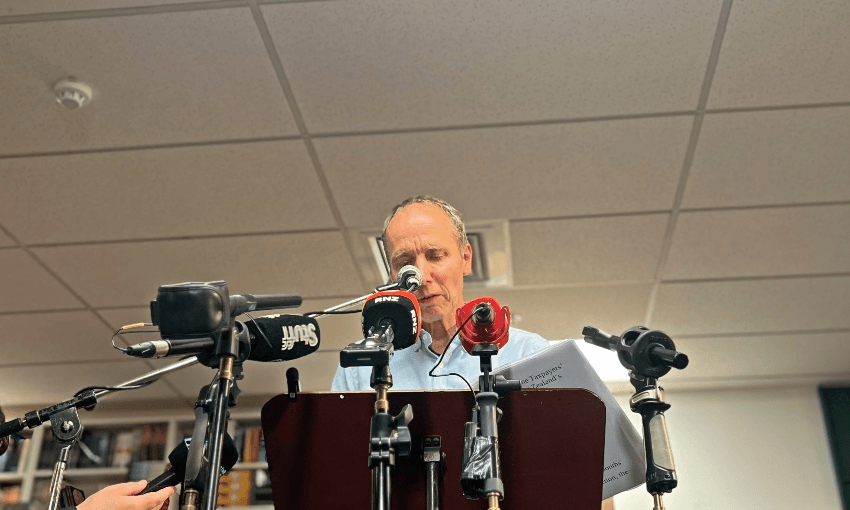
One way to make joy in tough times is to make art, and this weekend’s revived Verb Festival presented a Wellington that doom columnists and politicians don’t see, propelled by artists and people who understand that art is an essential part of our days.
Sessions at the Hannah Playhouse were led by mostly local writers with only one visitor from overseas, Michelle de Kretser (spotted at the Lawrence & Gibson launch, props to visiting writers who go to local book launches).
Brutalist architecture is hard on the quads
I worked in the Hannah Playhouse (then Downstage Theatre) in the late 90s; in 2026 it still smells the same and the flow of people through its cold exposed concrete blocks is still awkward. In busy sessions you queue to climb the steep steps while people clutch the handrails to descend or cram themselves in the bar area confused about which queue is for book signings, and which for the next session. You can’t help but see people you know. I have an affection for it, the way you do for a spiky, embarrassing aunt who blurts out family secrets at birthday lunches.
Wellingtonians like to get metaphysical
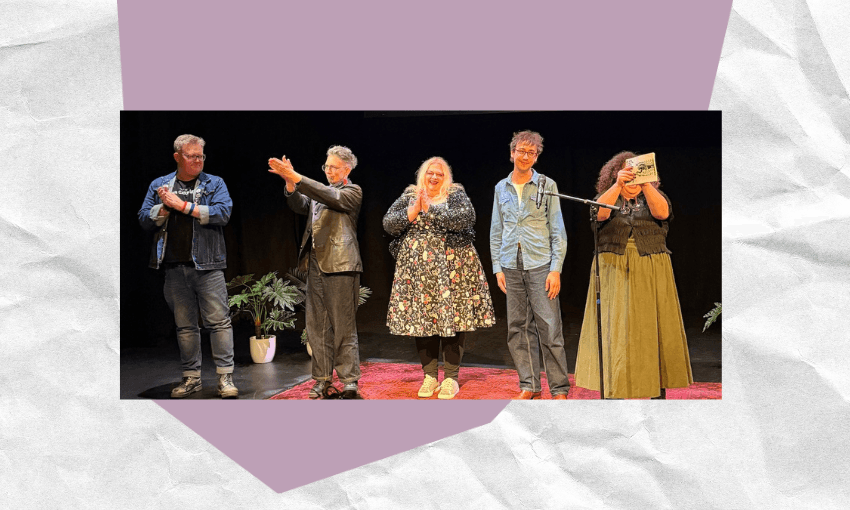
Friday night started with a celebration of Lawrence & Gibson’s 21 years in publishing (no mean feat, especially when it’s the authors who print, cut, bind, glue and distribute the books) and the launch of three new books by Brannavan Gnanalingam, Murdoch Stephens and Frances Pavletich.
Gnanalingam’s UXO is about the Sri Lankan Civil War as told by an Indian peacekeeper — a story of complicity, colonisation and grief, recurring themes through his nine novels. He’s a legend in terms of getting the writing done, alongside his other work as a lawyer, publisher and dad. He’s also the only person I’ve heard use “sobriquet” and “milquetoast” in a launch speech and make it sound normal.

Pavletich (That Was Not My Intention) was overseas but sent a magnum of Moet – classy – which we all watched Stephens (Pākēha Metaphysics) drink while he talked about how metaphysics is a useful philosophy for thinking about Pākēha-ness. In other cities, spending a Friday night this way might be considered a form of punishment, but because it’s Wellington, we were there for it.
Flies are like poetry (see what I’m doing there?)
I ran into novelist Duncan Sarkies at the poetry reading Fever! where we discussed poetry and flies. Sarkies talked about the patterns flies make as they move about a room. “Fruit flies,” he said, “are even more interesting.” Pay more attention, I told myself.
Poetry is the form of attention-paying and pattern; it too is drawn to death and making something out of it.
The throughline for Fever! was “pleasure and pain” which somehow Helen Rickerby, Jackson McCarthy and Nafanua Purcell Kersel made funny. I liked Simon Sweetman’s poems dedicated to the singer-songwriter Harry Nilssen (Nillssen Schmilssen being one of the great joke album titles of the 20th century). Alongside Hinemoana Baker – a queen of forcing knotty, crunchy sounds up against those with a sensual glide – and MC’d by the effervescent Victor Roger, Fever! left me feeling like I’d been pumped with legal peptides. No flies on this audience.
Verb Festival audience has the dance party crossover age mix
Alongside the well-heeled ladies clutching piles of books was the arty young, with their cool glasses and haircuts and activist badges. I’m of the age where I’ve gone back to late night dancing, and Verb had a similar mix of ages I see at DJ gigs – OG 90s ravers and bright youth.
Even Dame Silvia Cartwright had impostor syndrome
In Saturday morning’s sold-out session, Anna Fifield fired through her questions with Dame Silvia Cartwright who gave clipped, professional answers about her memoir, That Woman. Our former governor general and head of the 1988 cervical cancer inquiry, among many other historical pieces of work, told us how she got her first job in the man’s world of 1960s law because she had the best legs.
Cartwright got funny and relaxed when Fifield asked her about her husband, who she said loved the life at government house and had a sweet routine taking lunch and coffee during their eight years in Cambodia while she presided over trials of former Khmer Rouge leaders. Black humour got her through the work’s dark material. She said she was always doing jobs she wasn’t qualified for yet – even the inquiry that made her a household name. Fake it till you make it, like Dame Silvia.
Nick Bollinger is a master interviewer
The packed house came for Jon Toogood, who fulfilled the brief of ageing rock star to talk (and sing) about his book Home Again – creative burnout and despair, finding love, the monotony of making school lunches – but it was Nick Bollinger’s interview technique I was there for: full of historical context and musical knowledge, guiding us through a gracefully shaped conversation.
Time is written all over a city and it isn’t linear
Multiple sessions delved into place, and time’s spookiness, exploring each writers’ (including the iconic Witi Ihimaera) ways of delving into place through layers of history – to bring tīpuna and past stories alive in the present through the creative acts of writing and reading.

Poet Hana Buchanan reminded us that in te ao Māori, the future is also written in the past. One way to connect all these layers is to walk a place and learn its history, its griefs and violence, and the people who lived there – walking as an act of resistance and hope.
Creative non-fiction writer Noelle McCarthy echoed this in her own event when she said, “Cork is a place in continual communion and out of received order with the present and past.”
McCarthy and Doireann Ni Ghriofa (beaming in from the Netherlands) reminded us that reading is a magical act. That to engage your imagination in a book can raise ghosts. “Some art gets into the clay of you,” said McCarthy. Some festivals too.