Meet Aotearoa's new queen of crime fiction

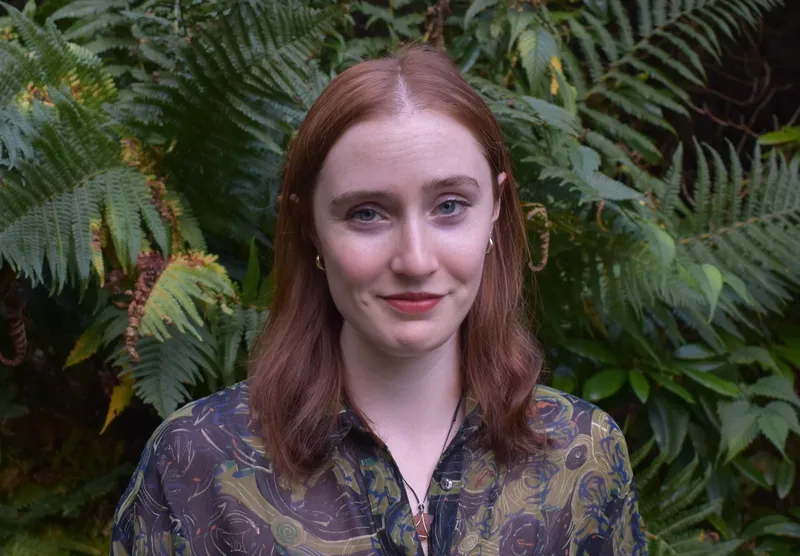
Molly Crighton, author of The Body and the Blood (Image: Supplied/The Spinoff)
Molly Crighton is author of bestselling crime novel set in Dunedin, The Body and the Blood. She talks to fellow crime writer and Dunedinite Liam McIlvanney about meticulous planning, speed writing and the horrors of self-promotion.
Liam McIlvanney: A couple of weeks after publication, The Body and the Blood was the number one bestselling fiction title in Aotearoa. How did that feel?
Molly Crighton: I felt like a rat happening upon a piece of Gruyère cheese in an alleyway: very happy, very satisfied, but slightly nervous it might be too good to be true. Something I forgot throughout the whole publication process: once it was in the world, people might actually read it!
LM: They will! And in gratifyingly large numbers, in your case! What’s the attraction of crime fiction for you, Molly? What does crime fiction allow you to do?
MC: To me, crime allows a scaffolding for story, a history you can converse with if you want, tropes you can pick from or turn on their heads, and a way of venting frustration about real-life injustice. I love a good bloody (or bloody good) crime, but to me The Body and the Blood is about righting the wrongs of misplaced blame, and justice for those who may not often get it.
Crime fiction also allows so many shades of light and dark. Mine has its moment of humour and levity, but I also love to read noir-heavy crime that’s grittier and darker, or detailed police procedurals, or militaristic spy epics, or medieval murders.
LM: Yeah, there’s so much variety in the genre, it’s such a broad church. I’ve described myself as a "slow-motion crime writer"; you write novels extremely quickly. What's your secret?
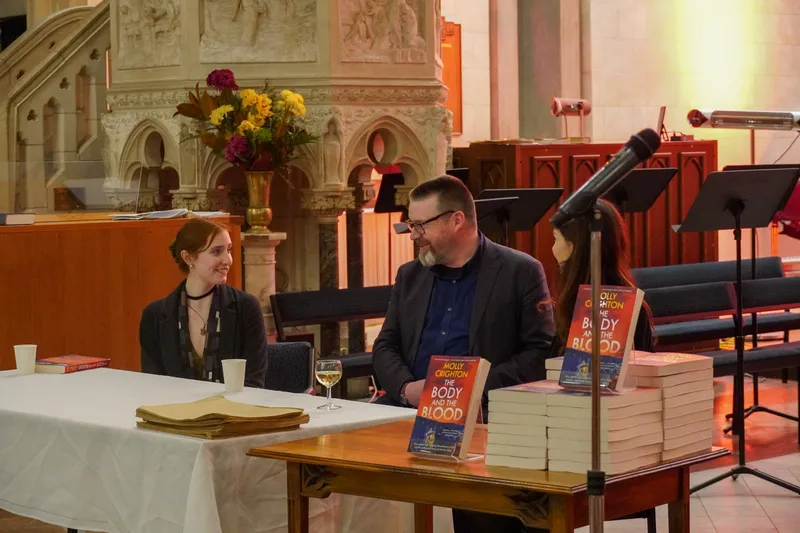
MC: I wrote The Body and the Blood between study and full-time work, so I had to write in short 10-15 minute bursts. It being crime fiction allowed me to know exactly what I was doing in each scene before I started it, because I planned everything so carefully: for every single scene, I had a spreadsheet showing what each character knew, what they were thinking, what had to happen, and what bits of information needed to be revealed. That meant I could dive in and immediately start writing, without spending time thinking up what needed to happen.
With subsequent books – I’m just about to finish a sixth! – I think it’s existential panic that drives me, a little bit. Last year I wrote a book in 13 days and felt physically feverish afterwards.
These days, I write for 20 minutes or so before work every day and average about 500 or 600 words. It’s nice to be able to think "if I just keep doing this, then in four or five months I’ll have a first draft".
LM: Thirteen days! That’s quicker than Georges Simenon! Slow down and give the rest of us a chance! Speaking of crime fiction being a broad church, your novel is partly set in St Paul’s Cathedral in Dunedin’s Octagon – indeed, the eponymous body is found there. How have the parishioners – and, for that matter, the Dean – responded to their cathedral being the scene of the crime?
MC: When I told the Dean of the Cathedral I’d turned him into a Belgian lesbian, he said "brilliant – the Belgians have the best beer!"
Everyone from the cathedral community who’s read it has been really lovely about it. I asked a good friend from the congregation to read it very early on to help me with liturgical accuracy, and because I wanted to make sure I wasn’t accidentally touching on any real histories. I was also very careful to not take details from real people – I combed through early drafts changing dog breeds, hair colours and accents to distance everything from reality.
The only major response has been that apparently they’ve been making extra sure to lock certain internal doors in the cathedral to prevent any curious readers getting into the nooks and crannies of the building. Health and safety!
Liam, I know you hoped you were going to be able to get away without answering any questions of your own, but alas! I wanted to ask:
I was a student of yours a few years ago. You must see many of the writers of tomorrow in their early years (or early writing). Are there any tropes or traditions of the genre you hope they carry forwards – or any that you hope they don’t? Are there any new ones you see emerging?
LM: One of the great privileges of the job is watching new writers develop. They find their own way in the genre, taking it in new directions, which is wonderful. There’s a young wahine Māori writer, Ponai Shaw, who is bringing the conventions of crime fiction into dialogue with te ao Māori in really exciting ways; look out for her. Wendy Parkins, who wrote a creative writing PhD with us, won a Ngaio Marsh Award with The Defiance of Frances Dickinson, which combines crime with historical fiction. And Penny Bloomberg, one of our Master of Creative Writing students, has just won the Allen and Unwin Fiction Prize and her novel, Soft, will be published next year. I don’t think we can claim any great credit for these writers but it’s such a buzz to see them get the recognition they deserve.
MC: Brilliant! It’s so exciting to know what new work is on the horizon. Great stuff happening in Te Wai Pounamu. (Funding, please?)
You asked about me earlier about setting my book somewhere I know well – the cathedral. I wondered: have you ever been tempted to set a crime novel in academia?
LM: Well, my most recent novel, The Good Father, has an academic protagonist, but my next novel, A Dance of Witches, is a supernatural mystery set in Melville College, a fictional American liberal arts college which may bear a passing resemblance to a certain South Island university! After years of writing police procedurals, and having to badger my ex-cop cousin for details of how murder enquiries operate, I’m greatly enjoying writing about university professors. I’ve been doing this job for the guts of 30 years, so I ought to know a couple of things about it!
I wanted to ask, Molly, how have you found the promotional side of things? Have you been going to book festivals and meeting lots of readers?
MC: It’s been the best part, but also character-building. Meeting readers is just incredible. I’m a reader first and a writer second – all my memories are coloured by what I was reading at the time. Being able to now hear that people enjoy something I’ve written is just incredible. I’ll never get tired of it! I can’t believe people spend their precious free time reading my book!
It’s also been interesting. Writing is a solitary, body-less craft. But on the other side of it – particularly as a debut – I’m plagued by worries that my book won’t sell and I won’t be published again unless I say yes to everything, get busy on social media, be engaging, be personable. I’ve sometimes felt an aspect of selling ‘Molly’ – not just selling a book.
But that’s all small fry compared to the pleasure of meeting readers and talking to other writers.
LM: What’s next for Molly Crighton? Can you tell us something about your next novel?
MC: Yes! I’m SO excited for it – and I’m so excited for yours too! I hear "supernatural" and "mystery" the same way a dog hears "walkies" and "bikkies". My next book’s a Greek tragedy-inspired contemporary thriller set mostly in England and the Scottish Hebrides. Gone Girl fans and billionaire-haters, look out for it in 2027!
Liam – thank you so much for talking to me, teaching me, launching my book, and generally being such an enthusiastic herald of fiction from the South!
LM: Ka pai, Molly. So great to see The Body and the Blood sweeping all before it. Look forward to seeing you take over the world as Aotearoa’s new Queen of Crime!
The Body and the Blood by Molly Crighton ($38, Moa Press) is available to purchase at Unity Books. Molly will be appearing in VerbCrawl in Wellington on November 14, tickets here.

The Spinoff Review of Books
A smorgasbord of books thoughts and formats by The Spinoff.


