To hell and back: John Summers on the books behind Green Sea

John Summers (Photo: Ebony Lamb)
Made possible by


John Summers' collection of essays about getting lost in the New Zealand bush draws on a long line of literature. Here he shows us his workings.
Books are made of books. To write Green Sea, my book about people being lost in the bush, I spoke to those who’d had that experience. I even went stomping into the bush myself. But the other thing I did throughout was read and read, never not passing a secondhand bookshop or library without looking to whatever they might hold on natural history or peoples’ calamitous experiences out of doors. I sat in the studious hush of the National Library’s reading room, perusing a 19th century guide to bush warfare and jotting down the author’s incredible moan about the risks of ripped trousers when pursuing Māori forces through the trees (you can find this in Green Sea). Opening each of these books was like making a billiards break, their bibliographies sending me off in many different directions. What follows are just a few highlights.
Inferno – Dante Alighieri
I read the Inferno in a Top Ten Holiday park, immersed in a world of heat and suffering while surrounded by the bright nylon skins of family tents. It documents Dante’s journey down through the nine circles of hell to its core, where Satan lives trapped within a lake of ice. But for me, lasting impact came from its opening, the first lines of which form an epigraph to my book: “Midway upon the journey of our life / I found myself within a forest dark, / For the straightforward pathway had been lost.”
It is there that Dante discovers a gate to hell inscribed with a message urging those who enter to give up all hope. A warning about the afterlife awaiting those who commit mortal sin, but after spending five years learning about the lost, I now see another meaning: despite its difficulties, hope still existed in that dark forest.
Lost Person Behavior: A Search and Rescue Guide on Where to Look – for Land, Air and Water – Robert J Koester
Did you know that half of all lost runners are found within 2.6km of where they were last seen? Or that many missing hunters avoid using the word “lost” when found? Robert J Koester does. The American researcher’s book is spiral-bound, a field guide compiling data from seven countries, including New Zealand, to present insights on everyone from missing anglers to snow shoers. For me, it was particularly useful in writing about one growing category of missing people, those with dementia. And despite its strictly analytical tone, I couldn’t help but see a tenderness in its suggestion that searchers may tell a lost person with dementia that a favourite person or thing might be waiting for them back at base, advice that speaks to the persistence of affection.
A Field Guide to Getting Lost – Rebecca Solnit
Early on in my project I seized on this thoughtful, cerebral collection of essays, which examine the theme of lostness in its broadest sense, looking to the work of artists, to history, to the colour blue even. Solnit writes that, “Never to get lost is not to live, not to know how to get lost brings you to destruction, and somewhere in the terra incognita in between lies a life of discovery.” Yeah, nah. Getting lost has always sounded horrific to me, and as beautiful as this book is, I wanted to know that horror, to have my own exploration of lostness grounded in the green and the gloom.
How to Survive in the Bush, on the Coast, in the Mountains of New Zealand – Flight Lieutenant B Hildreth
I looked at several books on survival and bushcraft. But this 1962 guide, published by the government printer, remains my favourite. Firstly, for its cover, which is the same bright orange used for Forest Service huts, DoC track markers and the cloth case of my own book, and secondly, for its advice that if you find yourself lost you should pause to smoke a cigarette, this the ideal means of steadying the nerves.
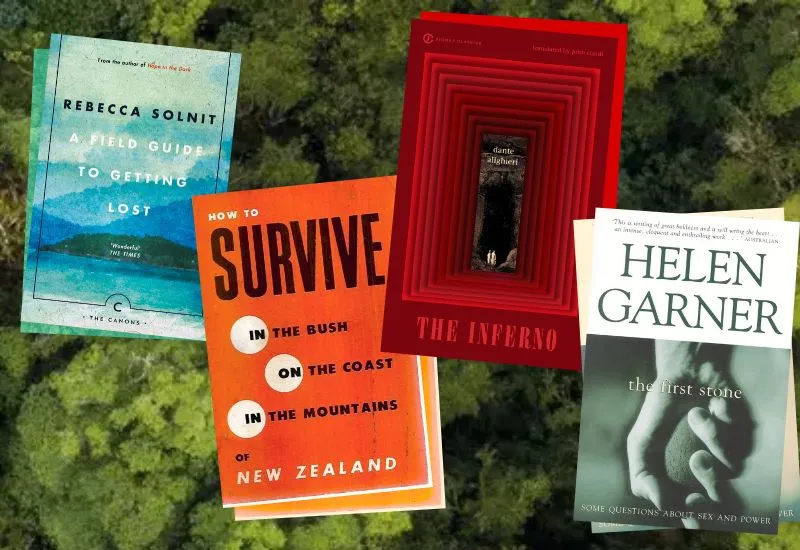
The First Stone – Helen Garner
Helen Garner has received sainthood status in recent years and I count myself among her fans, but this book about an incident of campus sexual harassment isn’t prominent in discussions about her genius nor is it among my favourites. Garner, her feminism borne of the second wave, approaches the topic alarmed at what she sees as zealotry among those pursuing the alleged male offender. Hmm. Controversial at the time, it is a particularly challenging read in a post-MeToo world, and its politics are often difficult to reckon with. But as a writer, I couldn’t help but be intrigued by its structure. Garner shows us her pursuit of this topic and her need to understand. She talks to people over tea and biscuits in their homes. She expresses self-doubt, and we see her reach conclusions in real time. She shows her workings in this way. We don’t always choose where we find inspiration, and this became one of many non-fiction books, completely unrelated to the bush or to lostness, that I found myself looking to as I grappled with the question of how to tell this story.
Discourses and Selected Writings – Epictetus
Almost a decade ago, I read a brief account, no longer than a paragraph, about a search and rescue award being given to a man named Wayne Keen, who was involved in searches for people who had gone missing in the bush. It said that these searches were suspended, after the people weren’t found. But still Keen went back. He found the body of a missing man while looking by himself on Christmas Day. And I wondered who Keen was, what he could tell me about all that, about what was one of my own worst fears: the dark and the loneliness of the bush. I carried this around for years until eventually I reached out to Keen, and in our very first conversation he quoted Epictetus, a former slave turned stoic philosopher from the first century AD.
When I later met Keen, he would reference Epictetus again, finding guidance in his words. He’s not the only one; the Stoics are having a moment. Alongside Epictetus’ Discourses on the shop shelves are books that make his teachings bright and breezy for those readers coming to them 2000 years late. But they needn’t bother, Epictetus already offers a kind of self-help, a guide to life. The term stoicism might imply this is about grimly suffering through, but Epictetus is more useful than that, speaking forcefully, urgently – as if he were here today, telling us to get better at recognising the limits of our agency, to let go of our worry about what lies beyond and focus instead on that we can actually control.
Tararua: The Story of a Mountain Range – Chris Maclean
Now sought after, this beautiful book was both written and published by Kapiti writer Chris Maclean. It is crammed with photographs, art, maps and detail, a loving history of the mountain range just north of Wellington. Among its stories are those about the significance of these mountains to Māori, the rise of tramping as pastime in the region, and the use of the Tararua Range as a training space by the army’s “School of Bush and Mountain Warfare” during World War Two, something that extended to visiting US Marines.
Most critically for my own research, it carefully documents the story of the 1933 “Sutch search”, in which four trampers attempted to cross the Range, only to be foiled by injury and bad weather. They emerged after a fortnight, having followed the Waiohine River and surviving on what was supposed to be only enough food for a two-day trip. Among the missing party was one Bill Sutch, later to become a renowned economist and public servant, but who is now best known for being accused of spying for the Soviet Union in 1974.
(See also: Maclean’s History of Tramping, co-written with Shaun Barnett, the late and much missed chronicler of New Zealander’s love of hiking into the backcountry.)
Green Sea: Lost in the New Zealand Bush by John Summers ($40, Te Herenga Waka University Press) is available to purchase from Unity Books.
The Spinoff Books section is proudly brought to you by Unity Books and Creative New Zealand. Visit Unity Books online today.

John Summers
John Summers is a Wellington-based writer and the author of non-fiction collection The Mermaid Boy (Hue & Cry Press) and essay collection The Commercial Hotel (VUP).


