
The giant online retailer Temu offers low prices and endless variety. Has the website changed how New Zealand shops?
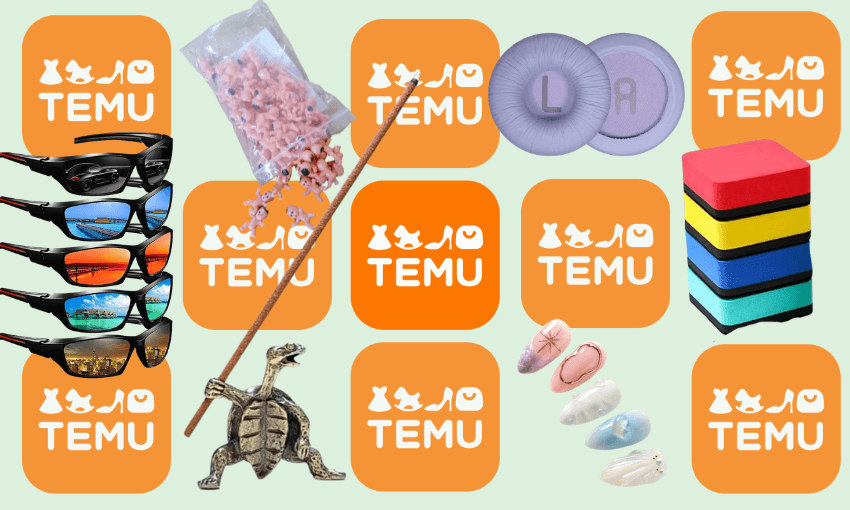
Projectors, a tent and lots of gel nail sets. Kites, grow lights for plants and shoes. When she thinks about it, North Canterbury woman Crystal says that she gets “just about everything” from low-cost retailer Temu. “It’s one of the few companies I’d be a brand ambassador for.”
The online shop, owned by Chinese e-commerce giant PDD, is known for its aggressive marketing and low, low prices. It entered the New Zealand market in 2023. Its tagline is “shop like a billionaire”; the implication being that a billionaire can buy whatever they want without worrying about the price, especially if what they want is a 1000-piece puzzle with AI generated art for $10, or a plastic dinner plate, with the caveat that measurements are manually taken and “if there is any error it is normal”.
How much space do we have in our lives for very cheap stuff? That’s something Freya, a professional based in Christchurch, has had cause to wonder. She looks around her house as we talk, spotting a turtle-shaped incense holder, clips to assist vines to trail around the walls, and an egg holder slotted in the fridge. All from Temu. “I’ve always liked silly, quirky home decor,” she says. “My house is very unique.”

Freya still goes to physical shops, like The Warehouse or Kmart, when she wants something immediately, but she appreciates the sheer variety Temu offers. “It fills a different niche.”
Retailers, however, are concerned. Carolyn Young, spokesperson for industry group Retail NZ says despite talk of an economic recovery, domestic retail spending is nearly flat. “It’s a two-speed economy – people are spending overseas, not domestically,” she says.
Retail spending in December, often a big month because of Christmas, was down 0.1 per cent, although spending in the last quarter of 2025 increased compared to the September quarter.
New Zealand companies are going up against giants online. “A large international organisation with deeper pockets can infiltrate the digital space,” Young says.
Whether it’s the economy, the overseas competition of platforms like Temu, or both, retailers are definitely facing hard times. The Warehouse Group has just announced it’s cutting 270 head office roles, and 61 different shops said they were closing in the first two weeks of January 2026.
It’s difficult to track exactly how many New Zealanders are using Temu, and when, or why they’re using, but it’s clearly being used throughout Aotearoa. Flags sit next to product reviews on the company’s platform denoting where the purchaser is from. New Zealand flags proliferated, including under headband multipacks, car seat fillers and arch support insoles.

Then, there’s a dreary Facebook group for New Zealanders looking for Temu discount codes, the endless Temu ads that pop up online, and the way Temu has become shorthand for “cheap” all over the country.
Freya initially became hooked on Temu thanks to a marketing campaign. It involved a fishing game, where sending links to people would feed the fish, and enough fish qualified you for free items. “I got completely sucked in,” she says. The digital advertising was incessant; she estimates that at least once a week, she would see an ad on YouTube or Google for a novel or intriguing item, and open Temu again. “I would go on there and put heaps of things in my cart – it’s all so cheap that you feel like you’re getting a bargain.”
Freya has found Temu’s website alluring too, and finds herself scrolling through dozens of products. “It’s addictive and distracting, harder to stay on task than in any physical shop,” she says. She recently went to Panda Express and found the overwhelm similar – lots of gizmos and gadgets, brightly lit gimmicks and genuinely useful items all stacked together, making it hard to separate what she needed from what she didn’t. She’s just uninstalled the Temu app. “I was spending a lot of money on stuff I didn’t need,” she says.
While Temu can come under fire for the quality of its items, Freya and Crystal both say they have received prompt refunds. Freya estimates that about one in 10 products she’s received from Temu is defective in some way. “You get returns so freely that it’s not an issue if [you order and] it’s junk,” she says.
Freya’s friends don’t all share her Temu addiction. She says some are concerned about consumerism and sustainability. “Obviously it isn’t ethical getting plastic bits and bobs you don’t need,” she says. But she wonders if it’s any better for the environment or people to buy products from a New Zealand-based company, if they’re made in similar factories, with similar worker conditions, in similar parts of the world. “From the consumer side, it’s hard to tell,” Freya says.
Young, however, points out that products sold in New Zealand, like kids’ toys or clothing, have to meet health and safety standards and come under the Consumer Guarantees Act. “New Zealand businesses must comply with New Zealand standards. If you buy directly from a supplier in Asia none of those requirements exist.”
Labour and National are backing a “modern day slavery” bill. Once passed into law, it will mean that New Zealand companies earning more than $100m in annual revenue will have to publish reviews of their supply chains, and will face fines if they don’t carry out due diligence to mitigate risks of exploitation. While Young supports the bill, she says that for retailers, it could create “a wider gulf between the costs of production and the costs of bringing things to New Zealand.” Those are costs Temu won’t have.
Three years into Temu’s presence in New Zealand, Freya’s living room has been transformed, but has all the shopping been worth it? “I’m on the fence about if Temu has been good or bad for me,” she says.