Why the feijoa is the true taste of Easter in New Zealand

Image: The Spinoff
Move along hot cross buns and chocolate eggs, Aotearoa’s real Easter food arrives with a gentle thud on the lawn.
Easter, as a concept, is a bit of a tangle. It can be, depending on your vantage point, the most solemnly profound moment in the Christian calendar – a story of death, resurrection and the improbable triumph of life. Or, it is a long weekend punctuated by traffic, shuttered supermarkets and a murky sense that one ought to be eating something symbolic to mark it all, even if, beyond chocolate and buns, no one is entirely sure what that something is.
Some of this tangle is historical. Easter’s origins are famously contested. Its very date has been the subject of ecclesiastical squabbles that have stretched across nearly 2,000 years. And despite the significance within Christianity, there are persuasive accounts tracing Easter back to pagan festivals dedicated to Eostre, the Anglo-Saxon goddess of spring, revolving around fertility, renewal and light. And the holiday seems to have inherited much of its accoutrements – eggs, rabbits, chicks and flowers – from those pagan customs.
In Aotearoa, Easter-time ambiguity – not helped by the fact that we’re celebrating a spring festival in autumn – extends to the table. In many parts of the world, Easter comes with a fairly detailed culinary outline: specific breads, soups, stews, pies, cakes, even, in some places, butter sculpted into the shape of lambs. Here, the list is shorter: hot cross buns and chocolate eggs, maybe lamb, perhaps brunch. Beyond that, Easter eating in New Zealand is rather incoherent. It lacks the culinary structure of Christmas with its weeks of planning and indulgent excess. It lacks, too, the kitschy theatrics of Halloween or the grounded-in-place meaning of Matariki. For those inclined to think about food, Easter in Aotearoa can feel like a holiday in search of a culinary tradition.
And yet there’s something rather liberating about that looseness. Few of us will be drafting multi-course menus or mentally bracing ourselves for marathon shifts in their home kitchen or lying awake wondering if we need to purchase just one more bottle of cream. There’s no particular pressure to produce anything impressive. In fact, there’s very little pressure to do anything at all.
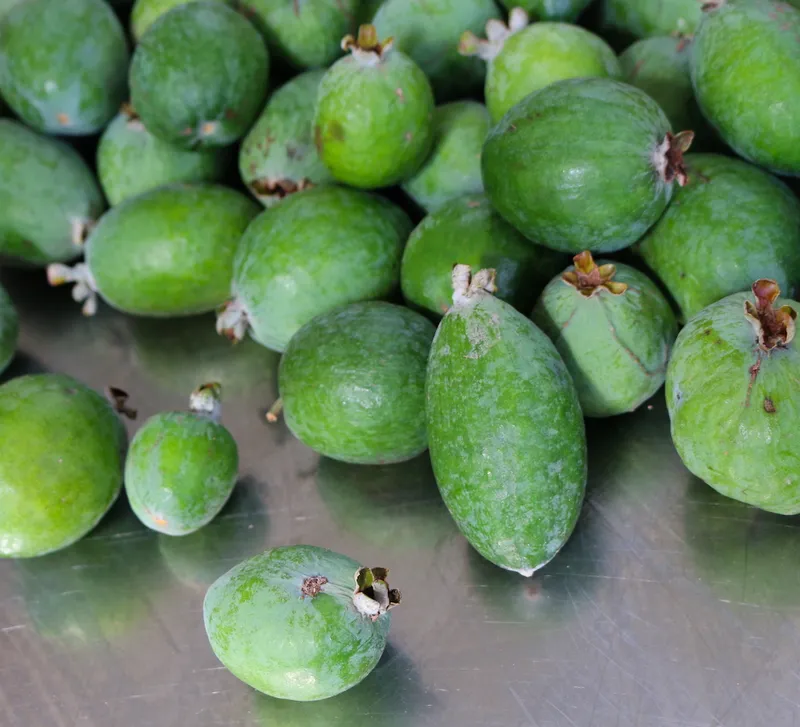
Which brings me, improbably, to the feijoa. Lately, while slicing them open and then scooping out their gritty, vaguely floral-tasting innards, I’ve begun to think of them not just as an autumnal treasure, but more specifically as our own, locally specific emblem of Easter.
Because while Easter remains symbolically tethered to spring, in this part of the world it arrives in autumn. The light has softened, the heat has dissipated. Mornings are growing darker. The afternoons are crisper. The trees begin their transformation, greens soon deepening into browns and bronzes. Easter here is less a time of emergence than a time of languorous withdrawal. And it is in this liminal moment that the feijoa appears.
It is, admittedly, an unlikely candidate for symbolic elevation. Small, green and unassuming. Common, even. It lacks the gloss of a chocolate egg or the rather morbid markings of a hot cross bun. Yet, I can’t help but point out that its ovoid shape does echo the season’s most enduring motif, the egg.
More importantly, the feijoa’s Easter relevancy lies in its seasonality. For a brief window, they are everywhere. They drop overnight, gathering beneath trees, rolling onto footpaths, accumulating in bowls and bags and in buckets in front of fences. “Help yourself!” There is always too much. And then, they vanish.
This fleeting presence feels especially significant (and rare) in a society accustomed to year-round availability. Berries in winter, citrus in summer, everything at all times. Among all this, the feijoa does not budge from its temporality. It arrives, it overwhelms us, and then it is gone. We miss it. When it returns again, we rejoice for about five minutes, and then we take it for granted again. Over and over.
Though not native, the feijoa has been so thoroughly absorbed into New Zealand life that it feels almost inseparable from it. It takes over gardens, spills over fences and its surplus is shared generously and freely among neighbours and strangers alike. There is some kind of theological lesson in all of this. Easter, whatever its precise origin story, is preoccupied with cycles: death and life, ending and beginning, absence and return, of giving and receiving. The feijoa, in its fleeting glut, is a kind of edible reminder of these never-ending rhythms.
Perhaps this is what makes Easter, at its most appealing, feel distinct from other holidays. It is an actual pause. A few days away from regular programming to notice the change in light, to sit with the big existential questions – of time, of what comes next, of what it all means. And, inevitably, to ponder what to do with the accumulating pile of feijoas on the bench. If Easter is, at its heart, a meditation on cycles, why not take the lesson from a small, green fruit.

Charlotte Muru-Lanning
Charlotte Muru-Lanning (Ngāti Maniapoto, Waikato Tainui, Ngāti Whātua) is a former staff writer at The Spinoff.


