Concern as number of laws rushed through parliament surges

Labour says it’s too much, National says it’s all reasonable use. Should the parliament rules be changed?
This story was originally published on RNZ
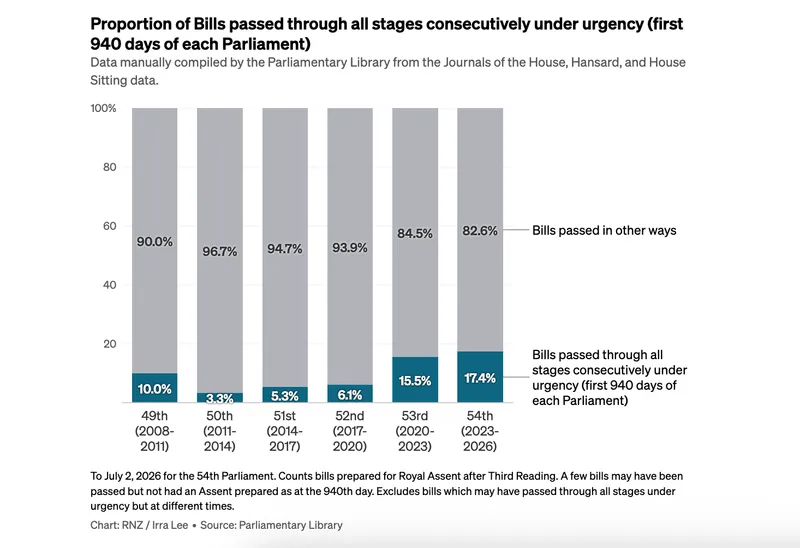
The coalition government has passed more legislation in one term under urgency than any other parliament in recent history, according to records dating back to 2008, raising concerns public scrutiny of proposed laws is diminishing.
Parliamentary Library data provided to RNZ showed 17.4% of all bills sent for Royal Assent in the first 940 days of this parliament – to July 2 this year – passed through all stages of lawmaking all at once, skipping the select committee stage and its public feedback process. This is part of an increasing trend over multiple parliaments. Over the same period, the Labour government passed 15.5% of bills in this way.
Former Labour prime minister and attorney-general Sir Geoffrey Palmer said the coalition government’s use of urgency wasn’t about coping with large volumes of legislation. He said it was more about “avoid[ing] the scrutiny of select committees” – something the government rejected.
Parliamentary Library data showed that while the total number of bill stages passed under urgency jumped in the first 940 days of this parliament, the number of bills passed into law remained steady at just under 200 over the past few terms.
Pay equity changes, the repeal of Fair Pay Agreements, the removal of clean car discounts, and the ban on killing greyhounds for economic reasons were among the laws passed through all stages consecutively in this parliamentary term. The previous Labour government passed several laws in this way, including the bill enabling the Covid-19 traffic light system and workforce vaccination mandates.
Palmer said governments of all stripes had used urgency, but not on this scale. “Its use has been normalised by degrees until it has become an instrument of convenience rather than of necessity,” he said. “I do think the desire to get things done quickly is driving some of this. Impatience is a very bad thing for lawmaking, because you’ll get it wrong, and it has to be done in a solemn and serious way.”
Palmer said overworked and under-resourced select committees were a related issue. For example, the government received hundreds of thousands of submissions for the Treaty Principles Bill. “They only give you about five minutes, but try to hear most people. It’s become overwhelming.”
Chris Finlayson, who was attorney-general in the John Key government, said the data pointed to a need for parliament to consider extending House sitting hours, given the complexity and volume of legislation. “I don’t necessarily see it as a sort of a partisan issue against this government, but perhaps a wider question,” he said. “The real area of concern is if legislation goes through all its stages without some kind of committee work being done, because that enables the public to have their say about the bill.
“Often, and I think for example… the New Zealand Law Society invariably makes very valuable comments on legislation.”
Government: Urgency used when necessary
Shadow leader of the House Kieran McAnulty said National criticised Labour’s use of urgency during the pandemic, but then quickly surpassed those figures once in government. “They [the government] have used urgency to pass laws that will negatively impact many people. In many cases, these Bills are passed in the dead of night, with no consultation with the public,” he said. “Labour’s use of urgency to get through more than a couple of stages of a bill at any one time wasn’t at all frequent.”
McAnulty said discomfort with the high use of urgency is reflected in submissions to parliament’s Standing Orders Committee. Before November’s election, the cross-party group will consider the rules for the next parliament. “We will take our concerns that much of the use of urgency by this government has been to avoid scrutiny to [the] Standing Orders Committee, but no amount of extending sitting hours will address the harm this government has caused.”
Leader of the House Louise Upston said the “vast majority” of bills being considered under urgency had gone through a select committee process. “Therefore, the only effect of urgency is to allow stages to happen back-to-back, and extend the hours the House can sit.” She said of the bills that had skipped the select committee, only 10 were not Budget-related legislation, or were passed in the first 100 days of government, some to repeal laws enacted under Labour. “All of these bills had necessary reasons to be enacted as soon as possible. Five of these bills were supported by Labour at [the] third reading.
“This government has never used urgency for the purpose of skipping scrutiny. Much of the urgency that we use is just to get overtime, to get extra hours, and that is to progress the legislation that the government and the parties in the Coalition campaigned on in the election that we won.”
RNZ also approached Chris Bishop – who has been the leader of the House for most of this parliamentary term –for comment. His office said Upston would be the most appropriate spokesperson.
Should the rules change?
Parliament’s rules require a minister to move a motion in the House to enter urgency, which is passed through a simple majority. When doing so, the minister must give “some particularity of the circumstances that warrant the claim for urgency”. Standing Orders do not define what those circumstances are or allow MPs to debate those reasons, something Geoffrey Palmer told the Standing Orders Committee in his submission that he wanted to see changed. He said four-year terms, while putting more safeguards in place, could also be considered.
During the Key government, there was a drop in the level of urgency used in the three years after 2011, compared to the same period after 2008. This coincided with Standing Orders amendments allowing pre-arranged extended House sittings on Wednesday or Thursday mornings. It followed criticism of the Key government’s use of urgency after the 2008 election and the Clark government’s rapid lawmaking during its final year in power.
Chris Finlayson said the House could consider sitting more often on Friday mornings or abolishing dinner breaks since MPs are not present for all debates anyway. For constituent MPs who needed to be in their electorates on Fridays, he said they should be allowed to go home.
RNZ asked Finlayson and Palmer to assess MPs’ willingness to enact changes for the next parliament, given political parties tended to justify their own use of urgency while in government, then criticise the other side while in Opposition. “Everyone said it’s the other person’s fault. That’s just part of politics,” Finlayson said. He was keen to present alternatives, and “less interested in attributing blame”.
Palmer said there were instances where urgency was necessary, including when mistakes needed to be corrected quickly. “The difficulty is that you don’t want to make urgency a standard method of making legislation. But it’s rather become that in New Zealand in recent years.”
Asked about his own government’s use of urgency, Palmer said: “There was quite a bit because there was a terrific amount when Muldoon left office. There was a terrific mess, and it had to be fixed up with a lot of legislation… There are proper occasions for urgency.
“How our parliament conducts itself is a matter of great democratic importance, since it is a House of Representatives in which there are very few checks and balances, and we have no written constitution.”
This story was first published on rnz.co.nz.


