From rosettes and pamphlets to promotional condoms: Inside the world of election ephemera

A selection of election ephemera held by the Hocken Collections. (Supplied images: Hocken Collections, Uare Taoka o Hākena, University of Otago. Composite image: The Spinoff)
Hocken Collections’ election ephemera offers a fascinating insight into New Zealand’s political and social history.
Katherine Milburn pushes a grey trolley into the special reading room at Ōtepoti Dunedin’s Hocken Collections. On the top shelf of the trolley is a neatly arranged pile of crisp, white folders, each one a different thickness and containing a multitude of hidden treasures. One by one, Milburn carefully begins to unpack each folder, taking out the many individual pieces of paper and curiosities inside, quickly filling every table in the silent room with an assortment of colours, textures and memories from New Zealand elections past.
Large, brightly coloured posters from the 1970s sit beside small black-and-white printed pamphlets, folded neatly into thirds. A tiny pocket calendar from the 1960s spills out from one folder, rosettes and candidate badges from another. There are stickers and flags and notices announcing public meetings, and even a hand-crocheted blue flower with a single pearl sewn carefully in the centre. Flyers covered in familiar National and Labour logos are filed next to leaflets promoting lesser-known parties, like the South Island Independence Party from 1978 and the New Zealand Women’s Political Party, whose 1984 election slogan was “a woman’s place is in the House”.
As curator of ephemera at Hocken Collections, Milburn is responsible for collecting and protecting every one of these historic pieces of campaign material, as well as thousands of other items created by political parties and candidates during New Zealand general elections. The items she unpacks in the reading room are just a small sample of those held by Hocken Collections Te Uare Taoka o Hākena, which began actively collecting election ephemera in 1966 when the librarians there approached every candidate in the country and requested a copy of their electioneering material.
Hocken’s election ephemera collection grew substantially over the next five decades, but in 2017, they realised that some political parties were better than others at donating their campaign material. In an effort to fill the gaps, they asked for volunteers across New Zealand to gather the flyers, posters and stickers from their own electorates, so that researchers and historians could access them in years to come. With only a few weeks until the 2026 election, Milburn recently put out another call for more volunteers to collect campaign material in places like East Coast Bays, Tāmaki and Te Tai Hauāuru, in the hope that every electorate across the motu will be covered.
“People might think, why do you want to collect that?” Milburn says, but every piece of election ephemera is valuable, regardless of how ordinary or insignificant it might seem. The oldest piece of ephemera in the collection is a labour movement pamphlet from 1890, while the newest items include a New Zealand First hoarding from 2023. Two of the most unusual items came from the Act Party – a 2017 Act-branded condom with a sticker reading “help people keep more of what they make”, and a 2023 yellow firearm safety tag that says "support firearms owners".
“It's really important for people to know that there's this documentary record of how we've carried out elections – how people have campaigned, the kinds of things they promised, the people involved,” Milburn says. That’s also why Hocken wants to gather material from the full range of political parties, so that all viewpoints are represented. “Even if it’s something you don't agree with, it's going to be protected and made available in the future.”
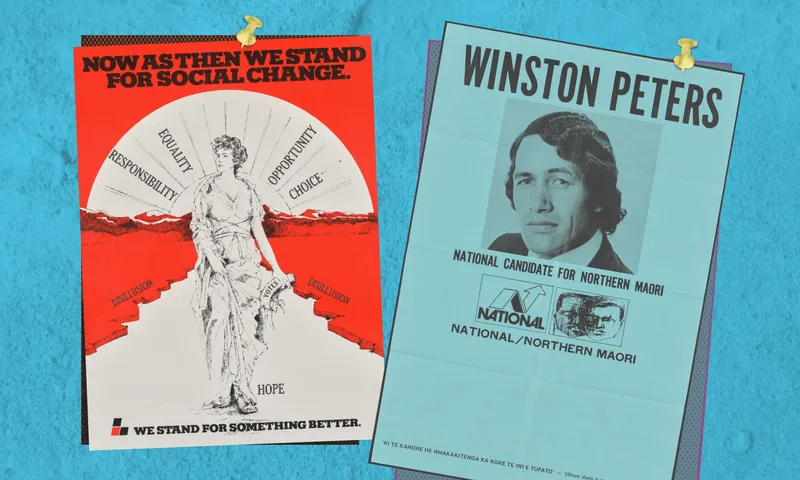
Milburn believes these items are a reflection of New Zealand society at a particular point in time, and they offer insights far beyond the political realm. “One thing we notice is that there’s little depiction of Māori,” she says of the material from the 60s and 70s, which predominantly features white men (a 1972 pamphlet from National was titled “Men of Action” and featured Robert Muldoon in full stride). Shifts in social attitudes, gender roles and technology become clear in material produced during the 80s and 90s – by 1996, National was appealing to the women’s vote with a large poster that showcased its 20 female candidates, including Jenny Shipley and Georgina Te Heu Heu.
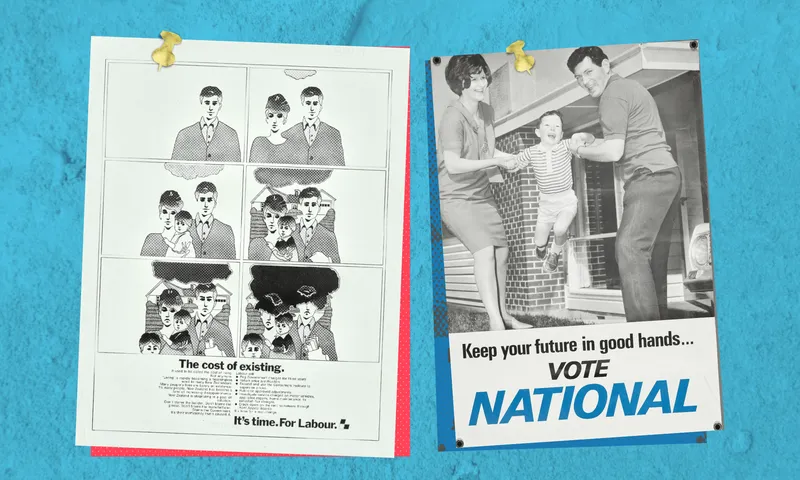
The collection also shows how political messaging has become more cohesive over the years, and while the style of communication may have evolved, some of the political themes remain the same. This 1963 National Party poster promised a government that would give young people “a better chance to get ahead”, while in 1972, the Labour Party published a warning about “the Cost of Existing”. Those political slogans from six decades ago about progress, improvement and “getting things done” are still being chucked around during the current 2026 election campaign.
What we don’t have in the current campaign is a bit of tickling and some jazzy hand-drawn art, like this impressive 1975 poster of many faces hiding in a Hawke’s Bay candidate’s hair. In 1984, the Home Brewers United Front took on Muldoon’s “think big” slogan with their own “drink big” message, while in 1990, The McGillicuddy Serious Party urged voters to “tickle the state to death”. Of all the curious and compelling collection items, Milburn’s favourite is an orange and black “Vote Labour!!!!!!!!!!!!!!!!” poster from 1963, donated by former Dunedin North MP Stan Roger and featuring former Labour Party leader Arnold Nordmeyer.
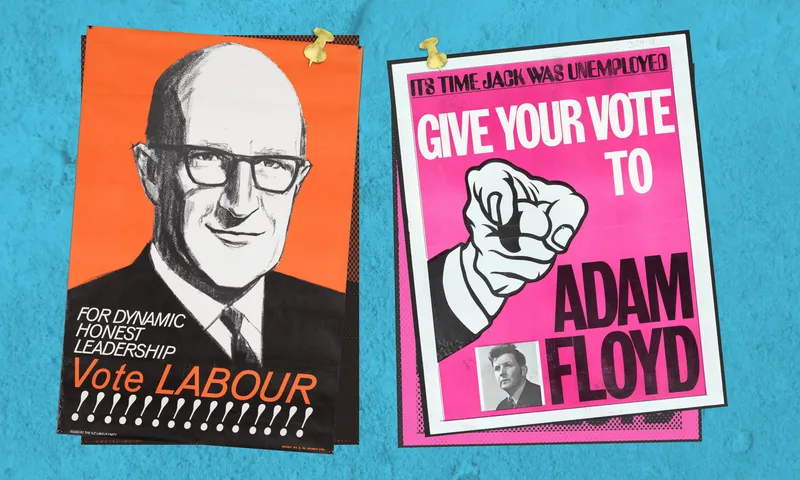
“That 60s graphic is so striking,” Milburn says admiringly, noting the ardent use of 15 – yes, 15 – exclamation marks. “Lots of other items from 1963 use a lot of exclamations. It must have been a thing.”
Milburn and her small team are digitising the election ephemera collection, focusing first on the large poster formats and material that is already out of copyright. Anyone can search the collection by using the public access catalogue Hākena or view the digitised items on Hocken Digital Collections, but Milburn says they’ll always retain the original pieces of ephemera as a rich resource for researchers and historians. “When you can see the thing in person and you can see the quality of the printing, the paper – it's a totally different experience.”
So, if you’ve got an old campaign poster or leaflet stuffed away in a dark corner of your home, Hocken Collections wants you to get in touch, no matter how ordinary it might seem. “That's the whole thing with ephemera,” Milburn says, as she puts Act’s gun safety tag back into its folder. “Because you see it everywhere, you don't value it – but if you imagine that thing 100 years from now, it’s going to look totally different.
“We're just trying to make sure that people know our history.”

Tara Ward
Tara Ward has written about television and culture for The Spinoff for several years. She lives in Ōtepoti Dunedin, where she tries to avoid walking up hills.


