Who could have predicted this? National can’t afford its roads

Chris Bishop has been saddled with the task of restoring economic reality. (Image: Tina Tiller)
It was easy to figure out Simeon Brown’s roading promises were a fantasy from the start. He still got an easy ride from much of our media, says Hayden Donnell.
Chris Bishop must have breathed a secret sigh of relief as he announced National wouldn’t be building the bulk of its Roads of National Significance any time soon. The transport minister has spent much of the last year in a prolonged state of economic agony. In November, he told a roading conference that just paying for the 17 four-lane highways his party had promised would cost $56 billion and require a 70% hike to fuel taxes and road user charges. Road tolls wouldn’t touch the sides of the shortfall and public-private partnerships weren’t a panacea, he admitted.
Though he didn’t say it outright, it was hard to escape the impression that Bishop had been thrown a flaming bag of bitumen-based turds by his predecessor. National’s Roads of National Significance were announced during Simeon Brown’s tenure in charge of transport. The Pakuranga MP was confident to the point of gung-ho about the programme’s affordability. When he announced the first batch of 10 ahead of the 2023 election, he said they’d cost just $24bn. His faith didn’t waver as he added another seven to the list the following year. Brown also got rid of a source of funding for the projects for good measure, ruling out what he described as Labour’s unnecessary fuel tax increases during National’s first term. “Our plan is fully costed and won’t require the heavy burden of any petrol tax hikes in our first term,” he said.
As it turns out, Brown had used years-old figures to price his initial roading promises. He justified the dated numbers by saying they were the only ones available. That wasn’t true for all of them. But even if it had been, anyone with a working brain and a rudimentary ability to count should have been able to tell the projections would be way off. New Zealand had just been through a long period of high inflation. Construction price inflation had peaked at 22% in 2022.
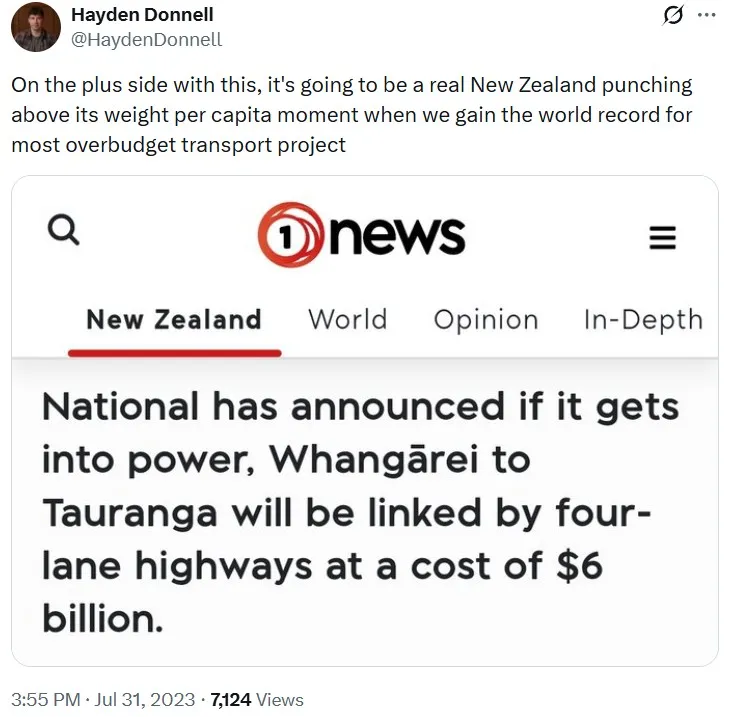
Some of the cost estimates look laughable in retrospect. Among other things, Brown said National would be able to build four-lane highways from Whangārei to Tauranga for $6bn. Just one section of that route – Warkworth to Whangārei – is now forecast to cost nearly $20bn. This is not a case of hindsight being 20/20 either. People at the time pointed out these roads were underpriced. Even mostly innumerate bozos from The Spinoff were posting about the problem.
Despite that, Brown’s magical economic thinking wasn’t just tolerated, but fêted, by parts of our media. The Herald named him its 2024 politician of the year for his populist transport manoeuvres, saying “people like roads and he gets to build them – a lot of them”. It went on to praise the minister for his fastidiousness on policy detail. “Unlike other ministers, he has not tripped up in his haste to make change, and has avoided having to embark on embarrassing backtracks and fix-ups later. That is because he has usually got it right to start with,” it said.
That’s proved true, but only because Brown has moved on and left Bishop to make the embarrassing backtracks and fix-ups necessitated by his wildly optimistic approach to pricing. It wasn’t just the Herald either. Over at Newstalk ZB, presenter Heather du Plessis-Allan referred to Brown by his apparent nickname, “golden balls”, while ranking him runner-up for politician of the year in 2024. The awards were accompanied by a string of sympathetic profiles. The general sentiment was that Brown, agree or disagree with him, was a good political operator.
That perception might have been different if our media had been more attentive to the eminently discoverable fact that he’d undercosted some of his centrepiece projects by 100% or more. There were exceptions to the rule. Marc Daalder at Newsroom carried out some deep dives into National’s transport numbers. The Herald’s Thomas Coughlan revealed that just one of its roads – the Northern Expressway – was estimated to take up at least 10% of all infrastructure spending for the next 20 years. Greater Auckland was reliably clear-eyed and across the data.
But for the most part, Brown got away scot-free from his two-year sojourn in monetary fantasyland, moving on to the troubled health portfolio with an untarnished reputation as a political Mr Fix-It. Now it’s Bishop’s unenviable job to arrange some of his promises into an economically feasible plan. That’s the thing with infrastructure: you can only get by on bluster and ideology for so long. Eventually reality will find a way to reassert itself. Maybe it would have done so earlier if our media had paid less attention to politics and more to the actual numbers.

Hayden Donnell
Hayden Donnell is a senior writer for The Spinoff. He previously worked at RNZ, TVNZ and the New Zealand Herald, alongside other media companies that have since closed down or been renamed. His primary passions are local politics and the Big Fresh animatronic fruit and veggies.


