Winston Peters still wants to be the prime minister

Winston Peters in the Spinoff studio for the At Large podcast. Photo: Te Aihe Butler
In the third of The Spinoff’s leader profiles for the 2026 election, Toby Manhire meets the great survivor of New Zealand politics to talk about the campaign today and the moment 48 years ago that ‘cost me psychologically’.
For longer than many of us can remember, it’s been Winston Peters’ last election. Ruled out, aged out, washed up – the political obituaries have had to be shredded over and over again. Fifty-one years ago he first stood for the National Party in Northern Māori, knowing he would lose. In 2026, his New Zealand First Party sits on the brink of something new: going from a place in government to sailing back into parliament above the 5% threshold.
That might be why Peters has so far seemed chipper in this campaign. The polls are “trash”, he says – they don’t do their own polling, he told me, but the mood in the halls around the country tells him that the even the 12% NZ First has recently registered understates their support – but that’s a hell of a lot better than the numbers of many campaigns, 2023 included.
It’s been an uneven campaign. In the TVNZ debate, especially, he looked sort of lost. But when Peters came into The Spinoff studio, a few days after a very Winstonian series of North Shore walkabouts, he was in excellent spirits. Puckish, almost. He beamed a cheerful hello to the room, and engaged in friendly conversation with Albert, The Spinoff’s loyal English Staffordshire terrier.
Last year, Peters had declined repeated approaches for an interview for the second season of Juggernaut, The Spinoff podcast which told the story of the fourth National government and the dawn of MMP – a story in which he is a central and crucial character. People who know him have told me he’s reluctant to take part in anything that might be construed as a valedictory. After all, at 81, he’s in his prime.
But Peters could hardly have been more willing to travel back in time when we spoke. What kind of campaign was it so far? “Perverse,” he said. “We’ve got a debate going on where one side is promising to spend money like there's no tomorrow, with no explanation as to where they're going to get it from, and the other side is talking about taxation non-stop. One party, the party that I belong to, is talking about what we need to do.” And what we need to do, he said, is reverse a rot that began in the 80s, with the installation of the Lange-Douglas government. “For four decades, we’ve failed to perform,” he said. “We had a neoliberal experiment in 1984… They got in on election night, threw their manifesto in a rubbish bin, and pulled out their secret agenda called Rogernomics, and the rest is history.”
Surely, though, the Rob Muldoon regime, the “Polish shipyard”, as David Lange put it, with its wage freeze and price freeze, wasn’t sustainable?
“No, of course it wasn't sustainable,” he said. The error had been in failing to adapt when Britain entered the European market a decade earlier. “Instead of getting offshore and going hell for leather to build our exports, we decided that we'd sort of retrench somehow, and then we could handle it from home.”
Such folly remains live today, he said, pointing to the National Party commitment to cutting the budget of Foreign Affairs, the ministry around which Peters as minister has jealously erected a steel belt. “Haven’t they ever learned,” he said, before launching into one of five acclamations of Lee Kuan Yew, the founding prime minister of Singapore.
The answer to New Zealand’s problems is straightforward, said Peters: we just need to double the size of the economy. He’s a fan of John Maynard Keynes – and says David Seymour has misread Adam Smith – but he eschews pesky things like the fiscal plans that other parties publish. He wants to buy back the BNZ (to heal another wound of the 90s), to spend heavily on infrastructure, to invest heavily in New Zealand representation around the world.
That all costs a lot of money. Does that mean borrowing? “Borrowing on the best terms you can.” How much? “Well, it’s not the amount you're borrowing; it's what you're spending it on.”

Winston Peters was born in the final breath of the second world war, the sixth child of 11. Māori dad, Scottish mum, farming up north, the last place to find out the Great Depression was over. He had direct experience, he’d later say, of what poverty tastes, smells and feels like.
Winston was named in tribute to the great wartime leader, and whether by inspiration or accident, inherited Churchill’s embrace of oratory. You might even say he embodied it: a riddle, wrapped in a mystery inside an enigma. Someone who lives for the rhetorical combat of the debating chamber or the courtroom, but avoids conflict in his personal life. A venerated statesman who trumpets international relationships while snubbing multilateral accords to score culture-war points at home. Someone who can say the most acerbic, inflammatory things, yet melt a room with a grin that could power the national grid.
Across this campaign Peters has repeatedly emphasised his experience. On that metric, he has no rival: here is a near-permanent part of the political furniture for half a century. He’s been a minister in Bolger’s National government, treasurer (a role contrived for him specifically), foreign minister, deputy prime minister, even acting prime minister to cover Jacinda Ardern’s maternity leave.
Andrew Campbell, former chief press secretary to Jacinda Ardern, says Peters is like a cat. “I quite like him, which is sort of a weird thing to say,” Campbell told me last week. Weird, he means, given how venomous Peters has been about the Ardern years since 2020. But why a cat? “You can just be playing with it and patting it, and then it just bites you for kind of no reason."
Peters went to parliament in 1979, as MP for Hunua, but only after a legal challenge to unseat Malcolm Douglas, younger brother of Roger, who had won on the night the year before. It was the first of countless battles Peters would contest in the courts as a politician.
By 1988, Peters had climbed to the top of preferred prime minister polls, powered by vocal opposition to Rogernomics. Even before the 1990 election, Peters, by then National MP for Tauranga, had been an open critic of his own party’s economic policy. “Nobody's ever gagged me and ever will in this business,” he said.
Much of the Peters playbook was already in practice. Railing against the media. Deploring abandonment to the market economy. Decrying “separatism”. Playing to fears around immigration. Prodding the populist nerves.
Peters’ rise in the public spotlight was plotted in part by an ambitious young staffer, Michael Laws. He would later write of their first encounter: “I remember walking into a dense blue haze and wondering if the sofa cushions were on fire. Instead I had just been introduced to the omnipresent calling card of my new boss. Winston did not just smoke – his lungs smouldered like an underground peat blaze. These attempts at self-immolation were offset by his appearance – a relatively short man, with a dapper dress sense that always appreciated the fine line between fad and fashion.”
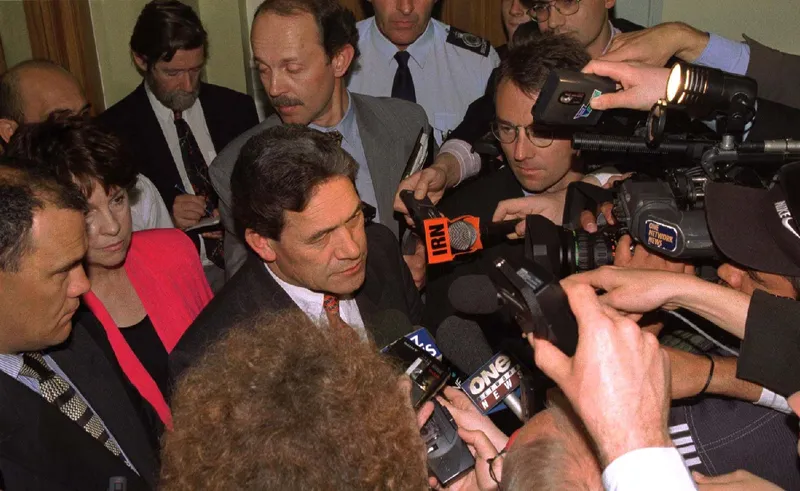
In an interview for Juggernaut, Laws said Peters made him an offer. “He said to me: Laws, you put me on the front page of the newspaper, or, more expressly, you put me on the TV news lead, and I’ll make you. I’ll give you a reputation, and you can go anywhere you want. So that was the devil’s deal, the Faustian bargain.” He set out to make Peters “a sensation”, a “leader of a popular emotion”. Laws recalled: “He taught me the rope-a-dope political technique of the time, which was to make a claim, make it sound outlandish, get the denial and then produce the evidence.”
In 1990, Jim Bolger appointed Peters to cabinet as minister for Māori affairs after National swept to power. When Peters was sworn in at Government House, Bolger’s lieutenant Bill Birch is said to have muttered under his breath, “too late now.”
Peters pushed back against the agenda of Ruth Richardson. He raged at Bolger’s U-turn on the superannuation surtax. He infuriated fellow ministers by going public with a blueprint for a pan-ministry Māori development project, Ka Awatea, without telling them first. Within a year of the election, Bolger had sacked him from cabinet. Peters called it “a sad day in New Zealand politics for my electorate and for the Maori people, who, last November, I was asked to serve”.
By the end of the term, Peters had fallen out irrevocably with the National Party bosses. He stood as an independent in a Tauranga byelection. The major parties chose not to compete, and Peters won by more than 10,000 votes. Second was someone called Greg from the McGillicuddy Serious Party.
Could Peters have gone become leader of the National Party? Had he “played his cards differently, he probably would have been”, Bolger told me in an interview for Juggernaut. “Winston could have been prime minister,” said Jenny Shipley. But, “he could never quite discipline himself”.
Instead, he founded the New Zealand First Party, in perfect timing for the advent of MMP. In 1996, they won 17 seats, including a sweep of the Māori electorates – electorates which today Peters would like to see abolished.
Peters became the kingmaker MMP prototype in 1996. He defied predictions – and much of his own rhetoric – by going into coalition with Jim Bolger. Hadn’t he campaigned on replacing the National government? Yes, he said at the time, and he had replaced a National government. With a National-New-Zealand-First government.
Those first MMP negotiations had seen Peters and his team barter with both National and Labour – as they would do again in 2017 – and a personal detente with Bolger, sealed by a mutual affection for single malt whisky and Bolger’s willingness to apologise for having accused Peters of fanning racist flames in the campaign.
At another point in those 1996 negotiations, the party leaders left the room, and Doug Woolerton, the New Zealand First president, floated an idea. “Doug said, 'Look, we would like to talk about the possibility of a shared prime ministership',” Rob Eaddy, then Bolger’s chief of staff, told me last year. “He said, 'You know, in the Scandinavian-type coalition, you can have a minority party leader being prime minister, and it can be for the full term or part of the term. We think we’d like you to give some consideration to that'.”
Don McKinnon, Bolger’s deputy, was having none of it. “Yeah,” he told me. “That was beyond the boundary fence. It wasn’t going to fly.”
The same idea had “percolated from somewhere”, in negotiations that year with Labour, said Helen Clark (Peters' pick as the best prime minister of the five he's worked with). “It was in the air, but I would have had the same response as Bolger gave… Not a runner.”
In 2026, with New Zealand First polling as high as 15% and the big party leaders struggling for popularity, could Peters make one last push for a share of the top job? The Irish, for example, are currently in the second term of a rotating taoiseach model. How about that? “No, no,” said Peters. “But, you know... the first coalition in this country was before MMP.” He’s talking about the 1931 election. Then, Labour finished first, Reform second and United third, but it was United that provided the prime minister, George Forbes, after they formed a coalition with Reform.
“You get my picture?… Forbes came in with his number two party, his was a lesser party in numbers, but he still got the prime ministership.”
So something like that, or the example we’ve seen in Scandinavia, could happen here? “Yeah, precisely,” said Peters before launching into one of his favourite bits about the big parties: “Tweedledum and Tweedledee, or Pepsi and Coke."

With such ambitions in mind, Peters has gone on a remarkable recruitment campaign in the leadup to this election – call it the Avengers or Dad’s Army, but New Zealand First in 2026 has assembled a cast of candidates so archival that it would hardly be shocking if it reached back as far as the 1930s. It hasn’t always been smooth sailing – Stuart Nash, for example – but the party list released last week included, above many of the sitting MPs, some real Travelling Wilburys. Former All Black captain Taine Randell. Former National minister Alfred Ngaro. And Michael Laws, who had become an MP for National and NZ First after working as the ferret to Peters’ Luigi.
How did the list get drawn up, I asked. Did he just write it down and hand it to an aide? “We have a most agonising experience over days,” he said. “We do it collectively.” It’s just that Laws, in his 1998 book The Demon Profession, wrote that “the entire New Zealand First organisation was the ectoplasm of Winston's personality exactly mirroring all his strengths and witnesses”.
“Well, that’s not right,” Peters said with a grin. “And everybody on that selection committee will tell you, I have the same say as everybody else. Why do I say that? It's because if it was my decision, you don't get any buy-in. If it's not my decision, that's why I do get buy-in. That's why these people are still here after all these years, working for the party. And this party is seriously on the rise at the right time.”
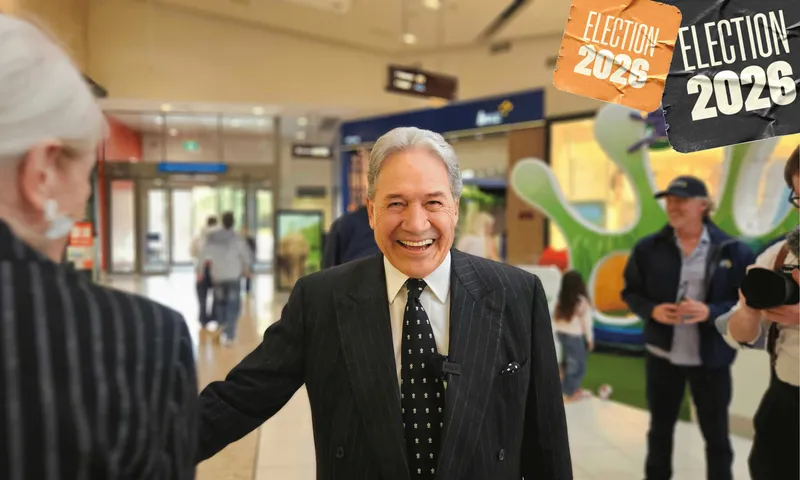
Part of the reason that New Zealand First has managed to retain support while in government is that it has spent much of the term, the second half especially, battering its own coalition partners. Peters has taken jabs at Act and Seymour. “David is trying to catch up,” he told me. “He's the most imitative politician there is. Look how many of his policies are New Zealand First steals, but he doesn't understand them.” That’s small beer, though, really – especially when you consider the depth of animus between the pair in the leadup to the last election, when, for example, Seymour told The Spinoff: ”We're not going to sit around the cabinet table with this clown”.
The more tense and vituperative stuff has been aimed at the prime minister. In commentary on Christopher Luxon's prowess as a leader at home and abroad, Peters has evinced nothing less than contempt. After Peters’ office released materials documenting the leadup to government statements on the US attacks on Iran – materials which underlined what already looked like haplessness on Luxon’s part – the prime minister’s patience cracked. Peters, he said, had “put politics ahead of the national interest”.
When I put that to Peters, he did what he does – he hit back. “I understand international affairs. The prime minister's still in training wheels. That's what I say to that statement.”
But it wasn’t really about their relative proficiency on geopolitics, so much as a perceived breach of trust, the fact that information had been released into the public domain. Wasn't it? Here, Peters took a different line to his remarks at the time, when he called it "a process mistake" not to have coordinated with the PM's office.
“The reason why those materials [emerged] was because the public was being misadvised as to the truth of the matter," said Peters. "And I wasn't going to stand back while the truth was somewhere else and it was in the documents.” Had it not been released, “then the public would never know.”
The issue returned to the spotlight this week, when Luxon was asked by Ryan Bridge in the second leaders' debate whether reports that "you supported the war or wanted to express more support for Trump's war" were "completely a hoax?" Luxon's response: "Absolutely." When asked whether he had ever supported the US attacks on Iran, "even a little bit at the start", he answered, "no, never."
There may be more to come. "Against the record of history coming," Peters told the Spinoff, "we'll find out who is telling the truth or not."

At the end of July, Winston Peters made headlines in New Zealand and around the world for all the wrong reasons. Angered in parliament by a provocation from Lawrence Xu-Nan about his vaccination status, Peters unleashed. “I know you just came here five minutes ago. Go back to your own country,” Peters seethed at the Green MP, who has lived in New Zealand since the 90s. “That’s where they lie like a flatfish, but they don’t lie like that here, all right? This is called democracy. This is called democracy, unlike what you’re used to.”
As soon as I raised that exchange – condemned as “racist” by both Christopher Luxon and Chris Hipkins – Peters launched into a blast at the “ignoramuses in the media and in politics”. But forget them for a minute; I read from an email – one of dozens from the New Zealand Chinese community I was copied in on at the time, ranging from disappointed to incandescent with anger. This one’s from someone called Wesley.
“Chinese communities have helped build this country for generations,” he wrote. “We raise families, pay taxes, create businesses, volunteer in our communities and contribute to New Zealand every day. We should not be treated as outsiders in our own home.”
“I say to Wesley,” said Peters, “do you know the guy that did the first deal with China, in terms of business? Do you know what his name is? Well you're talking to him right now. I'm the guy who went there in 1997 to [establish] export education for New Zealand, and there the Chinese said to me: Mr Peters, could you make me one promise? When they’re there, train them. But will you send them home? And I said: Of course, I'll make that promise, but for the time being, they'll be in the Latin term, in loco parentis. We'll look after them properly. That was my commitment, and I try to keep it, as opposed to others who have not kept the promise. That's my answer to Wesley. You need to know more Wesley. Oh, and by the way, Wesley, my people left your country 5,000 years ago. In case you didn't know.”
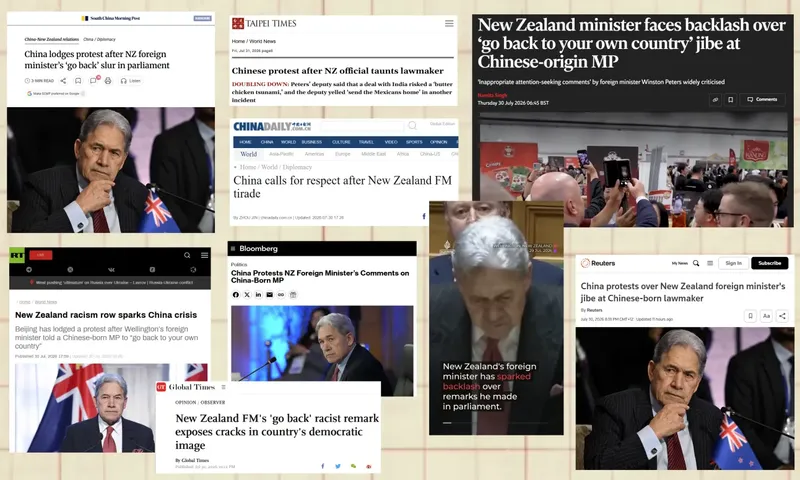
Peters insisted that his “flatfish” remark had been misinterpreted. “My statement about the flatfish is not what they think. In China, it’s an analogy for lying low in the sand and saying nothing about your surroundings.” He said of Xu-Nan: “He came to see me when my brother died, right? So he understands what I meant, but they [Luxon and Hipkins] don't. So all you white journalists are screaming out racism, racism, racism. Don't know what you're talking about.”
Xu Nan confirmed that he had approached Peters to offer his condolences last month. Of the flatfish semiotics, however, he told The Spinoff: “Regardless of which interpretation he feels people could choose to make, neither is good or appropriate, in the generalisation of an entire group of people.” He was confident that “we no longer live in a society where people think these divisive or racist comments are good for any of us”.
The popularity of New Zealand First can be seen as part of a global phenomenon of flourishing nationalist-populist movements. Luxon nodded at that in the first leaders' debate, shaking his head at Peters for “pretending” to be “Nigel Farage or Pauline Hanson”. He’s previously accused the New Zealand First leader of “cosplaying” the British and Australian party leaders.
When that is raised with Peters, he does not reject the comparison, so much as the chronology. “I was there in politics saying these things before anybody heard of Pauline Hanson or anybody heard of Farage. Go and look at the record. Go and look at the history. That's my answer to that. My answer is, Mr Luxon, you'll need to do more research before you make comments like that in the future.”
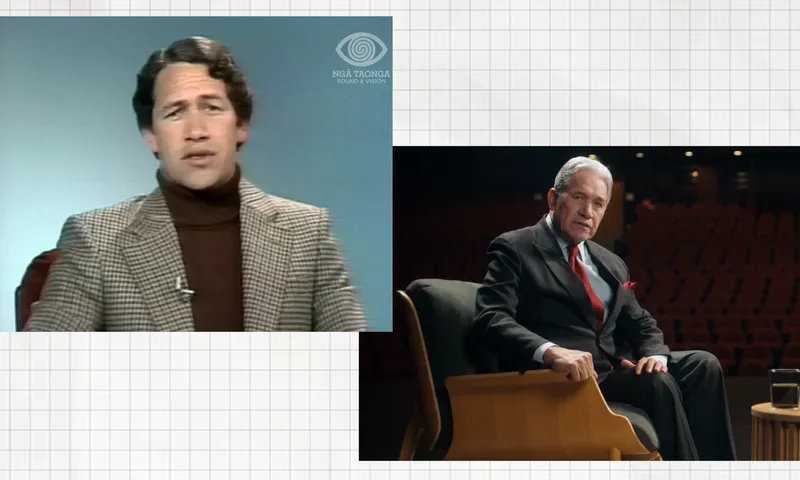
For Peters, the history is always present. I show him two pictures from elections 48 years apart. One is from 1978, when he’d been chosen to play the role of interviewer, asking questions of senior National figures, including Muldoon, as part of the “We’re Keeping Our Word” campaign. The other is from recent weeks. This time Peters is the interviewee, taking questions before swivelling to stare down the barrel of the camera.
What would the 2026 guy say to the equally dapper guy from 1978?
“Terrible haircut!” was Peters’ first response, quite unfairly. “It was a haircut every three months in those days.” He said: I learned a great thing on that programme. Never do that. Never front, unless you're happy. I came away from that experience, fronting the National Party's campaign, saying I'm never going to be caught out doing that again, unless I'm happy with everything. I'm not doing it.”
He continued: “I was being remodelled as not the person I was, but as somebody else. In short, I was remodelled as a reporter journalist interviewing ministers, and it cost me psychologically.” Psychologically? “I didn't believe I should have been asking those sorts of questions because they weren't true… National wasn't keeping its word. That's the point.”
It was a rare example of Peters marching to someone else’s drum. And it was a formative moment – maybe even the last of its kind. “You can marginalise, Cinderellaise, and think you can cauterise New Zealand First,” he told me at one point, playing the hits. “But it just motivates us to go harder.”
Because nobody gags Winston Peters, and they never will.

Toby Manhire
Toby Manhire is editor-at-large at The Spinoff. He loves to cast a pod, whether it's Gone By Lunchtime, At Large or Juggernaut. He is a former editor of The Spinoff and has worked as a journalist in NZ and the UK since the last millennium.


