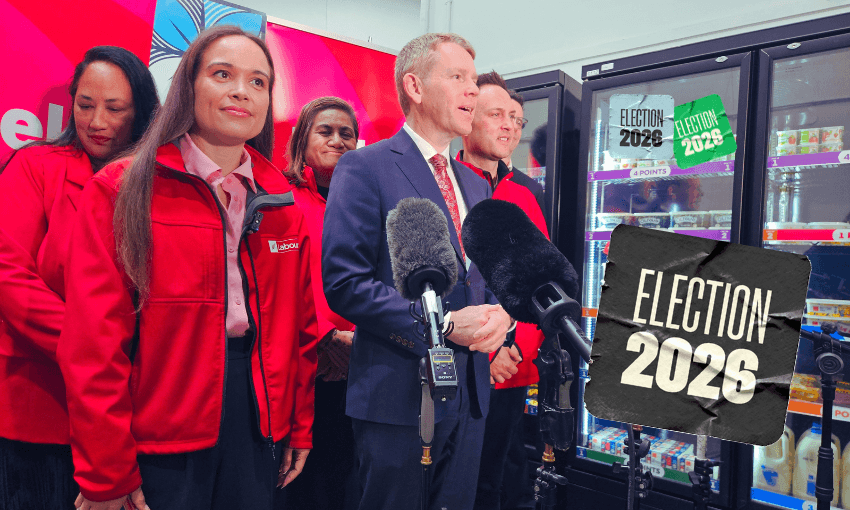



This is what people are telling pollsters.
What might be the impact of New Zealand politics’ new kids on the blocs?
Less than a month ago, the question was whether or not the Opportunity Party could tip over the critical 5% mark. Since then, three polls appear to have put that to rest, with the teal-decked outfit scoring 6.1% in a Curia poll for the Taxpayers’ Union, 5.2% in a Talbot Mills poll for clients and, most recently, a resounding 8% in a Verian poll for 1News.
Opportunity has presented itself as an alternative kingmaker to New Zealand First. Party leader Qiulae Wong has renounced “tribalism”, and the rule-in and rule-out gymnastics of an election year, with one exception: they’ve ruled out working with Winston Peters as a foreign minister.
Christopher Luxon is unimpressed. The National leader has ruled out working with Opportunity, saying, “they’re as centrist as I am an All Black”.
What do voters reckon?
Polling by Curia, conducted at the start of the month, shows a third regard Opportunity as centrist, with about the same number saying they’re unsure. Of the remaining third, most see a leftward party.
Among those aged 18-39, almost half of respondents consider the Opportunity Party centrist (49%) with the 10% who say leftwing slightly outnumbered by the 13% who say rightwing.
At the older end of the spectrum, just 25% of those 60-plus think it’s a centrist party, with 37% detecting a leftwing party, more than double the number (15%) who consider them to the right.
The Taxpayers’ Union, which commissioned the Curia poll, said the Opportunity Party’s headline policies of a land-value tax and a universal basic income made it hard to regard them “as anything other than radically left-wing”. A spokesperson for the lobby group said: “The fact that so many voters either see Opportunity as centrist or are unsure where it sits suggests there has not been nearly enough scrutiny of what the party is actually proposing.”
The headline numbers here are broadly consistent with the latest data from Talbot Mills, whose poll for clients was in the field from August 1 to 11. They didn’t offer “centrist” as an alternative to left or right, but “neither”.
Drilling into its numbers, Talbot Mills observed that among those who said they would vote Opportunity, 60% thought the party was neither left or right, with 33% saying left and just 4% right. “If the Opportunity Party ends up holding the balance, the pressure from its own base runs left rather than right,” noted the Talbot Mills commentary.
Among those who told the pollster they knew either a lot or a fair amount about the Opportunity Party – irrespective of whether they intended to vote for them – 47% said leftwing, 22% rightwing and 25% neither.
A majority were yet to draw any conclusions about Qiulae Wong – 21% said favourable, 22% unfavourable, and 57% answered unsure.
How much do voters know about the party itself? As of the start of this month, most said not a lot.
Opportunity rejects the idea that understanding the party better means placing it on a left-right spectrum.
In response to commentary urging it to declare where it sits on the measure, Wong said: “We will not slap a ‘left’ or ‘right’ label on our policies or party, just to make life easier for the media.” It was “time to leave the left and right behind”.