The Stuff Leaders' debate had two losers: Christopher Luxon and Ryan Bridge

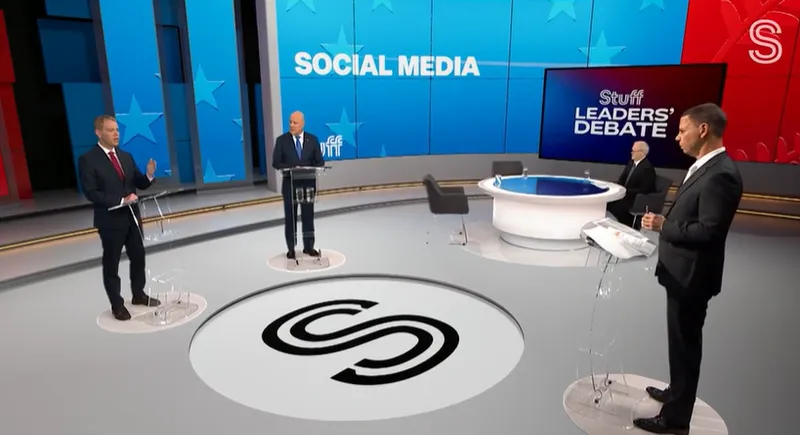
Paddy Gower moderated the third debate between Chris Hipkins and Christopher Luxon on Tuesday.
Paddy Gower’s restrained moderation made Ryan Bridge’s debate look even worse in hindsight. Luxon, meanwhile, floundered under the longer format.
“This is a debate and we are going to let you debate,” said moderator Paddy Gower as he opened the Stuff Leaders' debate, the third contest of the campaign between Chris Hipkins and Christopher Luxon. “There will be no silly questions. This is serious.”
It was a barely-concealed dig at the NZ Herald’s Ryan Bridge who, the previous week, oversaw one of the most horrifically unwatchable political debates in recent memory. Bridge made it all about himself: cutting off the candidates before they reached anything of substance, chasing news lines over detailed discussion, and forcing “silly questions” that seemed to exist only to prove how funny he thinks he is.
Gower, by contrast, was uncharacteristically demure. Wearing a muted black suit, he seemed to fade into the background, allowing the two Chrises to address each other directly with a good amount of back-and-forth. There were still a few moments where that devolved into unintelligible sniping, especially when Luke Malpass led a side discussion about the budget (uncomfortably titled “the probe”), but on the whole it was the best debate of the campaign so far.
The longer format suited Hipkins, who showed that he was the quicker and more informed of the two Chrises. And it was brutal for Christopher Luxon, whose shallow grasp of the details and bad rhetorical habits were repeatedly exposed.
The National leader got bogged down in jargon, used the word “operationalise” too many times, and struggled to give straight answers to moral questions about gambling ads, social media algorithms, and whether the healthcare system was in crisis.
He short-circuited when Gower asked whether he’d resign before forming a coalition with Opportunity. “I’ve ruled them out, I don’t know how to be any clearer,” Luxon said. “Say you’ll resign as leader,” Gower suggested. Luxon didn’t take the offer.
When asked about the cost of living, Luxon gave a particularly tone-deaf answer by suggesting it wasn’t so bad because some homeowners were paying lower mortgages. When Hipkins called him “out of touch” and “not up for the job” his response was, essentially, “nuh uh, you are”.
Luxon tends to fire up when he senses that his back is against the wall and this debate was no exception. However, his killer lines landed embarrassingly short. When Hipkins accused him of letting David Seymour and Winston Peters “run rings around him”, Luxon said “I wouldn’t go there” three times, grinning like he was winding up for a haymaker. But when he finally went there, it was just a limp reference to Kiri Allan’s drink-driving charge back in 2023 – a zinger that holds much less weight now that Allan has been out of parliament for a full term.
On healthcare, Luxon’s pleas for the opposition to not politicise the delays to cancer treatments at Starship Hospital felt especially disingenuous. If the shoe was on the other foot he would no doubt be accusing Labour of running the worst healthcare system in the history of hospitals. As noted by The Post’s editor Matthew Hooton in the post-debate panel, Luxon has an unfortunate tendency towards hyperbole, which often just demonstrates his own lack of nuance.
For his part, Hipkins was solid but unexceptional. He was often too preoccupied with fact-checking Luxon’s talking points, even when it didn’t necessarily add anything to his argument. As the old political adage goes, “if you’re explaining, you’re losing”. At times he came off as whiny, one of his worst attributes. And he spent too much time fighting the ghosts of the past, with several references to the actions of the John Key government. As has been the case all term, he spent more time negating the case against Labour rather than building the case for it.
There was no killer moment for either candidate. Last week’s interaction over increases to minimum wage will go down as the standout debate moment of the campaign, though that’s not saying much.
If you’re judging by debate club rules, Hipkins was the winner by default. But that doesn't necessarily mean he'll win many extra votes. Luxon gave people a reason to doubt him, but it's not clear if Hipkins did enough to get any of them to switch.

Joel MacManus
Joel MacManus is a senior writer for The Spinoff. He previously worked at RNZ and Stuff, and began his career at Critic Te Ārohi. His writing explores the political, economic and cultural systems that underpin modern New Zealand. He won the 2025 Voyager Media Award for Best Columnist, Opinion or Critique.


