New Zealand is falling behind on tech regulations

Australia is outpacing New Zealand in tech regulations (Photos: Getty, composite design: The Spinoff)
While Australia is fronting up to large tech companies, New Zealand keeps dragging the chain.
Across the ditch, Anthony Albanese’s Labor government has made a point of tackling the emerging powers of big technology firms, social media platforms and artificial intelligence. When announcing a ban on social media for children under 16 in December, Albanese said it was “a day in which my pride to be prime minister of Australia has never been greater. This is world-leading. This is Australia showing enough is enough.”
In New Zealand, the government’s attitude has been less ambitious. Ministers have repeatedly said they want to be “fast followers” or “smart adopters”, opting for Australia or other comparable jurisdictions to move first before deciding how to respond.
Here are a few examples:
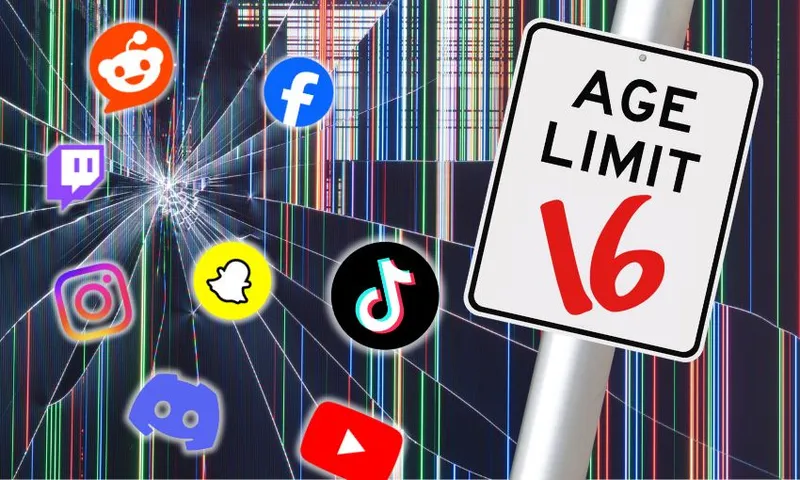
Social media for under-16s
Australia's minimum age law for social media took effect in December 2025. It was the first country to take such an action, blocking underage children from platforms including Facebook, Instagram, TikTok and Snapchat. Australian communications minister Anika Wells reported that nearly five million accounts were removed by large platforms within a week. However, a study by Australia’s internet regulator found that more than 80% of underage teens were still finding their way onto the apps.
The New Zealand government introduced a bill in August this year that would establish the same age restrictions. However, coalition partners Act and NZ First pulled their support, meaning National would have to rely on tentative support from Labour to pass the bill.
Online safety
Australia introduced an eSafety Commissioner in 2015 as the world's first government agency dedicated to keeping citizens safe online. In 2021, a law change gave the commissioner greater powers to take action against online harassment and cyberbullying, and ordering digital platforms to remove abusive content.
New Zealand’s Harmful Digital Communications Act, also introduced in 2015, provides some recourse for abusive online behaviour. Victims can complain to Netsafe or the District Court, but it's done on a case-by-case basis and there is no active regulator. In 2023 the Department of Internal Affairs developed plans for a regulator with the ability to fine platforms, but the proposal was scrapped by minister Brooke van Velden.
Online scams
Last year, Australia passed the Scams Prevention Framework Act, which requires banks, telcos and digital platforms to take a series of actions to crack down on scam messages and advertising, with fines up to AU$50 million per breach applying from March 2027.
New Zealand’s Online Scams Code, by comparison, is far weaker. It’s a voluntary industry code, introduced by Tech New Zealand and based on a similar Australian code. Companies that signed up to it, including Google, Meta and TikTok, committed to take actions against scammers but there is no regulator enforcing it or fines for breaching it.
Smart glasses
Australian agencies have been quick to consider how to handle the arrival of camera-enabled smart glasses – which, due to their covert nature, have been widely dubbed “pervert glasses”.
In August, Australian attorney-general Michelle Rowland told the Australian privacy commissioner to undertake an urgent review into the privacy risks of smart glasses. And the eSafety agency issued guidance urging manufacturers to auto-blur faces, delay livestreams and show clear lights or sounds indicating that the camera is recording. The City of Sydney council, and several other local government authorities, have already passed bylaws banning the glasses in some public places such as swimming pools and childcare centres.
New Zealand’s privacy commissioner Michael Webster warned in August that the current settings under the Privacy Act needed to be looked at to account for the new technology. However, the government has not taken any steps to advance this. Minister Paul Goldsmith said regulations may be considered next term.
Sexual deepfakes
In 2024, Australia made it illegal to share non-consensual sexual deepfakes with a penalty of up to six years in prison – or seven years for the person who created them. According to the eSafety Commission, several commonly used “nudify” apps have gone dark in Australia since the law change.
In New Zealand, the issue has been most prominently championed by Act’s Laura McClure, who introduced a members’ bill which expands the criminal definition of "intimate visual recording" to include AI or otherwise digitally altered images. It would be broader than Australia’s law, though with a lighter penalty of up to three years in prison.
The members' bill passed its first reading in May. It is currently at the select committee stage but will not become law until next term at the earliest.

Digital news bargaining
Australia introduced the requirement for large tech platforms (primarily Meta and Google) to bargain with local news media sites in 2020. Facebook temporarily cut off all news content from Australian feeds, though backed down after negotiations with the Australian government. The latest addition, the News Bargaining Incentive, introduced in 2024, closed the loophole that allowed platforms to withdraw news. Instead, if large platforms opted out of making deals with news businesses, a fee would be paid into a fund, which would then be fed back into the local media industry.
New Zealand’s equivalent, the Fair News Digital Bargaining Bill, was introduced to parliament in 2023 during the final weeks of the previous Labour government. It sat in purgatory for a while after the election of the National-led coalition before being officially put on hold by minister Paul Goldsmith in December 2024.
AI governance
In November 2025, the Australian government established an AI Safety Institute, with $30m funding over four years. Albanese set up an Office of AI within the department of prime minister and cabinet and committed to legislating standards for AI regulations, including copyright protections.
Until July 2025, New Zealand was the only country in the OECD without an official AI Strategy. When the government finally introduced a strategy, it opted for a "light-touch approach”, according to minister for science, innovation and technology Shane Reti. The government adopted the OECD's AI principles and created an expert panel to advise on AI use in the public service, but hasn’t passed any specific laws or created new offices of AI. Labour has proposed copying Australia’s homework by creating an equivalent office of AI, establishing clearer copyright laws and creating a more powerful online regulator.
Taking a "fast follower" approach towards rapidly evolving tech is a defensible strategy for a small country such as New Zealand, especially when a larger country right next door is funding policy research in the same area. But that only works if the government actually follows. Right now, New Zealand is sitting in the corner and watching.

Joel MacManus
Joel MacManus is a senior writer for The Spinoff. He previously worked at RNZ and Stuff, and began his career at Critic Te Ārohi. His writing explores the political, economic and cultural systems that underpin modern New Zealand. He won the 2025 Voyager Media Award for Best Columnist, Opinion or Critique.


