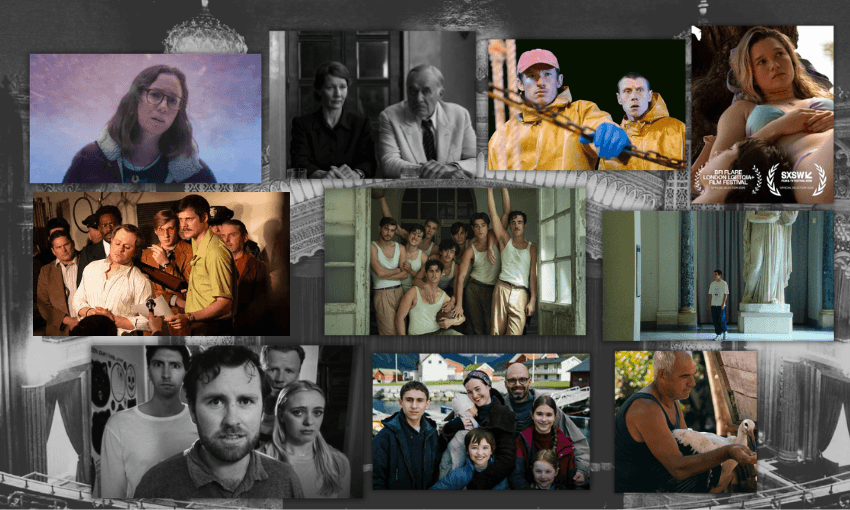



Already have decision fatigue for Whānau Mārama 2026? Thomas Giblin selects 10 easy wins.
The hotly anticipated 2026 Whānau Mārama New Zealand International Film Festival is just around the corner. Featuring over 100 feature films, from international auteurs to Aotearoa’s latest and greatest, there’s something for everyone at this year’s festival (July 29 – September 9). But with so many intriguing titles on offer, what films are worth spending your hard-earned money on? From lauded directorial debuts to Cannes heavyweights and heady horrors, here are my 10 must-see films (in alphabetical order).
Big Girls Don’t Cry
After breaking out at the Sundance Film Festival, Tāmaki Makaurau filmmaker Paloma Schneideman’s debut feature Big Girls Don’t Cry is having its eagerly awaited Aotearoa premiere as the opening night film of NZIFF. Set in the summer of 2006 in a rural town near Ōmaha, the tender film centres on Sid (Ani Palmer), an awkward adolescent attempting to navigate her burgeoning sexuality. Reminiscent of Christine Jeffs’s Rain, this “wry and intimate queer coming-of-age tale filled with as much desire as it has rebellion” is destined to become a Kiwi classic.
Read more: ‘Really mind-blowing’: The New Zealand coming-of-age film winning big overseas
The Black Ball
Directed by Javier Calvo and Javier Ambrossi – the Spanish filmmaking duo known collectively as Los Javis – The Black Ball sparked a 16-minute standing ovation at Cannes, and a multi-studio bidding war. Inspired by an unfinished work of the same name by influential Spanish poet and playwright Federico García Lorca, the “magnificently moving triptych that feels at once novel and like a classically staged military epic” is set in 1932, 1937 and 2017, and follows the interlinked lives of three gay men. Unfurling over a sprawling two-and-a-half hours, this “era-spanning monument to gay storytellers is a heartbreaking work of staggering genius.”
Dead Man’s Wire
Inspired by a wild true story, Gus Van Sant’s timely comeback film Dead Man’s Wire is a “thoughtful, bleakly funny 1970s drama that speaks to the current moment, and is equal to the many classics that inspired it“. Featuring Bill Skarsgård as disgruntled real-estate developer turned kidnapper Tony Kiritsis, who takes a man hostage believing the mortgage company the man works for is attempting to defraud and bankrupt him. What follows is a Dog Day Afternoon-like standoff that is sure to shred your nerves.
Fatherland
With a filmography that includes the gorgeous Oscar-winning Ida and the Oscar-nominated heartbreaker Cold War, any new Paweł Pawlikowski film is worth getting excited about. In Fatherland, an “impossibly elegant, poised historical vignette“, German acting icon Hanns Zischler is Nobel laureate Thomas Mann, and Anatomy of a Fall’s Sandra Hüller is his daughter Erika. In the aftermath of World War II, the pair embark on a road trip across the ruins of Germany. Clocking-in at a sprightly 83 minutes, the monochromatic Fatherland is “another expansive, enriching work from a modern master“.
Fjord
Based on real events, the Romanian Mihai (Sebastian Stan) and the Norwegian Lisbet (Renate Reinsve) are the heads of the devoutly Christian Gheorghiu family. They’ve relocated their family from Romania to a remote village in Norway to be closer to Lisbet’s family, but their move doesn’t go as planned as they struggle to assimilate and become the subject of a publicised judicial investigation into child abuse. “Sharply attuned to the world’s ever-expanding possibilities for movement, misunderstanding and conflict“, the Palme d’Or-winning Fjord has stirred controversy, dividing critics and audiences alike. It’s now time for Aotearoa to have its say.
La Gradiva
Helmed by Marine Atlan in her debut feature, and premiering in the Critics’ Week section of Cannes where it won the Grand Prize, the French coming-of-age drama La Gradiva “announces the arrival of a formidable new talent“. Set at the foot of Mount Vesuvius, this trembling depiction of teenage angst follows a group of French high-school students (all played by newcomers) and their long-suffering teacher (Antonia Buresi) who travel to Naples to roam the ruins of Pompeii. In the same vein as The 400 Blows, Peppermint Soda and To Our Loves, La Gradiva “is so wholly transporting that its running time flies by unnoticed, and as it barrels toward its melancholic end, you’re left breathless in your seat“. High praise indeed.
Rose of Nevada
No working filmmaker’s process is “more inseparable from his images“ than Mark Jenkin’s. The singular Bafta-winning writer, director and composer has shot all three of his features in Cornwall on 16mm using a clockwork Bolex, and Rose of Nevada continues that trend despite the Hollywood stars. The maritime mystery features George MacKay as Nick, and Callum Turner as Liam, two men who join the crew of the Rose of Nevada, a fishing vessel that has bafflingly come back to shore after three decades at sea. When they return from their fateful first voyage, the men realise that they have been transported back in time. Otherworldly, but “rooted in the bleak political realities of 2020s Britain“. Rose of Nevada is truly one-of-a-kind.
The Tale of Silyan
Tamara Kotevska’s The Tale of Silyan, a “cockle-warming mud-caked folk tale“, is a welcome escape from the doom and gloom of the world’s current affairs. Shot in Češinovo, North Macedonia, the docu-fable charts the friendship between Nikola, a struggling farmer, and Silyan, an injured white stork that the stoic agrarian takes under his wing. Their bond is a reprieve for Nikola, whose time-honoured way of life has been upended by migration, environmental change and government policy. A “succinct, entrancing, and life-affirming documentary“. The Tale of Silyan is bound to charm the whole whānau.
Teenage Sex and Death at Camp Miasma
Rounding out what I Saw the TV Glow director Jane Schoenbrun calls her “Screen Trilogy”, Teenage Sex and Death at Camp Miasma, which won the Queer Palm at Cannes, features Hacks star Hannah Einbender as the Schoenbrun-like Kris, a queer director. Hired to reboot the flailing Camp Miasma slasher franchise, Kris seeks out Billy Preston (Gillian Anderson), the original film’s elusive final girl. When the two meet, fantasy and reality collapse, setting off an “erotic explosion in this cerebral, pop-colored tale“ that gleefully deconstructs horror and Hollywood. Tailor-made for a late-night screening, Teenage Sex and Death at Camp Miasma is one to watch with a whole heap of friends.
The Ungrateful Tenant
After four and a half years in production, the topical silent horror comedy The Ungrateful Tenant is finally emerging from the darkest depths: the Tāmaki Makaurau rental market. Brought to life by Ōtautahi filmmaker Conor Bowden, who serves as the film’s writer, director, editor and star, The Ungrateful Tenant depicts an exasperated millennial renter (Bowden) who, after kicking out a problematic flattie, is struck down by karma and sent on a nightmarish odyssey through the City of Sails and its housing crisis. Drawing inspiration from the works of F. W. Murnau and Charlie Chaplin, this distinctly Kiwi micro-budget passion project is sure to spook and amuse.