

A Spinoff group think from the depths of our live music memories.
In the spirit of Te Marama Puoro o Aotearoa New Zealand Music Month, we tasked misty-eyed Spinoffers with lacing up their scuffed Doc boots for an amble down memory lane. (And we’d love to hear yours too.)
The Mint Chicks at The Big Day Out
(Mt Smart Stadium, Auckland, January 21, 2005)
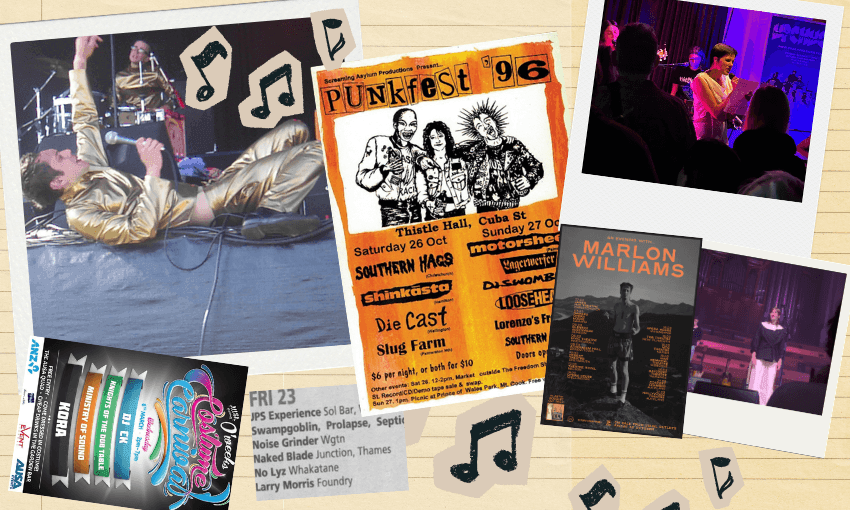
Here it is, the pinnacle of my very short-lived and consistently out-of-focus gig photography career: a photo of Blink taking a much better photo of Kody Neilson chopping down an advertising hoarding with a chainsaw at the 2005 Big Day Out. Talk about history in pictures.

The truth is I more or less hated both Big Day Outs I went to, but for the half hour or so the Mint Chicks were playing I was in pure live music heaven. The energy, the antics, the unpredictability… this was my Wrestlemania. My most ecstatic memory of this set isn’t even the chainsaw incident – it’s when they launched into a cover of ‘Ever Fallen In Love’, and the naivety of youth led me to believe I was the only person in the crowd who recognised it as a Buzzcocks song. Live music!
– Calum Henderson, production editor
Aldous Harding at Auckland Town Hall
(March 14, 2020)
It’s early 2020, the last year of your life has been soundtracked by Aldous Harding’s Designer and Weyes Blood’s Titanic Rising and now both are putting on a show at Auckland’s Town Hall. Meanwhile, there’s this buzzy little bug named Covid-19 shutting down the whole world, and you’ve got this weird feeling this might be the last normal thing you’ll be allowed to do for a long time.
Anyway, ignore the man mumbling nervously behind you, dropping dead from sickness, and mimic Harding’s robotic dancing instead. Twirl under blue lights with your friends and laugh and sing even though you’re the only ones treating it like a party. When Weyes sings “true love is making a comeback”, you really believe it. When Harding sings, “the wave of love is a transient hut”, it sounds a lot like “hurt”. You’re only 19 and but you’ve had enough alcohol in a plastic cup to know both can be true.

It’s a night you remember for the whimsical way you felt moving to the music and the poetry embedded in between. And the afters in Myers Park, drinking under the moonlight. Just over a week later, the prime minister announces that the country’s going into lockdown. That night and Harding’s gossamer tones are the last memory you have of what life felt like pre-Covid.
– Lyric Waiwiri-Smith, politics reporter
JPS Experience at Sol Bar
(Wellington, April 23, 1993)
It was April 1993 and JPS Experience, for some reason, were playing at Sol Bar, upstairs in the Oaks, Wellington. This was the place that would later become La Luna, but at this point it wasn’t really a live venue. It was glassy and the sight lines were no good, with the bar smack in the middle. We were in first year at university and went along mostly because a friend’s older brother worked behind the bar and was very generous with the pours. But despite everything the show was dazzling, infectious, with the reveries of Bleeding Star, which must have just come out, at its centre.

At some point during the show they announced they’d also be playing the next night, a Saturday, at Bar Bodega, the grubby temple of live music in Wellington at the time, up there on Willis Street, where the main act almost never began before midnight. If my memory is right, David Kilgour also played that night and it was even better, even more entrancing and mysterious. That album didn’t leave my trusty five-CD changer for at least a year.
– Toby Manhire, editor at large
Shihad at Aotea Square
(Auckland, May 1, 2005)
It’s 2005 and I’m 16. Clad in converse and Dickies shorts. My best friend and I had journeyed from the depths of east Auckland (most likely via the Half Moon Bay ferry) to Aotea Square. We were there to see Shihad. It felt like a big deal. Their Vodafone-sponsored show on May 1 was kicking off New Zealand Music Month and significantly, especially so for underage teenagers with part-time jobs (I washed dishes at a neighbourhood restaurant), the gig was free. Due to that, and the band’s mid-career success – “big” by New Zealand standards, and newly returned from the US after a brief rename – Aotea Square was packed with people waiting for Shihad.
I remember bogans, indies, normies and a lot of teenagers like us there for a free gig with no ID required. The crowd was 7,000 strong, I learned later, which is more than the population of Kaitaia. (Rumours of the damage caused to The Civic carpark below were debunked by Chris Schulz in 2025.) As the band took the stage at 4pm and started playing, the heavens opened. I don’t remember the set list. I don’t remember how we got home again. But seared in my memory is a skinny, shirtless Jon Toogood, with black drainpipes and long dark hair, absolutely saturated. He didn’t care and neither did we. To this day I’ve never seen so many people unfazed by a downpour. The crowd was steaming like cattle.

Revisiting coverage of it – you can watch the whole thing on YouTube – I read a report of the show by a young Derek Cheng, early in his long Herald tenure, noting that local music enjoyed 20% of the airplay on commercial radio. Compare this to now, with NZ on Air recently reporting that the majority of commercial stations didn’t meet that voluntary standard last year. In 2005 it really did feel like New Zealand music was everywhere. As teenagers we watched C4, listened to bFM and Radio Hauraki, scoured Real Groovy and treasured every issue of Rip It Up and Pavement. Music discovery felt physical and hard – although, yes, Limewire and MySpace existed by then too. Standing in the rain felt worth it. It still is.
– Emma Gleason, contributing writer
Adam McGrath at the Wine Cellar and Sam Prebble at the Maritime Museum
(Auckland, May 10, 2016; Auckland, October 31, 2013)
At the risk of sounding like the Blade Runner tears in rain monologue, I’ve seen local bands you wouldn’t believe. Reb Fountain on fire on the top floor of Lopdell House in Titirangi. Aldous Harding glittering on stage at the Wunderbar in Lyttelton. But still some of my most enduring local music memories are tied up in the bits between songs from two shaman-like folk singers.
Both are road warrior working musicians. The first, The Eastern’s Adam McGrath, has a personality to match his really quite massive size. I’ve seen him play probably a dozen times, mostly in lounges or small spaces. He carries himself like a booze-soaked preacher, espousing the gospel of old-fashioned folk, pouring scorn on sellouts and cynical politicians and advocating for the people at the end of their boot. I don’t know when I became a true believer but I still remember him explaining his beautiful ballad ‘People Like Us’ at the much-missed Wine Cellar.
Sam Prebble was a different kind of preacher, though no less committed to a potentially hopeless cause. His final album with his band Bond Street Bridge was The Explorers Club: Antarctica, a catalogue of songs about the Scott and Shackleton expeditions. At the album release show at the Maritime Museum, he embodied the manic energy and desperation of those men’s journeys on stage, throwing his hair about wildly and monologuing about days, months and years spent freezing out on the Antarctic tundra.
Sam died in 2014. These days I think about the time we spent together on stage, and more still about the time we spent off it, swigging from bottles in the courtyard of the Leigh Sawmill Cafe. After he went, I wrote a few songs about him. One was called ‘Honey in the Whisky’. He thought it was sacrilege and hated anything that would take the edge off the bitter taste. Both he and McGrath have always wanted to look the hardest stuff in life straight in the eye, and then most of the time take aim at it with a huge gob of spit, and that commitment has always stayed with me.
– Hayden Donnell, senior writer
Punkfest at Thistle Hall
(Wellington, October 26, 1996)
What is probably my most important local music memory has little to do with music. By 1996, I’d become a fan of DIY punk music, and was aware of the scene primarily through after school trips to the anarchist bookstore on Cuba St, just a block away from the comic book store I’d been religiously visiting since intermediate. Having dedicated most of my life up until that point to competitive junior sports, for someone who cared so much about music, I’d seen very little of it live. So by the time of my first show, I already had a collection of screen-printed patches sketchily sewn onto the mottled brown polyester pants I’d fished out of a clothing bin while a friend held my legs to ensure I didn’t fall in.
Though entirely sober, my memories of that night are a little hazy. I remember Lower Hutt band Diecast, all just a year or two older than I was, fronted by a charismatic singer who reminded me of an op-shop Zack De La Rocha (in a good way) and backed by drummer Julian Dyne, who already had a technical dexterity well beyond what seemed possible in that context. I remember Christchurch band Southern Hags, a whirl of dreadlocks, rags and percussion. Shinkasta, a heavy hardcore band from Hamilton whose EP my cousin Nick – the reason I was there – had either just released or was just about to, crushed me right through the chest.

While I was blown away by the music, I would be more so by many shows over the next few years. But what was truly life-changing about that night was its introduction to an underground network, where kids who seemed old to me but were probably mostly 17-22 built a whole world for themselves without the input or interest of bars, or arts organisations, or the council, or especially the music industry.
That night I learnt that music can be so much more than music (though it can always just be music too – that’s a wondrous thing in its own right). Punk music especially was more than overblown guitars, screamed vocals through shitty PAs, blasted beats played on rock drum kits or rubbish bins. Music was people, it was community, it was sweeping up the bottles and putting away the benches that lined the walls, it was screen-printed posters, it was weathered anarcho-communists drinking homebrew barely blinking at a bright-eyed, slightly scared tennis-playing kid with too-new patches on fraying suit pants.
– Henry Oliver, contributing writer
So So Modern at Rockquest at the Hunter Lounge
(Victoria University, Wellington, some time in 2007)
On a chilly autumn night in 2007, Wellington’s best teenage musicians converged on the Hunter Lounge for the Smokefree Rockquest regional final. The bands would play their hearts out, of course, all dreaming of the coveted national title and a studio interview with C4’s Drew Neemia. Most would leave disappointed – but not before having their brains utterly rewired by a kaleidoscopic avalanche of neon jumpsuited madness that came in the form of guest performers So So Modern.
Playing the traditional role of “professional band who fill time while the competition judges deliberated”, So So Modern were a fucking anomaly; math rock and synthesisers and matching costumes and a drummer who played faster and harder than anything I’d ever heard before. They jumped and convulsed and screamed gang vocals in unison, and I could but watch in awe from the audience, like that one Danny DeVito meme. A guest band performing for a bunch of nervous teens had no need to go so hard – and yet they did, the absolute legends. Bless you So So Modern.
– Te Aihe Butler, podcast producer
Kora at the University of Auckland Student Quad
(Auckland, March 6, 2013)
It was my first week at Auckland University and first time watching Kora perform live. The band had just released their Light Years album and performed to a crowd of no more than two dozen rowdy punters in the uni’s quad.
It was about 6pm when they took the stage and we were all well lubricated by that point, feeling pumped for the headline act. I vaguely remember vodka in a water bottle being passed around after more than a few $7 jugs of Shadows lager had been downed.

The band was electric. Despite the small crowd, the place was rocking. Lead singer Francis Kora stopped a few songs in and mentioned that it was one of the smallest crowds the band had played to in years, but also one of the most rowdy it had ever seen. He was laughing and shaking his head at how amped we were. They looked genuinely happy to be there.
If my memory serves me right, Laughton Kora was on bass that day and pumping from the start of the set until the end. As a first year uni student, it was an unforgettable experience to see one of the country’s best bands in such an intimate setting. They played everything from Skankenstein to Drop Dead Killer. 10/10 experience.
– Liam Rātana, Ātea editor
Marlon Williams at the Leigh Sawmill Cafe
(Leigh, March 21, 2021)
While his 2018 Auckland Town Hall gig was nothing short of a religious experience, a lesser-known, more intimate Marlon Williams experience I shan’t forget in a hurry took place in March 2021 at the legendary Leigh Sawmill. It was one of those heady in-between lockdown times where the joy of gathering with fellow humans to have a nice time felt almost intoxicating. Beers were drunk, waiata were sung, and, with Anika Moa showing up as a surprise special guest, many a lol was had. Add in a lift home with a sober driver pal and it was pretty much the perfect evening.
– Alice Neville, deputy editor

L.A.B, Che Fu and more at Good Vibes Rotorua
(Rotorua Village Green, July 18, 2020)
What a hoot, what a shindig! This one brings back some smiles. From what I can remember the crowd was the real winner, the atmosphere was second to none. It was the friendliest audience I have ever had the pleasure of joining. It was raining but that didn’t dampen the mood in the slightest. We relocated under the shelter and joined the swaying waves of hands and bobbing heads. L.A.B. was buzzin’ as always, I had seem them up in Auckland a few times and they always bring the energy on stage but boy oh boy Che Fu really had me poppin’ my knees! I hadn’t heard his goods in a minute but we all know the lyrics living rent free in our heads. So when he took stage I was zoned! Reggae usually isn’t my choice of music but I can see why the people flock to it. Good energy, good music – no snacks though but that’s OK cause the amount of bass those speakers were blasting ate.
– Tina Tiller, senior designer
Princess Chelsea and the Dream Warriors at Public Bar
(Auckland, March 12, 2026)
My first ever regular writing gig was a live music column for Real Groove magazine (RIP) in the early 00s, and it would have been easy and entirely defensible to pick one of the dozens of shows I saw in that era: Xanadu, Fake Purr and Coolies showing a path not taken at the King’s Arms. The explosive energy of the 2003 hip hop summit. The Mint Chicks, anywhere at any time.
But instead I’m going with a night that happened less than two months ago that I have not been able to shake since. It was Princess Chelsea and her scorching hot band the Dream Warriors, playing Whammy’s Public Bar on March 12 of this year, and easily the equal of any show I saw in the 00s.
In front of a sold-out crowd of 70, the band started with I Love My Boyfriend, but then proceeded to play a set of brand new songs from a forthcoming album. New material, mostly getting its first ever airing, wholly unfamiliar to everyone but the band, who were also still figuring it all out. Despite – or maybe because – of that mutual semi-comprehension, that set was a rocket to the moon and beyond.

These new songs are a departure, mostly six- to eight-minute multi-part epics, wiggy prog workouts with the Dream Warriors standing on the edge of reason (and occasionally soloing on top of the bar). But they were anchored in Chelsea’s deceptively sweet, secretly savage, lull-you-to-sleep-then-plunge-a-knife-into-your-chest melodics, a thrilling tension that never let up even once. There was something so electrifying about hearing a major artist play songs they’re still mapping themselves that placed the show in a different category from even a great set which you and the artist know very deeply.
The whole thing ran for maybe 45 minutes, and every face in the crowd was wide-eyed and slack-jawed, fully cognisant that something rare and precious had been conjured on an unassuming Thursday evening. It was also a necessary reminder that even though we’re all – bands, fans, labels, venues, scenes, cities, a whole damn country – haunted by what has gone before, there remains an outside chance that the best is yet to come.
– Duncan Greive, founder
Have a great local music memory? Tell us about it in the comment section.