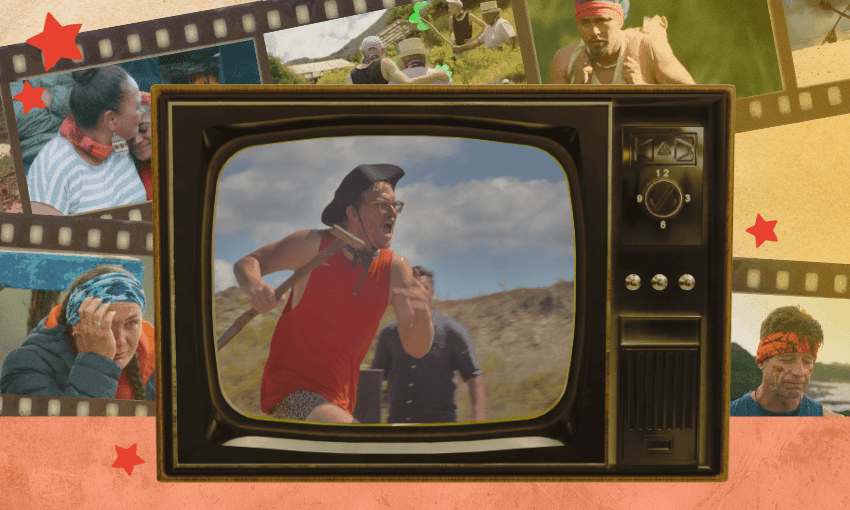



Twenty-five years ago, Celebrity Treasure Island debuted on our screens as a very different series to the one we watch today. Alex Casey charts the evolution of our most enduring original reality show.
In the beginning, there was Dominic Bowden, in a bandanna, lusting after fruit. “I was imagining a Just Juice ad where they are sitting on the hammock and the two fruits hit each other and it falls on your face and there’s all the beautiful fruit everywhere,” he laments to his diary cam. “But there’s nothing.” Self-professed “lolly junkie” Sally Ridge is after a sweet treat, and Stacey Daniels just wants chips. It’s been less than 24 hours on the island when cricketer Danny Morrison wrings a chicken’s neck for his fellow starving celebrities. “Look away,” teammate Handy Andy says. “It’s just like stir-fried chicken you have at home.”
A quarter of a century later, you’ll still hear the odd grumble on Celebrity Treasure Island about contestants being hungry, but the new era of the show is less centred around survival and defined by something much more surprising. Whether it’s Nix Adams opening up about her addiction struggles to clean-cut broadcaster Simon Barnett, legendary activist Tāme Iti imparting wisdom to comedian James Mustapic, or actor Gaby Solomona encouraging politician Carmel Sepuloni through traditional Samoan song, the show has hosted no shortage of revelatory, moving exchanges between people from all walks of life.

This current season in particular has been ripe with emotion. There was not a dry eye in the house when actor Vinnie Bennett gifted his pounamu to Simon Barnett, a gift over a decade in the making after Barnett inspired him at a youth group talk as a naughty teenager. “My best friend made this, and he told me that you’ll meet someone across your way that deserves to have this,” he said. “And that’s you my friend.” It’s these kinds of moments that feel impossible to write or plan for, so how has this silly castaway show managed to capture so many of them? And how else has it evolved over the last 25 years?
‘It was rip, shit and bust’
To discover how we got here, we must first understand where Celebrity Treasure Island began. Treasure Island was an original format created by Touchdown in 2000 that pre-dated Survivor by a matter of months. Dropping everyday New Zealanders in the remote Mamanuca Islands of Fiji, they were forced to survive while hunting down clues to a treasure map and eliminated each week by a computer-based quiz. In 2001, the format launched a celebrity edition featuring stars like model Nicky Watson, All Black Frank Bunce, and TV builder John ‘Cocksy’ Cocks.
It was in those early seasons that current Celebrity Treasure Island executive producers Emma White and Craig Burton from Warner Bros. International Television Production joined the series – White as a line producer and Burton as a soundie. “It arrived at a time where New Zealanders were watching lots of other reality shows like Big Brother, but not much that was actually made here,” White recalls. Burton has similar memories of the series being groundbreaking. “It was a true New Zealand show, and I think it was the start of us showing our culture through reality TV.”

Perhaps also true to the New Zealand way, the early seasons were extremely “rip, shit and bust” as White describes. The crew had to clear their way to camp with machetes, and there was no running water, toilets or showers. “Put it this way: if you didn’t like spiders or rats, you were in trouble,” laughs White. “It was so hard, but it was so fun.” The gear was much heavier back then and nothing was wireless, leading to what Burton calls bouts of “cable rage” sprinting after camera ops in the jungle. While filming the finale of Celebrity Treasure Island in 2005, he tore his hamstring chasing Josh Kronfeld up a steep hill.
The first chapter of the Treasure Island franchise spanned nine seasons throughout the 2000s, including four celebrity seasons and deviations like Treasure Island: Couples at War and Treasure Island Extreme. The final season of the era was Treasure Island: Pirates of the Pacific in 2007, won by Hayley Holt. “I think it had just run its course at that stage,” recalls Burton. “Back then, there wasn’t much tolerance for trying to keep things going that weren’t working,” adds White. “New Zealand’s just such a tiny market that when you’re down, you’re out.”

‘We knew we could reboot it’
In the interim decade before Celebrity Treasure Island’s eventual return, New Zealand saw a slew of giant international reality formats adapted for our shores – many of which were made by WBITVP. Not just glitzy dating shows like The Bachelor NZ and Married at First Sight NZ, but ambitious renovation series like The Block NZ and the apex of all castaway shows: Survivor NZ. “Everything was getting a lot bigger and a lot better,” says White. “During that time we really learned how to produce really high production value content in New Zealand.”
Towards the end of the 2010s, there were rumblings that it was time to bring Celebrity Treasure Island back from its watery grave. “We knew we could reboot it and apply everything that we’d learned,” says White. “Tony Manson, the network executive at TVNZ at the time, believed in it and backed us, and that’s how we got it back off the ground.”

Celebrity Treasure Island returned to TVNZ in 2019 with an all new cast including boxer Shane Cameron, bachelorette Lily McManus and broadcaster Matty McLean (who didn’t need to prove himself to Barbara Kendall). Returning to Fiji, the revamped show featured bigger and more brutal challenges which saw contestants caked in mud, puzzling on pontoons, and trapped in coffins. “When we returned to Fiji, we were really focussed on moving it forward with those big production values on a scale that a New Zealand hadn’t really seen before,” says Burton.
“But things really changed when we brought the show home.”
He’s referring to what awaited production, the country, and the entire world, just around the corner in 2020. The Covid-19 pandemic closed borders and made their big, bold Fijian vision a distant dream, pushing the next season to the following year as alert levels fluctuated and travel remained precarious. Forced to bring the show back to Aotearoa, production found a location in Northland and embraced the opportunity to collaborate with local iwi from the very beginning of the process. “When we came home, we thought we could start to tell our story,” says Burton.

‘A better reflection of who we are’
Telling that story meant working with a cultural advisor and local iwi on everything from weaving te reo Māori into the scripts to telling the story of the whenua throughout the series. “We just embraced not only what was happening in the broader industry, but what was happening right around New Zealand – it was a real time of change,” says Burton. “We also started to make sure that our cast was truly diverse and a better reflection of who we are in New Zealand.”
The first season shot on our shores aired in 2021 during the Delta outbreak, which saw shifting alert levels once more and plunged Auckland into lockdown for over two months. “Everyone was stuck at home and really wanted, and needed, something fun to watch to bring about that sense of togetherness,” says Burton. “Thankfully, that season just delivered.” White describes the triumphant underdog win for comedian Chris Parker as a “turning point” for the series. “He really brought the warmth and the humour that established what the new era of the show is today,” she says. “He was just unapologetically himself.”

Future seasons saw more comedians enter the fray, along with people from other professions like dancer Elvis Lopeti and scientist Joel Rindelaub. “The world is so different now and the idea of a celebrity might be different to every single member of our audience,” says White. “In the early era, the cast did start off with mostly sportspeople and TV stars, but now we care about the rangatahi and tamariki, and it’s crucial that there’s a person in there for everyone.” It’s how you end up with scenes like BossBabe Edna Swart sparring with Sir Buck Shelford, and TikTokker Louis Davis bantering with Polly Gillespie.
Along with the expansion of the casting net, White says the new era of Celebrity Treasure Island also embraced a more “sophisticated” storytelling approach that let conversations, relationships and situations play out with less producer intervention. “I think the big difference now is that we want the cast to have those life-changing moments that help them grow and find something in themselves they never knew they had,” she says. “They don’t have to be self combusting, getting buried alive with snakes and getting blown up with explosives like we used to do.”
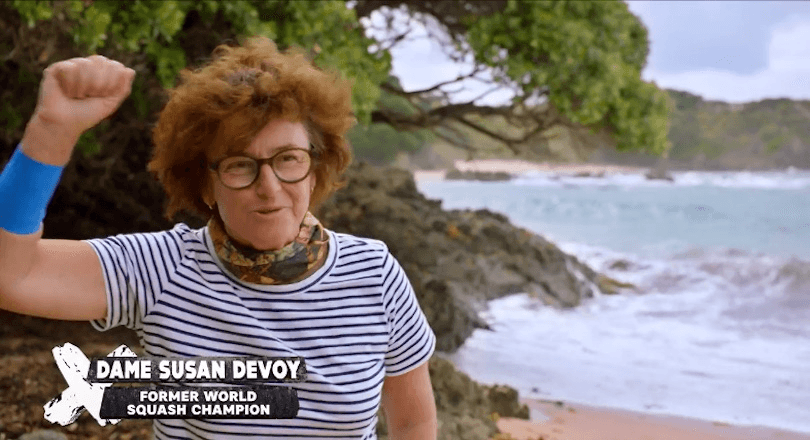
Indeed, the most memorable moments from the new era all appear to have arisen from this approach. In 2024, Duncan Garner had one of the most dramatic Outward Bound-style transformations in CTI history, emerging a changed man. “It’s a detox in life, social media, internet, this game brings you right back to the basics of life,” he said at the time. Dame Susan Devoy also provided one of the biggest character reveals in recent memory, with the squash world champ turned race relations commissioner revealing herself to be a total foul-mouthed riot.
‘We’ll be fighting for our existence’
But even the most memorable moments of television gold don’t always equal money. ”Unfortunately, all local television shows are struggling in this super tough commercial landscape,” says White. “The reality of keeping any long-running show in New Zealand going at the moment is that you’re constantly having to make a case for the existence of the show.” Last year, that reality was laid bare when NZ On Air’s factual round included funding for two major reality franchises in The Traitors NZ ($1,436,911) and Celebrity Treasure Island ($1,349,000).
And while it was a decision met with online outcry by critics who dismiss reality television as “trash” and “junk”, White says funding support from the likes of NZOA and NZFC is crucial in supporting the local screen landscape in all its forms at the moment. “Without it, New Zealand audiences would only be watching Australians, Americans and Brits,” she says. “Public funding exists to support New Zealand stories told by New Zealanders that reflect who we are and create shared cultural moments, and I think Treasure Island ticks all of those boxes.”
A quarter of a century into the franchise, the future of Celebrity Treasure Island may look as precarious as a ball at the end of Polly Gillespie’s paddle, but White says they are more than ready for their own elimination battle. “We’ll be fighting for our existence in the future, and I’m sure we’ll be fighting for our existence even later this year,” she says. With just two weeks to go in this year’s highly-charged emotional season, White hopes the legacy of the show is this: “You can have it all. You can be a New Zealand show, you can have the big audience appeal, and you can still be a cultural moment.”
Celebrity Treasure Island airs Monday-Wednesday on TVNZ2, and here on TVNZ+