Review: Synthony was at once joyous and a bit depressing

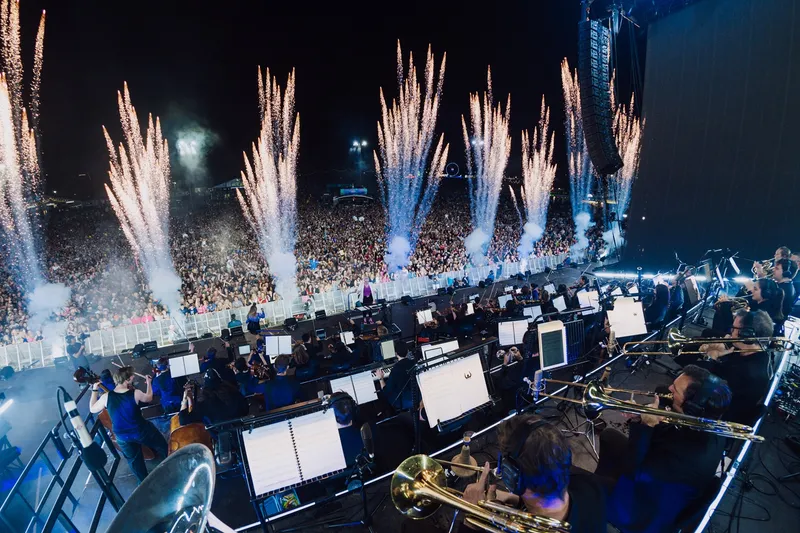
Holy cow there were a lot of lasers and pyrotechnics at Synthony. (Photo: Radlab)
The festival features some amazing musicianship. It can also feel like the world’s most elevated school disco.
One of the best parts of Synthony came near the start, as the still-sober crowd was trickling in and sourcing its first rounds of drinks and drugs. Kaylee Bell delivered a rendition of her 2024 hit ‘Cowboy Up’ early on in the day’s second set. It was rousing, fun and enthusiastically delivered by the fluro-pink clad Canterbury country singer, even if lyrics like “heel toe and round we go” are more tailored to a line dancing convention than an audience of EDM fans. It was also one of the only songs performed over the next six hours that was written within the last decade.
Synthony at the Auckland Domain is New Zealand’s biggest one-day music festival. About 40,000 people showed up to see the eponymous “collision of the biggest electronic dance anthems with a live orchestra” on Saturday, edging out the 36,000 who went to Laneway down the road in Western Springs. This time the orchestra was supported by a host of acts including international headliners Faithless and Peking Duk, along with local staples like Shapeshifter.
As a former folk singer who’s spent much of his life being aggressively sad, I have more in common with The Spinoff’s Alex Casey, who once wrote an article headlined ‘I still don’t know what Synthony is and at this point I’m too afraid to ask’, than with the people who paid $120+ to throng the fields below the Auckland War Memorial Museum. Generally I prefer my music to induce deep existential angst rather than ecstatic dancing. This is an outsider’s perspective.
But Synthony has built up an almost cult-like following since its first ever show at the Auckland Town Hall in 2017. It’s beloved not just by EDM hardouts but by an eclectic audience which includes everyone from teenagers to 60-year-old bank managers. Could it win me over?
Sort of. The festival felt at once joyous and depressing, awe-inspiring and dispiriting. The joy started with the Auckland Philharmonic Orchestra, which acted as backing band for the set of EDM classics in the day’s headline concert. Though Timothée Chalamet recently gave ballet and opera a terminal diagnosis, at Synthony the philharmonic showed aging artforms don’t have to lay down and die quietly. They can adapt. In a rotating cast of acclaimed guest artists and soloists, its conductor, Sarah-Grace Williams, was the star of the show. She deftly manoeuvred her instrumentalists through a surprisingly technical, pyrotechnic-infused set, displaying a heap of emotion while still acting as an anchor of calm in the middle of the chaos.
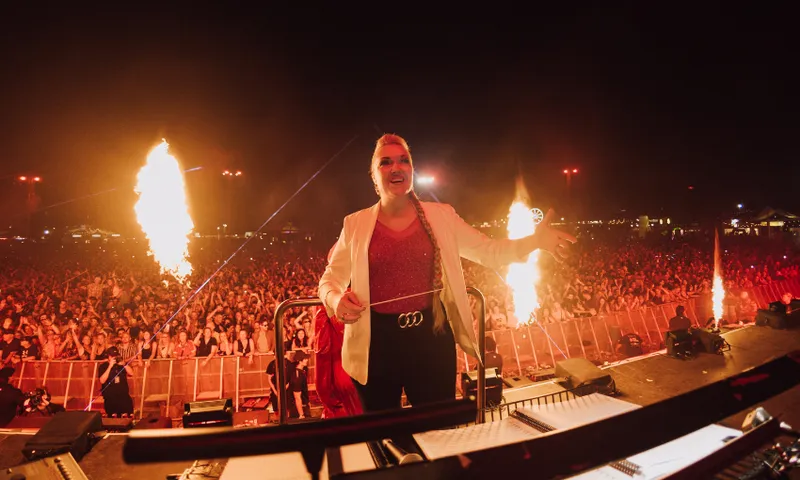
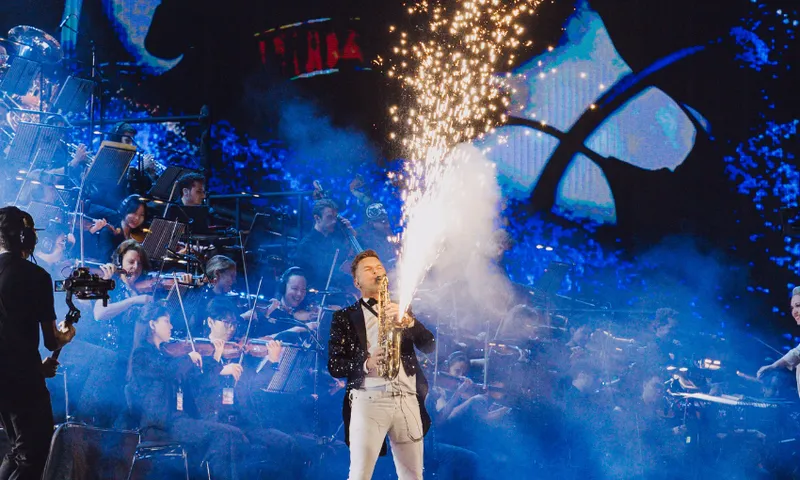
Under Williams, the philharmonic showed how a big, butty brass section can add heft to the pounding bassline of a song like Calvin Harris’ ‘How Deep Is Your Love’. It demonstrated how sweeping strings can elevate the iconic synth lines of Darude’s ‘Sandstorm’ or Robert Miles’ ‘Children’. Most impressively, it conclusively proved that you can make sparks come out of the bell of a saxophone when it plays high notes in a solo.
If the orchestra members were Synthony’s Ripples ready salted chips, the guest vocalists were the Kiwi onion dip. Devilskin’s Jenny Skulander could have a claim to being New Zealand’s best singer, belting out Avicci’s ‘Levels’ with enough raw power to make your eyeballs wobble in your skull. Still, former X Factor contestant turned international pop star Cassie Henderson may have eclipsed her. Her second guest vocal of the night, 1996’s ‘Freed From Desire’, was a highlight.
Henderson nailed Gala’s hypnotic “nanananananas”, but it’s worth noting the song was first released two years before she was born. Thanks to our crippling cost of living reality and increased touring costs, musicians have increasingly been leaning on nostalgia to sell tickets. Every few months, you can see some of the country’s best musicians and songwriters cover albums from classic rock bands in the Come Together concert series. There’s an economic logic to these shows. The only people with any disposable income these days are 50+ years old.
Synthony is part of the trend. At least 70% of its attendees looked to be north of 40. Most of the time, it made for harmless elder Millennial, Gen X and Boomer fun. Still, there were moments when the festival felt like being trapped in an elevated version of a 90s school disco.
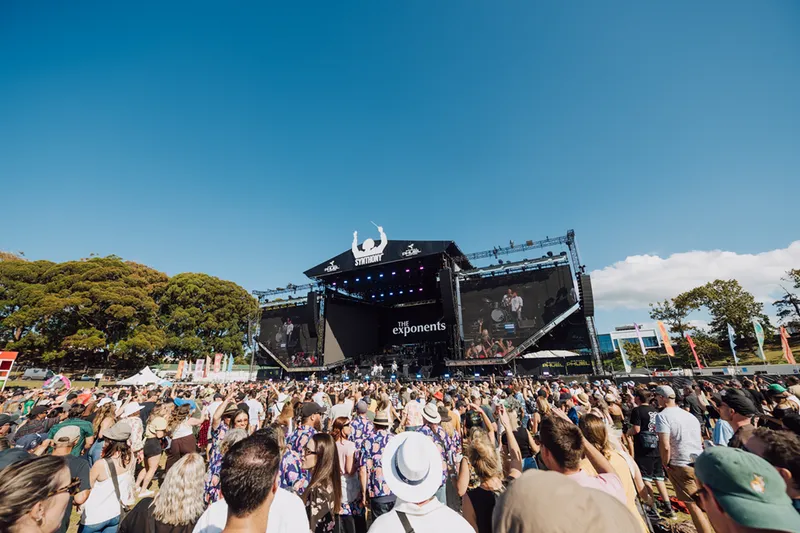
If the philharmonic was extending out of its comfort zone to win fans, it seemed some bands were relaxing back into theirs. Shapeshifter, The Exponents and The Black Seeds delivered enjoyable sets composed almost entirely of past hits. Peking Duk, particularly vocalist Adam Hyde, had a magnetic stage presence. But the duo’s set was at least half remixed classics from the 70s, 80s and 90s.
They weren’t the only ones performing a kind of Solid Gold FM for people on MDMA. Synthony’s performance was jarringly interrupted by an unadorned acoustic singalong of Oasis’ Wonderwall. The night’s nadir came straight after the orchestra got off stage, when Hot Dub Time Machine took the crowd through a cringe-inducing medley of pop hits. DJ Tom Lowndes turned the volume down on his deck to try to get the crowd to sing to ‘Don’t Dream It’s Over’. When that failed, he tried the same on ‘Sweet Child Of Mine’. The feeling of being imprisoned at your uncle’s birthday party only amplified when he started repeating songs from earlier in the evening, including a version of ‘Freed From Desire’ sans Henderson or anything else interesting.
Thank God then for Faithless. The veteran British duo was the last act of the evening. Even if they were technically a nostalgia act too, they felt creatively a cut above anything that came before, delivering a dark, pulsating, immersive set mostly uninterrupted by repeated demands to “make some noise”.
We left after they played their biggest hit, 1997’s Insomnia. As we filtered out toward the free buses Auckland Council had provided from outside the museum, we walked past the Pepsi DJ Stage, where a dance remix of ABBA’s ‘Gimme! Gimme! Gimme! (A Man After Midnight)’ was booming out. I recognised it because it was in Hot Dub Time Machine’s set an hour earlier. The thing about nostalgia is there’s limited material. Eventually you have to create something new.

Hayden Donnell
Hayden Donnell is a senior writer for The Spinoff. He previously worked at RNZ, TVNZ and the New Zealand Herald, alongside other media companies that have since closed down or been renamed. His primary passions are local politics and the Big Fresh animatronic fruit and veggies.


