Budget 2026: Everyone wants to cut costs until it’s their own

David Seymour and Winston Peters are all for fiscal discipline and hard choices, just not when it comes to their own ministries.
David Seymour was fizzing as the government announced 8,700 public sector job cuts earlier this month. “Fewer departments, fewer bureaucrats, and the public service sucking up less taxpayer money is just what the doctor ordered,” said Act’s leader, in his party’s first press release on the move.
That hardline stance softened a few days later, in an RNZ interview on a new report from Seymour’s Ministry of Regulation, which shows we have 267 regulatory bodies. When Midday Report’s Guyon Espiner pointed out that Act had contributed to that number by setting up a new charter school agency, Seymour was suddenly less bullish. “What you’re saying here is a false premise that everything named in this report is somehow bad or shouldn’t be there,” he replied.
Seymour went on to defend the “specialist” work being done by that agency’s staff, along with the return on investment from his own Ministry of Regulation, which has boasted some of the highest salaries in the public sector over the last two-and-a-half years. “It’s very clear that the value to taxpayers in removing red tape… far exceeds the cost that has gone into it,” he said.
Act’s leader isn’t alone in having a more generous perspective on the departments he’s connected to. New Zealand First leader Winston Peters successfully negotiated a carveout from the cuts in this year’s budget for the foreign service. Though it’s still subject to reductions in future years, Peters scoffed at the suggestion those projected job losses will actually materialise. “The budget doesn’t stretch four years, if you believe that [the cuts will take place] with an election coming, you know nothing about democracy,” he said. “That’s knucklehead stuff, mate.”
Our diplomatic corps will be breathing a sigh of relief. Not so other workers, who face losing their roles after New Zealand First joins Act and National in approving the budget on Thursday.
Louise Upston will be among those casting their vote in favour of the budget in parliament. The social development minister is also getting in on the cost-cutting drive with a bill slashing government accommodation support for low-income households. Currently they can claim a supplement if they spend at least 30% of their income on housing costs. Upston is seeking to up that to 40%.
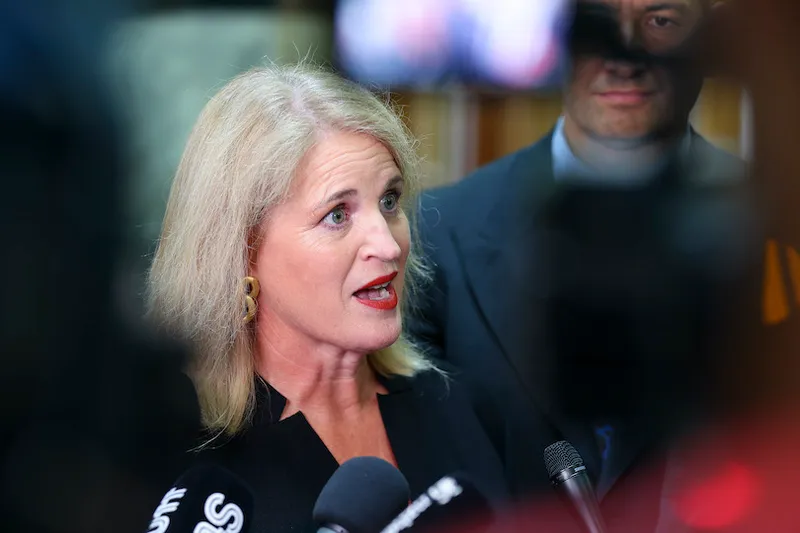
Upston has defended the move, saying the eligibility rules for the supplement haven’t been updated in 33 years. At the same time, she’s taking advantage of another decades-old accommodation support scheme, claiming $1,000 a week to live in Wellington as an out-of-town MP despite parliament’s pecuniary records showing she jointly owns an apartment in the city.
The records don’t show any mortgage debt for Upston, so it’s unlikely she’s paying more than 40% of her $320,000 salary towards housing. Despite that, the government hasn’t shown similar interest in updating the eligibility rules for its own accommodation support scheme.
Perhaps the government would say the savings from adjusting its own rules would be small in the scheme of things. Peters might claim the foreign service needs stable funding to keep us “safe and prosperous” in an increasingly unstable geopolitical climate. Seymour would argue his own ministries’ staff are difficult to replace and generally make a cash-positive contribution.
But all those arguments could be applied elsewhere too. Inland Revenue would probably view the value-for-money argument with some interest, given it collects $100 in tax for every 46 cents invested in its operations. The Ministry of Business, Innovation and Employment and the education ministry may think they have a role in keeping us prosperous. The corrections and justice departments could say they’re keeping us safe as much as the foreign affairs ministry.
Low-income families, meanwhile, might ask why they’re being asked to sacrifice for relatively paltry savings, while the high-paid elected representatives making those cuts retain the most generous government benefits on offer. They could wonder why, when it comes to our politicians, it almost always seems to be nuance for me and tough economic necessity for thee.
Perhaps they’re just too far from those politicians’ inner circles. It’s always easier to wield the bludgeon rather than the scalpel when it only affects someone you don’t know.
The issue is wider than budget cuts. Back in 2023, New Zealand First deputy leader Shane Jones appeared on RNZ’s Mata, where Mihingarangi Forbes asked him about NZ First’s efforts to ban trans women from female bathrooms. “I’m surprised that women themselves have allowed this virus and this narrative of trans rights to essentially trump womanhood,” he said.
But when Forbes brought up Jones’s old colleague Georgina Beyer, asking him whether he’d force her to go to the bathroom with “you and Winston”, the bluster dissipated. “I have no recollection of Georgina ever raising those kinds of issues,” he said. Perhaps he was worried that enacting his policies on a real, rather than theoretical, person would seem cruel. If the same empathy could be applied across the board, it might improve our politicians’ decision-making.

Hayden Donnell
Hayden Donnell is a senior writer for The Spinoff. He previously worked at RNZ, TVNZ and the New Zealand Herald, alongside other media companies that have since closed down or been renamed. His primary passions are local politics and the Big Fresh animatronic fruit and veggies.


