Thanks to The Odyssey, Auckland’s Imax is having a moment. Could it be its last hurrah?

Imax, through the ages (Design: The Spinoff)
Its early days were marred by empty seats and a debt-forced closure, but now, 27 years since opening, New Zealand’s biggest movie screen is more popular than ever as The Odyssey draws record crowds. But with the building that homes it in disrepair, and rumours of a soon-to-expire lease, is it living on borrowed time?
He remembers the 3D cleaning machine that didn’t work, the hair that needed picking out of the reusable headsets by hand. He recalls the movies, mostly short, plot-less documentaries about nature, space and extreme sports. And he mentions the barrier straps for crowd control that he never used. “It was the easiest shift to be assigned,” says Jim, who asked to go by a pseudonym. “It was a great place to work.”
That’s because no one came. When Auckland’s Imax theatre opened in 1999 as part of the Sky World complex on Queen Street, screenings in the 440-seat theatre offering the country’s biggest movie screen were so poorly attended it often didn’t need cleaning. “Some sessions we wouldn’t even bother taking the dustpan through because they were so empty and we knew the place would be tidy,” says Jim, who worked there for two years.
The writing was on the wall for Imax’s epic Aotearoa adventure almost from the start. The movies it showed were mostly plot-less documentaries. They were too short, and audiences too small. It was treated as a novelty tourist attraction, a “once and done” experience, remembers local film guru Ant Timpson. Debts quickly spiralled and Auckland’s sole Imax theatre spent several years shuttered in the early 2000s.
Visit that same Imax cinema right now and you’ll find packed screenings full of fans frothing over Christopher Nolan’s The Odyssey, the first full-length blockbuster shot entirely on Imax cameras. Nolan has demanded fans see his three-hour epic on the biggest possible screen, and those fans have listened. Queen Street was Event Cinemas’ most popular theatre on The Odyssey’s opening weekend, a spokesperson confirms.
The question is – as the building around it seems to fall further into a state of disrepair, as just this week insects infested screenings, and as, The Spinoff understands, the cinema’s lease nears expiration – how much longer can Auckland’s Imax survive?
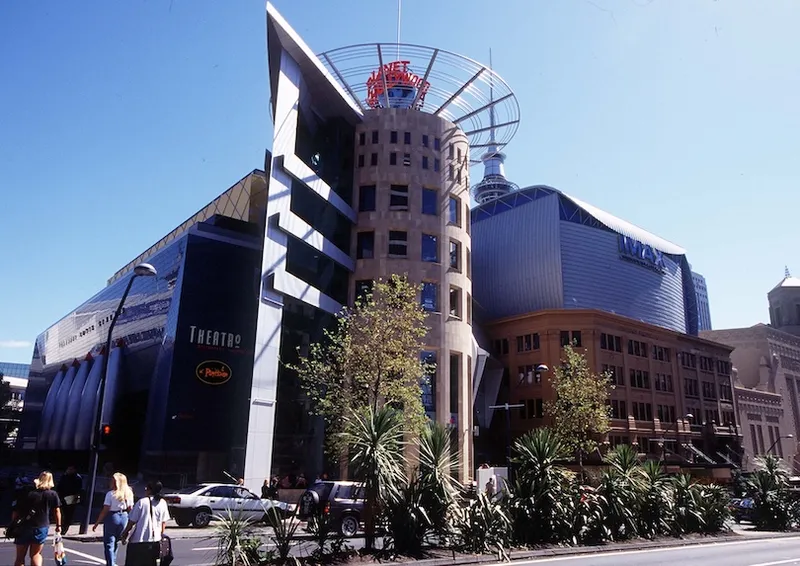
Twenty-eight years ago, Imax’s Aotearoa adventure was almost over before it began. It wasn’t in the plans. That space on Sky World’s third level was reserved for offices and a boutique hotel. Visitors would be able to spend the night “inside the building”, remembers Sky World’s architect Ashley Allen. Construction was about to begin in 1998 when Allen was told Cinema Plus – the movie company that had opened three Imax screens in Australia to roaring success – wanted that space.
So Allen quickly flew to Sydney, toured its Imax theatre, returned home and drafted plans for a 440-seat, five-storey cinema so tall it would poke out of Sky World’s roof. There was one issue: Allen designed a screen too big. “The Sydney people said, ‘You have to make your screen smaller than ours,’ because they’d advertised theirs as the largest screen in the southern hemisphere,’” he says. He relented. “We made it slightly smaller.”
Auckland’s downsized Imax theatre opened along with Borders, Planet Hollywood, Starbucks and the rest of Sky World in 1999. But attendance at Imax, which was a separate entity from the nearby multi-screen cinema complex, was sluggish from the start. “There was not a high repeat factor once you’d been once,” says Timpson. “I think Kiwis didn’t know what to make of it so didn’t really approach [it],” says Jim.
Both blame the lack of interest on the small selection of Imax movies available at that time. The same films played month after month, and with just six films screening a year there was little variety to inspire repeat visits. Documentaries aired about Sydney, California, Mount Everest and Egypt. Extreme was a 40-minute compilation of surfing and rock-climbing footage that could induce motion sickness.
Most Imax movies around this time were short out of necessity. Film stock for Imax costs far more than the normal letterbox format, and cameras are bulky, heavy and loud. Because most films didn’t have a plot, Imax movies felt like “tech demos”, remembers the local film and TV critic Karl Puschmann. Jim agrees. “The look on some people’s faces when exiting was very much, ‘OK, well, that can be crossed off the list.’”
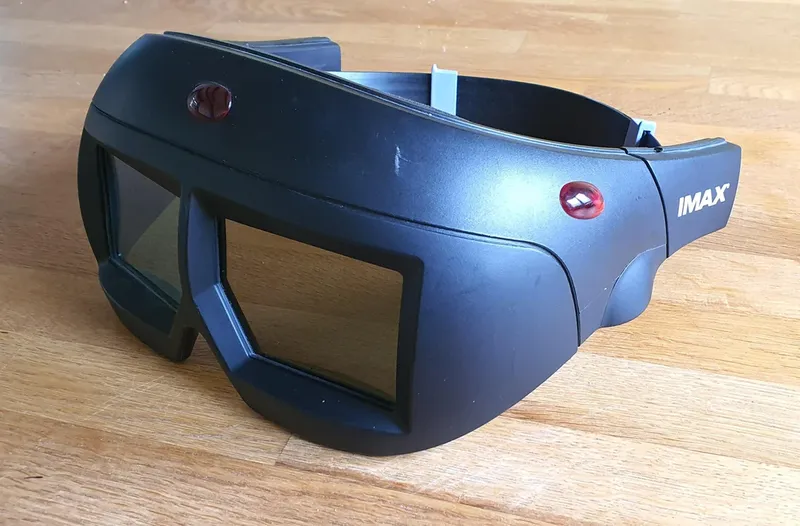
Other initiatives attempted to draw in more customers. School trips helped fill seats during the day, and 3D experiences like the animated Cyberworld triggered a sense of awe. Film critic Dan Slevin calls those 3D experiences “incredible”. Puschmann loved them too, but remembers the “heavy-ass” goggles ticketholders were forced to wear. Jim has less fond memories. “The 3D glasses cleaning machine was so ineffective that we ended up just using wet wipes,” he says. “I’ll never forget picking long hairs out of the head straps.”
By 2002, the lack of interest had taken a toll. Imax’s debts had spiralled to $200 million, reported the Herald. The cinema was shuttered amid calls to turn it into a theatre for live shows. What happened in the following four years is a mess of buyouts, mergers and acquisitions. A press release about its 2006 reopening, now combined with the cinema complex, includes this impenetrable boardroom-speak sentence: “Village SKYCITY Cinemas is a joint venture between SKYCITY Leisure – a subsidiary of SKYCITY Entertainment Group, one of Australia’s leading entertainment and leisure companies, and Village Roadshow.”
By then, Imax was able to deliver full-length movies. That press release also touted “an exciting pipeline of digitally remastered Hollywood movies in both 2D and IMAX(R) 3D”. It was true: blockbusters Transformers, Beowulf, and Superman Returns all aired in Imax. Sometimes, the experience was awkward: for Harry Potter and the Order of the Phoenix, cinema-goers were instructed to put their 3D goggles on for the last 20 minutes. But by 2008, Nolan had started experimenting with Imax cameras. The Dark Knight included 30 minutes of footage using the full height of the Imax screen.
Imax seemed to have found its groove here. But by 2013, more problems arose. By then, the screen was nearly 15 years old and needed replacing. That meant opening a trap door in Sky World’s roof so a helicopter could lower a new one down. It also meant the cinema’s 70mm projector was replaced with digital projection equipment. “It’s easier to handle a computer disk than assemble up to half a tonne of 70mm film for a single feature,” projectionist Bruce Blackley told NZ Herald. (That statement will probably anger all those fans travelling to see The Odyssey in one of the 41 Imax cinemas still able to play it in that 70mm format.)
By the end of 2016, Imax’s new landlord James Kwak, who purchased the building in 2011, was having issues with Auckland Council. Sky World was deemed a dangerous building by Auckland Council over “inadequate fire safety systems”, reported RNZ. A bizarre agreement was reached: “human smoke detectors” – that’s security guards periodically sniffing the air – were placed in every cinema, including Imax, for five months. It cost Kwak $15,000 per day, RNZ reported.
The drama was followed closely by then RNZ journalist Zac Fleming, who doorstepped Kwak at the top of his own escalator, near the Imax theatre, and attempted to ask him questions about the state of his building. During a brief exchange, James Kwak appeared to deny he was James Kwak. Fleming’s resulting short film (the Kwak escalator encounter is about 10 minutes in) is surely among the finest pieces of video journalism made in this country, right up there with Tova O’Brien’s “Is Paul Goldsmith Māori?” gotcha.
This weekend, The Odyssey’s record-breaking run at Imax seems set to continue. “Advance bookings have been particularly strong, with many Imax sessions selling out shortly after being released,” an Event Cinemas spokesperson said. When The Spinoff checked, only the worst seats – right at the front, or in the aisles on the side, those requiring an osteopath to fix your neck afterwards – were available this weekend.
Cinema fans are making the most of it. They need to. While putting together this story, The Spinoff heard from three different sources that Event Cinemas’ Sky World lease expires in 2028. A spokesperson didn’t respond to multiple requests for comment. But the ongoing decay of Sky World, including an insect plague that infiltrated screenings this week, may impact that decision. “Because of the issues in the building, they may not want to keep it,” says Allen.
Insects won’t put Ant Timpson off. He’s yet to see The Odyssey because he’s waiting for his seat, the only one he’ll ever use inside the Imax theatre, to become available. It’s an aisle seat, smack bang in the middle, two rows from the back. It is, he says, the perfect vantage point to take in the country’s biggest screen. “I only go see films there with true Imax aspect ratio,” Timpson says. “Everything else ain’t the real deal.”
*Name changed to protect identity.

Chris Schulz
Chris Schulz is a contributing writer at The Spinoff. He's an award-winning journalist from Tāmaki Makaurau who has spent 25 years working for local publications. His specialties include live events, pop culture, infrastructure and Aotearoa music.


