What do you do if there’s a Nazi flag in your neighbourhood?

Image: Getty. Additional design by Tina Tiller
After a startling experience on a suburban stroll, Alex Casey checks in with the experts about our attitudes to Nazi memorabilia in 2025.
It always astounds me what one can stumble upon on a humble suburban walk. In my time plodding around various corners of Christchurch, I have encountered such baffling scenes as 10 empty packets of Mexicano corn chips, laced through a chicken wire fence in a perfect line. I have seen a car adorned with “SLUT” in grape purple spraypaint. I have seen a plastic baby doll, limbs twisted in macabre directions, drizzled in what can only be described as honey.
All of these horrors, and yet nothing even comes close to the Nazi flag. It wasn’t quite flying up a flagpole, but it was very much hanging on display inside someone’s property. Their front door had been left wide open as I idly wandered past, my eye instantly drifting to the bright red fabric, the white circle and black swastika within. Dizzy, I paused my podcast, steadied myself, and looked back again. Surely that couldn’t be what I was looking at in 2025.
Over the coming days I became riddled with doubt, trying to convince myself that I had just misinterpreted a Klingon flag, as locals once had in Wānaka. Still, I couldn’t shake the bad feeling in my stomach. It had reminded me of the swastika I saw carved into a local park fence, the same symbol etched in ink onto the bald head of a man browsing our local supermarket aisles. What do you do if you come face to face with Nazi stuff in your neighbourhood?

Professor Paul Spoonley, who has researched and written about far right extremism for decades, tells me over email that there’s not much an individual can do if they see Nazi memorabilia on private property. “It is offensive but does not breach the Human Rights Act, and there are no grounds for considering it incitement,” he says. “I do think it is important not to stay silent but to let someone know – the police, perhaps local councils or the media.”
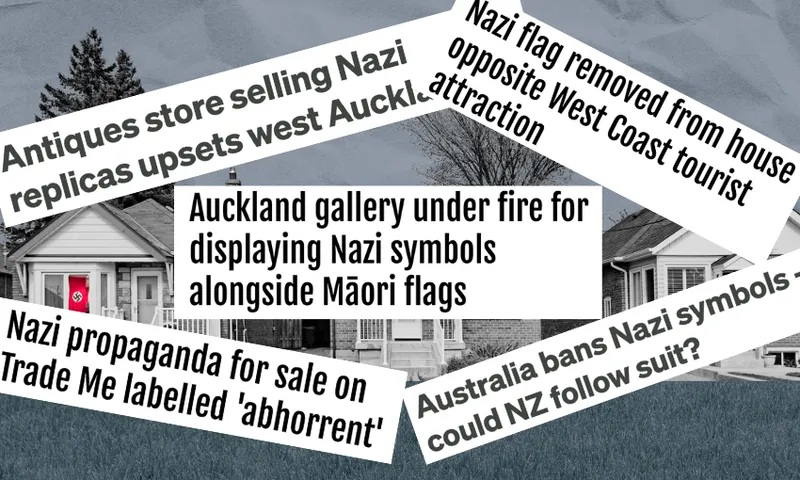
Indeed, there have been many headlines over the years about galleries coming under fire for displaying Nazi flags, as well as local antique stores, auction houses and Trade Me causing outrage by selling Nazi memorabilia. In 2020, a large Nazi flag hanging on an Ōtira property next to a popular tourist location was removed after complaints. In 2021, NZ Herald reported that prominent far right activist Kyle Chapman was selling plastic Nazi toy figures online.
In many parts of the world, it has long been illegal to display Nazi insignia, sometimes even in private. Unsurprisingly, some of the strictest laws are in Germany where the production and distribution of any Nazi material, including the swastika, comes with a three-year prison term or a hefty fine. Closer to home, the Australian state of Victoria introduced a ban on Nazi symbols and gestures “in a public place or in public view” in 2023.
In 2024, during the crackdown on gang patches, David Seymour said that he was not in favour of a ban on swastikas. “I hate those symbols and salutes, but I quite like knowing who the idiots in society are, and if they’re prepared to self identify like that.” When asked by RNZ about why he held a different position on gang patches, Seymour said, “people are genuinely intimidated by seeing certain gang patches and symbols.”
Spoonley says that Aotearoa has “long had a reluctance” when it comes to banning Nazi material. Following the Christchurch mosque attacks in 2019, he wrote that our innocence about such extremist politics might be dislodged. In 2025, he’s not sure that it is. “I think most New Zealanders are uncomfortable with the presence of Nazi symbols… but I do not think that they understand the threat associated with such extremist political views,” he says.
“Even though we are talking about basic symbols such as a flag, we need to recognise the possibility that the individuals or groups represent a threat.”
Byron Clark, author of Fear: New Zealand’s Hostile Underworld of Extremists, agrees that the March 15 attacks were a “big wake up call” for Aotearoa. “That confirmed that this extremist ideology was definitely here, that it wasn’t just an American or an European thing,” he says. And while he wouldn’t be surprised if what I had seen on my walk was indeed a Nazi flag, Clark adds that the modern alt right tend to opt for more subtle symbols these days.
“A lot of the alt right now try and distance themselves from that imagery and that ideology,” he explains. “So they won’t use those explicit Nazi symbols, but will instead create new symbols or appropriate symbols like the New Zealand flag or even the Anzac poppy.”
And while a ban on New Zealand flags and Anzac poppies would be impossible, Clark agrees with Spoonley that Aotearoa appears reticent to enter the debate about Nazi memorabilia. “I think there probably aren’t many politicians who really want to touch it in the current environment,” he says. So for now, since it’s not illegal in New Zealand, if you ever catch a flash of red and white with black lines in your neighbourhood, just hope it’s a Klingon flag.

Alex Casey
Alex Casey is a senior writer at The Spinoff with over a decade of experience writing about popular culture and social issues in Aotearoa. She lives in Ōtautahi and likes watching reality TV and walking the dog, occasionally at the same time.


