‘It was 10 years of work, all in one moment’: Wellington’s kiwi are now truly ‘free range’

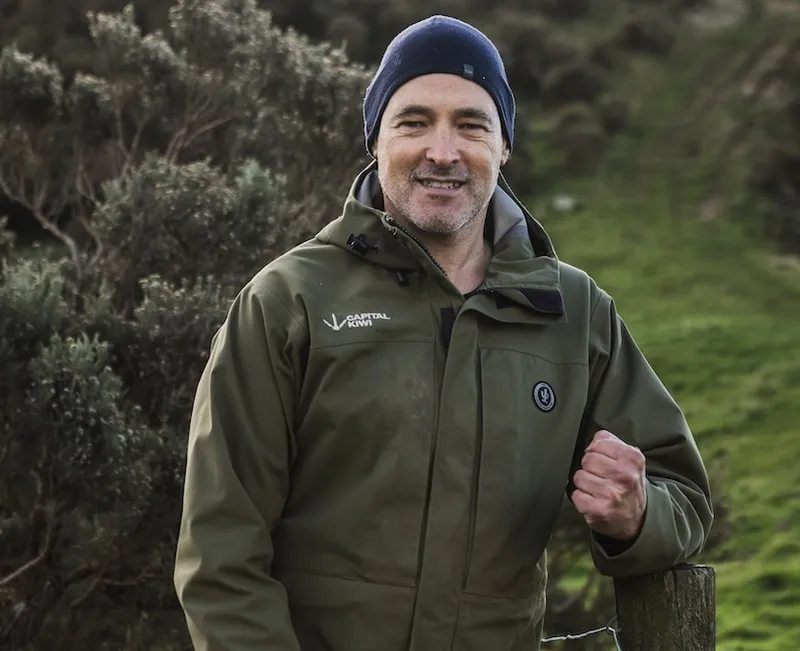
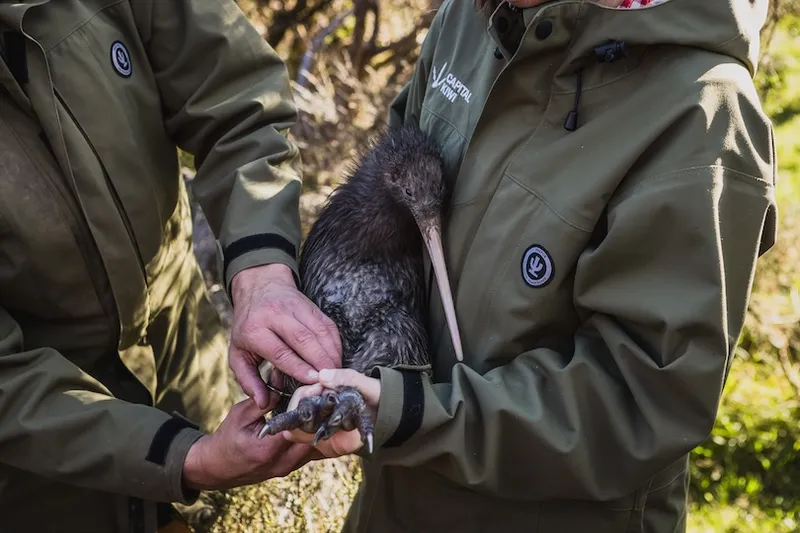
The big moment. (Photo: Caleb Smith, for the Capital Kiwi Project. Image design: The Spinoff)
The Capital Kiwi Project has just marked a major milestone: the final monitoring transmitters have been removed from the 250 kiwi released in the hills around Wellington. Founder Paul Ward tells Shanti Mathias about what it took to get there, and what comes next.
Tell me about taking the final transmitters off. How did you feel?
It’s a bit like taking off a cast: there’s a mulchy, fetid odour under the transmitter. That aside, it was incredibly special. It was 10 years of work, all in one moment. They’re now free range and uncaged. It made me think of when a child leaves home – it’s sad to lose that contact, but also so sweet because it enables these kiwi to be wild, as they have been for 80 million years.
How did the project begin?
Ten years ago, we pulled out a map and looked at the land south and west of Wellington city. It’s mostly privately owned, there is no big regional park. To do this we had to get landowners on board for support. We also couldn’t have done it without the support of Ngāti Toa and Taranaki Whānui. We had lots of meetings in Mākara and Ōhāriu community halls.
In 2018 we got the first traps – 5,300 traps from Pariwhero Red Rocks in the south to Porirua in the north. We had to run that for three years and meet a number of metrics to show stoat numbers were low enough to bring kiwi back. In 2021 and 2022 we had conversations with sanctuary sites and iwi, and the first kiwi were released in November 2022.
Adult kiwi are strong birds with huge claws, and kiwi have a massive egg, too big for a stoat to get its jaws around. Where kiwi get hammered is in between hatching and getting to fight weight, around one kilo. With no pest control, 95% to 100% of chicks fail to get to that weight. The challenge for kiwi conservation 25 years ago was to figure out how to get those chicks to the point they could look after themselves.
The ambulance at the edge of the cliff approach was to uplift eggs, remove them from danger, incubate them in the facility before returning them to the wild. On a bird-by-bird basis it’s successful, but it’s the bird equivalent of intensive care: expensive and invasive. And the pest-free spaces (islands, fenced sanctuaries) where kiwi have been protected were running out of room – in ecological terms, they were reaching carrying capacity.
For the population to grow, you need 20% of chicks to survive. In the project’s DOC translocation permit, we had a target of 30%; for the first 20 chicks we monitored, if six survived, we would be succeeding. The first chick we monitored died, which we knew could happen, but it really added to the emotion last week, taking off those final transmitters.
People aren’t used to thinking about conservation in those terms – that success means some will die.
We were set the goal of 30% survival, and hoped it would be higher, maybe 45% or 50%. But after three years of monitoring more than 5,000 hectares, several dozen chicks – over 90% – survived. We’re pretty proud of those stats.
You said that this is a landscape of farms and wind turbines, not ancient rainforest or a national park. What are the kiwi eating?
Kiwi can live everywhere from sand dunes to snow, pine forests and scrub. That long bill with nostrils at the end is the ultimate kai-detecting device. They eat worms, cicadas, grubs, small eels, huhu, wētā. They’re like humans – not fussy eaters. In modified environments like farms and pasture, in regenerating scrub and mountain bike parks, there is heaps of food, so much that the kiwi chicks were reaching fight weight in four months rather than six or eight, which was the standard. It’s like they had been at all-you-could-eat pizza night.
The intense kiwi conservation had made people think that kiwi were these fragile birds. But they’re incredibly adaptable.
Yeah, exactly. It’s not necessarily the same story for some of the little birds, like hihi or tīeke. But for big birds with varied diets – Wellington’s kākā crossing the fence from Zealandia was a real proof of concept. If predators are controlled, it doesn’t take much to turn the dial from extinction to thriving.
The transmitters are off now, but what kinds of ongoing monitoring are you using?
When I tell people about the transmitters, they ask, “So how will you know how they’re going?” We just have to be confident in other metrics. Our goal is for the birds to be wild and able to live freely on their own terms, not be poked and prodded by us. The results of the intensive monitoring are strong enough to give us the confidence to shift to less invasive methods.
We’re continuing with tracking tunnels and trail cameras to look for stoats. When we do catch stoats, we use DNA to find out if it’s a resident stoat or an invader. We also do population monitoring with acoustic monitors, to listen for kiwi calls. AI helps to analyse the results. We’re training community members to do call surveys.
And of course there’s heaps of ongoing trapping, dozens of community groups. It’s a big shift to make that mahi sit with four-wheel-drivers and mountain bikers, not something that happens because of DOC. Kiwi are cryptic, they’re nocturnal, so it’s not about people in Wellington seeing kiwi, although it’s great when that happens. It’s about a shifting relationship to nature as a whole. We’ll have those moments sometimes, people seeing a footprint in a cowpat with big fighting claws – like a dinosaur footprint, but right next door.

Shanti Mathias
Shanti is a contributing writer at The Spinoff with a focus on Christchurch and the South Island. Email her at shanti@thespinoff.co.nz


