After 20 years in NZ, I feel like a tourist when I go home to the UK

Kathy Young (Photos: supplied)
What happens when home is two places, more than 20 hours apart.
It begins at Heathrow’s baggage reclaim. Everyone stands right up against the belt, a wall of shoulders and trolleys, so nobody can actually see their bag until it’s already squeaked past and you have to lunge across two strangers to grab the handle.
Belt 8 has been flashing our flight number for 10 minutes but nothing’s moving on it, and a single ground handler in a hi-vis vest shrugs when someone asks. It all feels grey and faintly broken. Once I’m finally through arrivals, I look for an information desk, but don’t find one. The signage points to an exit that turns out to be closed and one of the lifts is out of order. I think, how did I ever live here? I’m here for a fortnight, that’s all; I can cope.
I moved to New Zealand, freshly married, 20 years ago. I’ve lived here long enough that people tell me my vowels have shifted, and that I say “togs” and “tramping” and “eh” without thinking. Long enough that the bush feels like home, and the sheer space of it feels like the way things are supposed to be. But not so long that the United Kingdom has stopped being mine in some cellular, pre-verbal way. As a friend once told me, I’m a Briwi – half British, half Kiwi. A blend. A little of both. And a little of neither.
Being a dual citizen means you arrive back in the UK with two sets of eyes, and they don’t always agree.
The tourist eye sees the unfamiliarity: The Elizabeth line on the London Underground. When did that happen? The new shops standing shoulder to shoulder with old faithfuls like Tesco and Marks & Spencer. I have to look up what the ULEZ signs mean.
I’m not used to how cramped everything is. The houses, the rooms, the parking spaces, the roads. Where I’m staying in Surrey, the lanes are so narrow and the oncoming traffic so confident that I genuinely fear for my life as I’m driven past the enormous houses and the cricket greens and the George Cross flags strung from the odd window for the World Cup.
My visit includes family trips to a National Trust property and a Royal Horticultural Society garden. And I’m struck by the sheer institutional weight of heritage here, the volume and scale of it, making New Zealand feel very young, very thinly painted onto its land. Very new.
Then my local eye opens, and I see things tourists don’t see. Like the ambulance siren that’s pitched ever so slightly higher than the one I’ve got used to in New Zealand. There’s the wood pigeons in the mornings, with their coo so different to the kerūru. I know the smell of a Sainsbury’s in-store bakery the moment the doors slide open. I know to watch the lawn at dusk for badgers tearing it up. I know Marmite. I know which Marmite.
It occurs to me that belonging to a place isn’t only about the deep history you share with it. It’s also about the current references – what everyone’s watching, the latest political scandal or meme, and the latest fad. When you’ve been away, you keep the historical references but you lose the current ones, and that’s the gap that gives you away. You’ve grown up somewhere and still feel out of the loop, because the loop has moved on without you. You feel closest to the references you live inside day to day, wherever that happens to be. And over time, those grow.
I’m a local in the past tense and a tourist in the present one, and the two of me are walking around the same streets having quite different days.
There’s a heaviness in England this time. Friends keep telling me they’ve had enough – of the cost of things, the politics, a sense that the place has stopped fighting its own corner. I can see the discontent but I have no real standing to join their complaining. I don’t pay tax here. I don’t queue for the GP. I get to have opinions about the place, then fly home to a different hemisphere and grieve, instead, the fact that New Zealand has its own poverty, healthcare and housing issues.
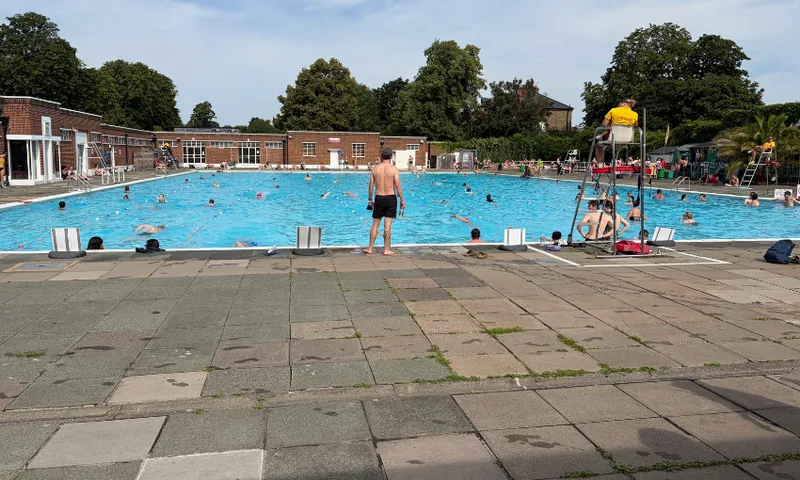
London feels different to Surrey. It’s vibrant, full and gloriously diverse, and the capital’s melange of cultures and faiths and colours and leanings wakes me up. Planes overhead. Cars beeping. Queues for coffee, ice cream, tickets and drinks. Queues for everything, because New Zealand’s population can fit almost twice over into London’s (5.3m people vs 9.8m people). We visit the Brockwell Lido in Brixton one day, ticketed with a timed entry, so that even at full capacity it doesn’t quite tip into a swarm, and I revel in the strange luxury of floating in cool water in the middle of a baking city. Then on the way home, we get a bus, with deep reggae bass coming from somewhere, carnival-adjacent, the whole top deck swaying and people actually smiling.
And the conversations. The thing about London is that you can say anything and no one you know will ever overhear you. It’s an anonymity that a small New Zealand town simply cannot offer, where the person at the next table may well have gone to school with your dentist. I sit with old friends, and we do a quick catch-up on the in-between years, the ones we’ve missed in each other’s lives, and then we just talk about now. Whether anyone’s going to walk the Camino this year. What we think of AI. Politics, briefly, then mercifully on.
That’s when I feel gratitude for it all. Grateful that I get to come here and see and do all of this, and then leave. I am undone by the joy that both places have a claim on me.
Here’s what 20 years in New Zealand has taught me about being half local and half tourist in my homeland: it isn’t a deficit, it’s the other way around. I’m at home twice. I get the badgers and the bellbirds. The in-store bakery and the bush. I can love a country because I can also see it clearly, the way you can only really see someone close to you once you have stood a little distance away from them. The tourist eye and the local eye don’t have to agree. They just have to both keep looking.
When my flight lifts off, headed for New Zealand and the cramped green patchwork of the UK falls away under the wing, I don’t feel that I’m leaving home, or going home. I feel a lopsided richness of having two. And being, for better or worse, entirely myself in the strange land between them.

Kathy Young
Kathy Young is a freelance writer, magazine editor and proofreader.


