We’ve forgotten what universities are for

Getty Images
With New Zealand universities facing not only a funding crisis but a philosophical challenge to their role and the value of academic freedom, the soul of tertiary education is at stake, argues OUSA president Liam White.
In 2023, during my campaign for Otago University Students Association political rep, I was approached by a first-year Italian and music student who asked for advice after receiving an email saying there was no future for either discipline at Otago. My heart sank.
It’s been a brutal stretch for universities in Aotearoa. I came into political and personal consciousness as a third-year Otago Uni student that same year, right as the sector began to unravel. Hundreds of voluntary redundancies, dozens of paper and course cuts, whole departments wrapping up, and a $128 million government lifeline just to keep the institution hobbling along in the hope of a better tomorrow.
The supposed light at the end of the tunnel looks less like hope and more like a dying flame. The government commissioned two reviews of the tertiary and science systems, both led by Sir Peter Gluckman, and then seemed to mostly ignore them. The Marsden Fund, one of our few sources of blue-sky research funding, has now excluded the humanities and social sciences entirely. The researchers best equipped to help us understand how societies adapt to climate change, technological disruption and inequality are being told their work doesn’t matter enough to be funded.
While the collective response to the 2025 budget was “it could’ve been worse”, we still didn’t get much breathing room. The government made me lose a bet with a dozen humanities professors by only putting forward a $231m cut in real terms to overall tertiary funding and cutting the cord of that 2023 lifeline. Meanwhile, operational costs keep climbing. Student fees are up 6% across the country, entrenching the user-pays model of tertiary education. Those staff who remain are stretched thinner than ever. Yet it must be said that, despite fewer staff and increasing student numbers, New Zealand universities are still producing world-class teaching and research.
That resilience should be worth celebrating, but it’s a bit like setting a land-speed record right before a crash… there’s a bigger impact coming. New Zealand universities are not just facing a funding crisis caused by fiscal neglect. We are facing a philosophical challenge to the value of academic freedom and the place of our universities.
The war on thought
Back in 2024, then deputy prime minister Winston Peters took to X to accuse the University of Auckland of being both a “woke cultural brainwashing factory” and, somehow, comparable to the Ku Klux Klan. All this because the university chose to offer dedicated study spaces for Māori and Pasifika students. Soon after, current deputy prime minister David Seymour and Act’s tertiary education spokesperson Parmjeet Parmar piled on, calling the targeted spaces “segregationist”.
Seymour’s “victim of the day” series resulted in two complaints to Cabinet, with former Wellington city mayor Tory Whanau alleging Seymour breached the Cabinet Manual requiring ministers to uphold “the highest ethical and behavioural standards”. Seymour targeted dissenting academics such as Anne Salmond, George Laking and Metiria Turei for their critiques of his Regulatory Standards Bill, dismissing their expertise as “derangement”. The irony is obvious. Those same politicians who rail against “cancel culture” are also actively attempting to silence dissenting academic opinions. This seems more like a direct intrusion into university autonomy and independence than one might expect from a liberal movement built on minimal government interference.
Peters has since declared a self-styled “war on woke”. Seymour took a similar position, claiming that those young New Zealanders who choose to stay here through this challenging economic period “are infected by universities with the woke mind viruses of identity politics, Marxism, and post-modernism”.

As far as rhetoric goes, they’re both intellectually lazy. These imported, low-rate culture war talking points are less about the policy or principles claimed and more about manufacturing resentment, seeking to take the legitimate work of equity and inclusion – an admittedly slow and imperfect but ultimately necessary attempt to build a fairer Aotearoa – into a manufactured threat to New Zealand. Ultimately, their crusade seems less about defending free thought and more about punishing dissenting or alternative worldviews.
David Seymour has carried that torch into legislation. His Education (Freedom of Expression) Amendment Bill would require every university to develop a “statement on freedom of expression”, outlining how universities interpret freedom of expression. Further, universities must develop reporting and complaints procedures associated with the statement. Those that fail to conform risk funding cuts, resulting in a bizarre imposed protection of “freedom” that comes with the threat of financial collapse.
All of this is unfolding with the prime minister silent on the issue, despite historic claims that education is “the biggest enabler” for social mobility and economic growth. Christopher Luxon made big promises during the 2023 election campaign, claiming that education would play a key role in the success of the next generation. But unfortunately for us, that commitment seems to end at Year 13.
The problem is not just loud politicians picking fights with universities and students, but the politicians who have quietly stopped believing in the importance of universities and, worse yet, stopped defending them.
This increasingly tired playbook is borrowed from abroad. In the United States, Donald Trump promised to “defund the Marxist assault on our American heritage”, vowing a “war on higher education”. Unfortunately, we are seeing the same anti-intellectual rhetoric repackaged for an audience down under.
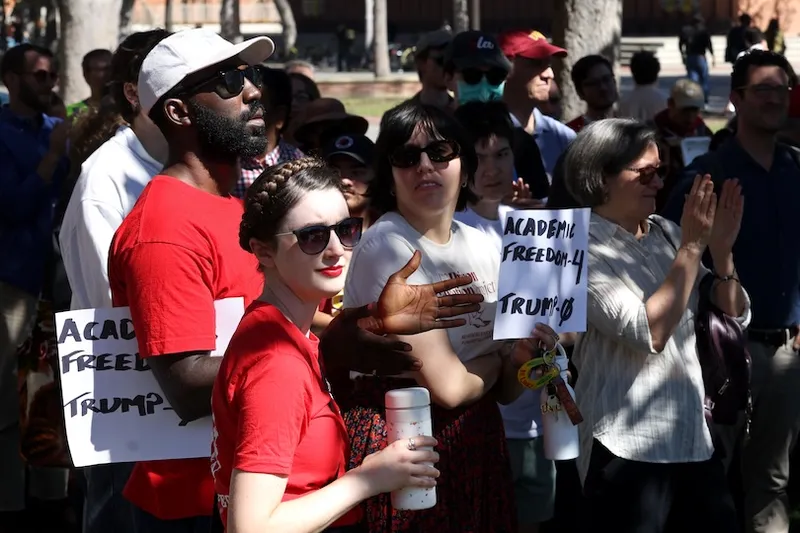
The danger is that New Zealand begins importing not just the language, but the consequences: a hostile, American-style campus environment where the choice to study itself becomes a minefield for families just trying to enjoy Christmas with their Facebook uncle. Universities should be places that encourage disagreement, not stage-manage it; where free speech is lived, not legislated.
The truth is that while we might be reaching a flashpoint, none of this started with Peters or Seymour. For decades, governments of every stripe have treated universities as businesses to be managed rather than institutions of learning and curiosity. Since the 1980s, with the introduction of tertiary fees and later the performance-based research fund, higher education has folded into the logic of the market. Students are rebranded as customers, research, degrees and graduates as outputs. Successive governments, with the best of intentions but admittedly narrow visions, have entrenched the narrative that universities serve the economy. The result is a system that measures success in head counts and outputs, and curiosity and experience as externalities.
A mate of mine said to me recently, “We really take for granted that we’ve got a functioning university system in New Zealand.” Or maybe it was something closer to, “Shit, uni’s actually pretty important, eh?” Either way, he was right. For all the lazy jokes about “woke” students and academics, universities remain special places, strange, stubborn, beautiful engines of public good.
More than excellence – change
In a recent address, the not-so-new-any-more vice-chancellor of Otago, Grant Robertson, said the purpose of universities is “excellence” in teaching, learning, research and student experience. He’s not wrong, but excellence is an outcome. The purpose is something bigger: change.
Universities teach us to ask questions without tidy answers. They train us to look for truths we didn’t know existed and to challenge assumptions we didn’t realise we held. At their best, they remind us that intellect isn’t about having opinions, it’s about earning them.
Anyone who’s ever found a blunt “no” scrawled in the margin of an essay knows that universities force humility upon us. They knock down the confidence of the certain, giving the critical a necessary voice. In lecture halls and late-night tutorials, you realise how much of yourself is inherited or assumed and how freeing it is to rebuild that self from first principles.
Tertiary education also changes our economic horizons. Graduates typically earn around $1.6 million more than non-graduates over their working lives. Despite what the tech-bro crowd might tell you about “skipping uni and starting a startup”, a university education still matters. It’s one of the few public investments that reliably lifts incomes, builds skills and expands opportunity.
And while studying brings personal benefits, it also strengthens our country and communities. Graduates pay roughly 30% more in taxes, volunteer more and are more likely to vote, play sport and join community organisations. That’s without mentioning how desperately we need more teachers, nurses, doctors and other trained professionals. A society that invests in its universities isn’t subsidising degrees, it’s investing in prosperity, cohesion and the shared ability to think critically about the challenges shaping our future.
I’d be remiss not to mention the research that flows from our universities. The answers to our biggest problems – climate change, inequality, energy and health – won’t come from Cabinet or talkback radio. They’ll come from research grounded in evidence, imagination and patience. That work starts in lecture theatres and labs across Aotearoa, quietly shaping the future we’ll all pretend we saw coming.
The phrase “critic and conscience of society” gets thrown around so often it risks sounding ornamental, but it’s written into law for a reason. Every movement that’s nudged New Zealand forward – the Vietnam War and Springbok tour protests, the nuclear-free campaign, the revival of te reo Māori – began with someone who once sat in a lecture theatre and decided to care about something bigger than themselves.
So yes, universities teach, research and pursue excellence. But they also evolve people, places, and principles. They’re one of the last public institutions in our post-truth age still willing to insist that ignorance isn’t inevitable, and that idiocy deserves challenge.
Where to?
The reason I’m writing this is simple: I’m increasingly worried we’ve stopped celebrating what our universities mean, not just as buildings or degrees, but as ideas. The endless debate that defines our national conversations exists for a reason: because change is rarely comfortable, and never final.
If we don’t nurture education, we don’t just lose our universities. We’ll lose one of the few spaces left where change isn’t feared but encouraged, trading it all for a cheaper, more ignorant future, and another round of tax cuts for landlords.
I’ve spent this year as OUSA president thinking about what we can actually do. How do you fix a system that feels this buggered?
The answer is unfortunately simple (which means we actually have to do it): we demand better. We stop treating education as a short-term cost and start seeing it as a long-term nation-building investment in our country’s future. We protect the arts and humanities that create citizens, not just workers. We value research even when it’s inconvenient. We support students and staff against a culture of apathy and fear. We challenge the user-pays fees model. We support policies that push students out of poverty. More than anything else, we make tertiary education a real election issue in 2026.
Universities aren’t broken beyond repair. They’re breaking because we’ve stopped defending them. By both remembering what they’re really for and standing up for them, only then can we build a smarter and fairer Aotearoa.

Liam White
Liam White is the 2025 OUSA (Otago University Students' Association) president.


