Resisting the allure of the AI sparkle

Some of the generative AI companies embracing the sparkle (Image: Tina Tiller/The Spinoff)
It’s no coincidence that so many generative AI companies use the little sparkle image in their branding – they want to make us think of all the magical ways in which their products can improve our lives, but not to look too closely.
You may have noticed that generative AI is now often associated with the image of a spark, or sparkle. I only consciously registered it recently, but people have been talking about the AI sparkle for a couple of years already (here, here and here, for example).
There are some strong benefits – at least for the people who want to sell us on using generative AI – to being associated with the image and concept of ✨ sparkle ✨. Firstly, the sparkle is connected to magic; the unknown, the unknowable. Many of us feel nostalgia towards magical stories and characters from our childhoods, like Tinkerbell, the genie from Aladdin, Sailor Moon, or (if you are capable of overlooking the real-life evil that is JK Rowling), Harry Potter. With magic, we are not invited to look closer. We are encouraged to let the magic exist; to have faith in what we see, without explanation.
The companies pushing AI on us rely on our ignorance for us to continue wanting to use their AI products. They don’t want us to think about the mass theft of human thought and art that makes generative AI possible, or the enormous environmental impact, or the intentions of the men spearheading the use of AI, or all the human biases and prejudices that influence the “thinking” of generative AI models. Far better that we see that little sparkle on every app on our phone and think of how it can magically improve our lives than to see AI for the man-made tool that it is.
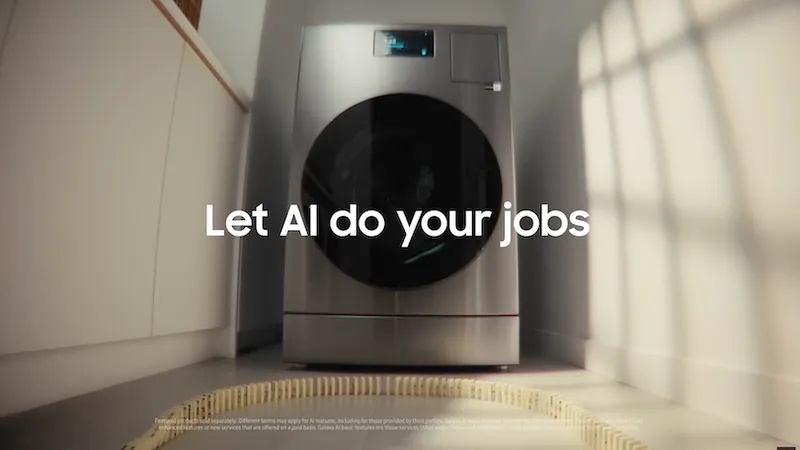
Magic also suggests convenience, often without consequence. In the Harry Potter series, characters generally use spells freely to do things like travel instantaneously, transform objects into different objects, become invisible. That’s what AI companies keep telling us they can offer: convenience and, ultimately, freedom. Driving through Mount Eden in Auckland the other day, I spotted a large billboard promoting Samsung’s suite of AI-powered products. It simply read, “Let AI do your jobs.”
These companies are desperate for us to believe that we should want to outsource our lives to AI. That we should want convenience above all else. What I want to know is, if we’re outsourcing every daily decision and chore to AI (from writing a shopping list, to deciding the setting on a washing machine, to writing a text to a friend), what exactly are we saving that time for? Certainly not the jobs that we’re likely going to lose to AI. I personally don’t see that outsourcing the everyday tasks of life to a machine is going to give me a better life. What is life without the mundane to balance the rest?
Lastly, the image of the sparkle is very closely related to the image of a star. Stars feature heavily in religion, myth and art as representations of gods, or of souls. Some believe that people’s souls become stars after they die. You might’ve seen this narrative play out in The Lion King, Stardust or the Percy Jackson novels. In Aotearoa when we celebrate Matariki, we look to the stars – the eyes of the god Tāwhirimātea – and remember the creation of the universe, and we plan for the year ahead. The phrase “guiding star” represents a person or a thing that is wise and reliable. Human beings are obsessed with stars. To us, they are almost magic. How else could something that has long been dead still light up our sky at night?
I’m going to take us down one more rabbithole. The idea of “the spark” characterises our lives as human beings. From “the spark of life”, that inexplicable thing that is our existence, to having “a spark” with a person, or rediscovering your spark/sparkle after a period of difficulty. We feel that there is a magic – maybe a soul – that is unique to humanity. Something that cannot be replicated. One of the greatest tales in western literature, Mary Shelley’s Frankenstein, warns us of the dangers of messing around with the creation of life, the mimicry of humanity. We see Victor Frankenstein recoil in horror in the face of this creature he has created, which is not quite human. Both the creator and the creature suffer terrible fates as a result of his cruelty and hubris.
The sparkle – though it may just be an emoji or an icon for these brands – represents far more. Its choice is no mistake; the people investing billions into these companies don’t roll out a brand without immense forethought. The sparkle, something both magical and human at once, is supposed to make us trust the products it is attached to. We are supposed to believe that generative AI, though man-made, is more magical, more convenient, more effective, more intelligent, more creative, than we are. We are supposed to learn to distrust ourselves, to put faith in these mysterious machines instead. The sparkle has been chosen to push us towards choosing to use AI instead of using our own, non-magical, human brains.
Generative AI is not better than us. It’s not a teacher, it’s not an artist, it’s not a friend, and it’s certainly not magic. It’s a machine that has been raised on a diet of other people’s ideas and art, and shits out generic responses when instructed. It cannot survive without the grand-scale theft, the scraping of the internet for content. It has no original experiences. It has nothing without the creativity of human beings. It’s just lines of code and data centres. If magic exists, it is human, not machine.
This was originally published on Soph Jackson’s blog Collecting Myself

Soph Jackson
Soph Jackson is a writer and podcaster from south Auckland. They are most interested in queer issues, disability and internet culture. Soph has (possibly) Aotearoa’s largest collection of different editions of Pride and Prejudice.


