When a wild animal becomes your neighbour

Matariki and newborn Jade, 2016 (Photo: Emma Shanks)
As the Catlins celebrate 20 years since sea lion pups returned to its shores, locals reflect on living next to, and sometimes with, endangered mammals.
This feature was made with the support of the Auckland Radio Trust, sponsors of the Vince Geddes In-Depth Journalism Fund.
When the sea lion climbed into his water trough, Catlins farmer Max Harrison had had enough. It was disturbing his stock. Arriving in their ute, two local rangers, “Tinker” and Peter, first tried clapping at it. The “big bastard” didn’t budge. Then they backed the ute up and gave it a good ol’ rev. The sea lion sunk its teeth into the bumper. “So the old man’s like, ‘I’ll fix him,’” remembers Max’s son, Nigel.
His father brought the tractor over and started banging the bucket on the ground. Bang! Bang! The sea lion finally spooked a few metres. Bang! Bang! Another few metres. As a kid, Nigel thought the whole thing was a hoot. It’s a uniquely Kiwi way to describe a conservation success story – with a disgruntled eye-roll at the nuisance of this lumbering new neighbour, and a cheeky grin at the antics.
For the people of the Catlins, the return of New Zealand sea lions (pakake) to their shores has never been as simple as an endangered species coming home to the mainland. It’s come with clogged beaches, warped fences, road hazards and backyard intruders. Pakake have gone from targets behind the local pub to animals that locals call the Department of Conservation about, protect from dogs, and generally keep an eye out for. And as DOC celebrates 20 years of the return of pakake breeding in the Catlins, they say the neighbouring community could be the make or break of this wild species’ return.
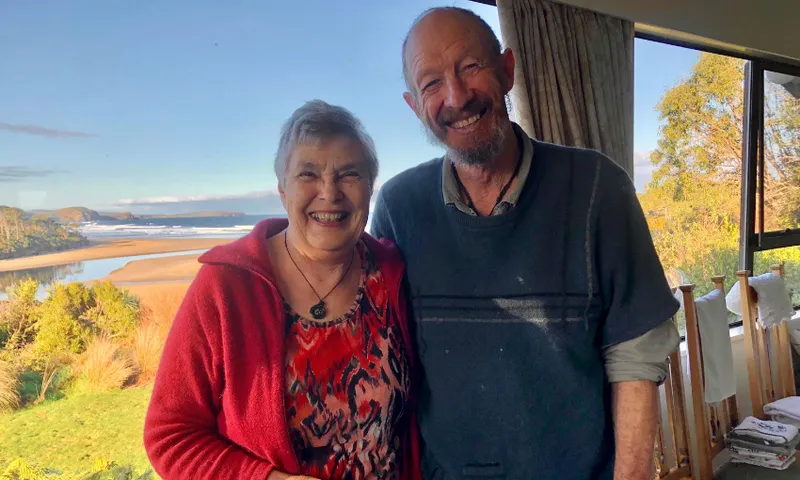
A corrugated iron sea lion letterbox stands sentinel at the driveway of Catlins locals Mary and Fergus Sutherland. Fergus has owned the property since he was ten-years-old (sold to his family by a family friend, who put it in his name). During his lifetime, he has witnessed the return of pakake to the area. From 1990-2016, the couple ran wildlife tours out of this very house. Neither knew anything about pakake to begin with. No one really did.
Pakake once had their pups across the motu. By the 20th century, hunting had restricted their breeding range to the Subantarctic Islands. Then, in 1993, a female wanderer from the Auckland Islands – now known as Mum – gave birth to a pup in Taieri Mouth on the Otago coast. Further south, another wanderer gave birth to an unrecorded pup in the Sutherlands’ yard. But despite Mary and her son’s protective efforts, the pup disappeared, suspected to have died. It wasn’t until 2006 that a surviving pup, born to Marea, marked the beginning of a breeding population in the Catlins.
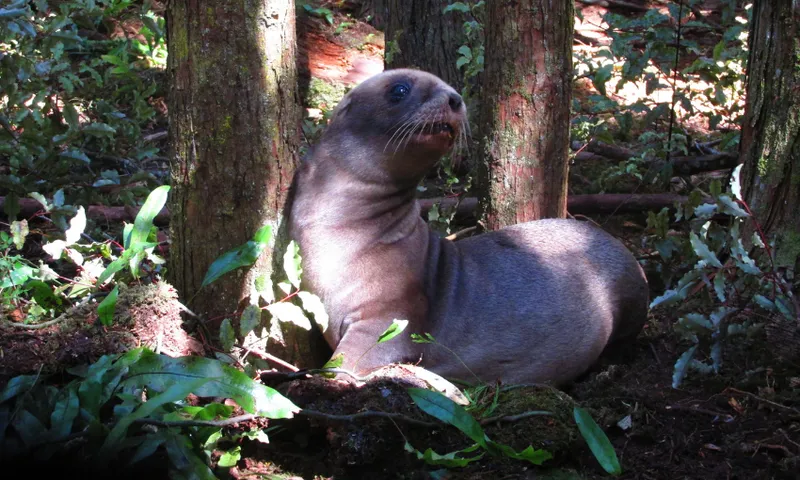
The Sutherlands’ lounge is adorned with Fergus’ art depicting the wilderness of the coastal region: rugged cliffs, surf beaches, hoiho and pakake. Matching pairs of binoculars rest beside a floor to ceiling view of the Tahakopa River mouth – now a popular hangout for pakake. Over a cup of tea and biscuit, the retired couple admits initially confusing sea lions for fur seals (kekeno). It was a common mistake – still is. Kekeno are smaller, smellier, and hang out on rocks. The heftier pakake tend to hang out on beaches and in the shelter of the bush.
The only difference local fishermen noticed was the size, according to the Sutherlands. “So that means he’s eaten more fish,” says Mary, adopting the imitation of a grouchy fisherman. “More of my fish.”
Back in the 90s, the couple says the local pub had a sea lion photo pinned behind the bar with a target on it (other sources say it was actually a fur seal). Over a pint of Speight’s, locals would trade stories of running down the wild animals on beaches and getting out the shotgun. “It was the thing to do,” Mary shrugs. “We’ve come a long way. We’ve still got a long way to go.”
There is still too little data to know whether pakake will actually compete with fishermen. “The only thing we know for sure is that, currently, the sea lion population around the Catlins is still so small so any negative feelings from the fishing community (recreational or commercial) is not well founded,” Amélie Augé, whose Otago University PhD in 2010 studied Otago sea lion foraging behaviour, says. She’s now a Biodiversity Planning and Monitoring Advisor for DOC.
Catlins-specific data from 2022, when DOC tracked five females during winter, revealed that almost all pakake foraging took place on shallow rocky reefs. From what Amélie knows based on studies around the world, there is the potential for a sort of symbiotic relationship between fishermen and pakake. Their diet includes species that prey on marine life fishermen want to catch. So fishermen want crayfish, octopus prey on crayfish, but sea lions eat octopus.
Amélie argues that a science-backed response to those fishermen would be that – since sea lions are an important part of a balanced coastal marine ecosystem – their return should be welcomed as mutually beneficial. “The coastal marine ecosystems will become healthier and more productive,” she says. But again, more research is needed.
In the 90s, budding tour guides Mary and Fergus built their knowledge up from scratch. Their tourism itinerary took guests through Surat and Cannibal Bays, the two most popular pakake hangouts, separated by a strip of farmland. Fergus would drop everyone off and enjoy a cat nap at the next bay over while his wife guided the group through. “So the sea lions were my area, really,” Mary says. “You learn quickly when it’s your job to pass on information.”
Mary calls the bays “bachelor pads” and pakake the “fellas” – males on holiday from the Auckland Islands during breeding season down there. “They would make the trip and then lie about on the beach and just enjoy their holiday, grumpy because they’d missed out again on the mating,” Mary chuckles.
Ex-DOC ranger Jim Fyfe, who’s worked with sea lions for over 30 years, explained to me the social structure Mary would have encountered. “The whole social structure with males is…” Jim put his shoulders back and puffed out his chest “…I’m the king of the castle.” The biggest and oldest will often assert itself as the “beachmaster” who younger males submit themselves to for protection.
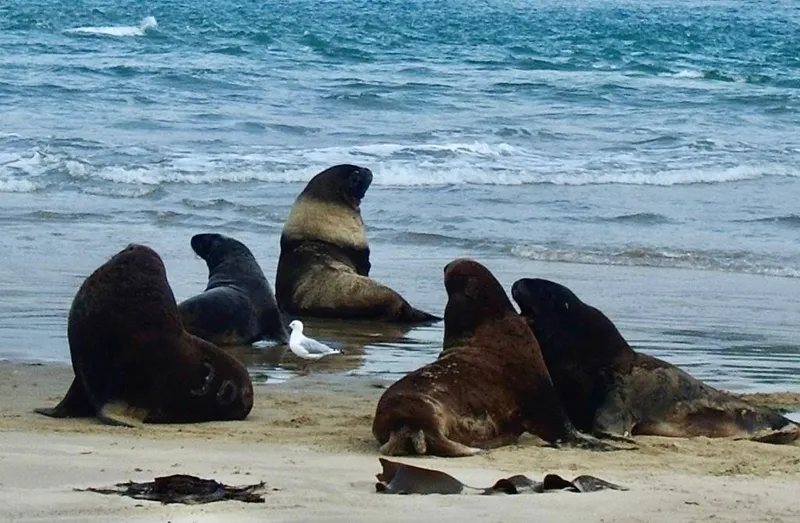
The beachmaster of Cannibal Bay had a white mane. Mary called him King. “You’re not supposed to name them and make them into people, but I did name some – King I did name,” she says.
But her favourite was George. She would call out, “Hello, George!” And he would sit up – one, two – and turn to look at the group from his left eye. Click, click, click, went the cameras. Then she would say, “George, you know that’s the wrong side.” And he’d turn his head to the right.
“He was a great sea lion,” she beams. “I was very fond of George.” She pauses. “And, uh, the last time I saw George he had fishing rope around his neck. And we didn’t see him after that.”
A key observation Mary passed onto her tour groups: much like a labrador, sea lions are excessive in everything that they do. “If they’re sleeping, they are sleeping,” she laughs. “If they are playing, they are playing. And if they’re eating, they are eating.”
Mary’s absolute first principle has always been respect for the wildlife. Under her instruction, the group would not be sudden, nor loud. Pakake are notorious nappers, and so Mary encouraged the tourists to think of the beach as their bedroom. “Well, if somebody comes into my bedroom, I would like them to say, ‘Excuse me, here we are. Don’t be upset’,” she says.
There was the odd, ugly occasion when she’d be forced to school others who didn’t pay the same respect. “One time I really hollered at a man,” Mary chuckles, not one bit sorry about it. The man had been encouraging his son to approach a sleeping sea lion, who reared up and gave a big “HUFF”.
Mary intervened as the boy’s father picked up a stick, scolding, “Look, if you were in Africa with your son on a safari and you saw a sleeping lion in the grass, would you encourage your boy to go up and walk close to it?”
“Well, of course not.”
“There is no difference. This is a wild animal, in the wild, and you’d leave them alone.”
Above all else, the Sutherlands abide by advice they were given once on a trip to the Sub-Antarctic Islands: “Be boring.”
During a picnic lunch on Enderby Island, a curious pakake had sidled up. One woman remained frozen as it slowly reached over and pulled her beanie off. “She was absolutely petrified,” laughs Fergus, while Mary snorts at the memory.
Bored, it dropped the hat, turning instead to a nervous young couple. Giving in to instinct, they bolted. “And of course, what does the sea lion do?” Mary asks. She claps her hands together: “Oh goody, goody, goody! And off he goes after them!”
“Meanwhile the rest of us just sit there and finish our lunch,” Fergus says calmly, leaning back with a ‘see?’ expression. “Just be boring.”
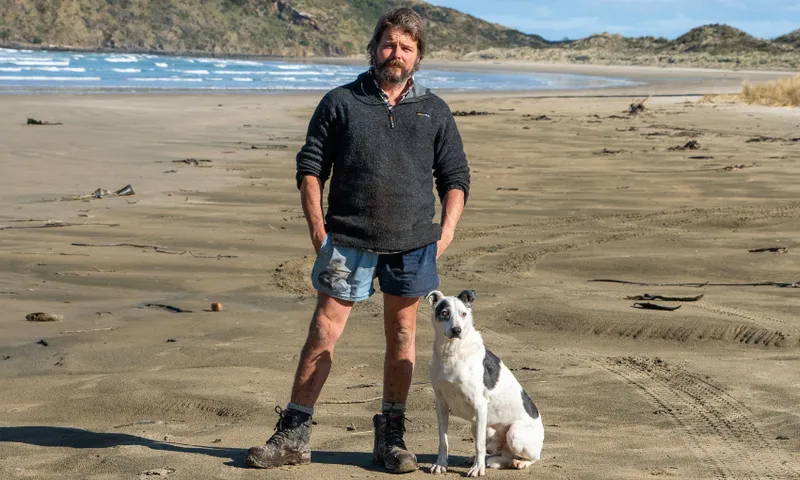
The strip of farmland that the Sutherlands crossed on their tours belonged to Max Harrison. That strip led to a paddock on a headland called False Islet, which Max and his stock could only reach via the beach. In the early days, he rode horseback and cracked a whip to scare sea lions out of the way. His son, Nigel, has now taken over running of the farm. He’s the picture of the typical Southern farmer: Canterbury stubbies, rolled up flannel shirt, and apologies for his “slippery swear words” and political vents.
Nigel’s old man reckoned sea lions were a nuisance – and not just on the beach. Nigel’s memory of when his dad moved along the sea lion in a tractor remains a fond favourite. As a young fella, Nigel had noticed something had disturbed the hoggets (young sheep). When his dad had a squiz, he found the pakake sitting in the trough. “He was just sitting there flapping away,” Nigel chuckles. Chances are it was actually a female, which trek inland to avoid males’ aggressive courting and to protect their young.
Because of the Harrisons’ unique location, the family had gotten to know rangers “Tinker” and Peter who came along as a “comical pair”. Recounting the hullabaloo of shifting the reluctant bastard, Nigel laughs, “Sea lions are like people, you get chilled out ones and you get assholes.”
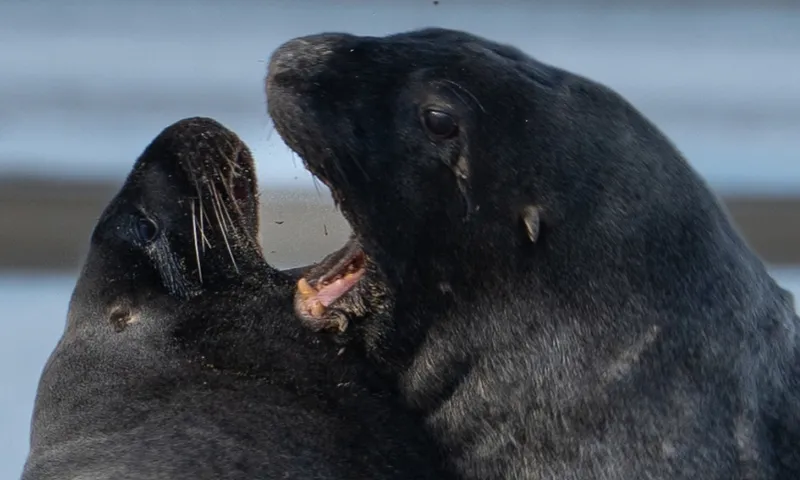
At the time, Nigel didn’t really get the big fuss that tourists or the German pinniped researcher who stayed with his family once made over these wild animals. But after a lifetime spent tripping over them, he has a different perspective. “Anyone that’s ever looked into the eyes of a female sea lion that’s protecting her pup, it’s a connection that I can’t quite explain,” he says. “I don’t take for granted the place that I’ve grown up in.”
One of those pups was Jade, the first pup former DOC ranger Emma Shanks met after working two pupless breeding seasons. In 2014, at the age of 25, she was drawn to the role by the taonga species there. “It was like all the charismatic animals you could imagine,” she says. Penguins, dolphins, sea lions – the Catlins had it all.
On one of her monthly monitoring walks along the coast, Emma came across a school group just as a pakake made a beeline for them. Quickly dashing down the dunes, she ran in front of the kids, stood her ground and held up her work bag – calling its bluff and halting its charge. “The kids thought I was some sort of superhero,” she laughs. “I was like a real ranger.”
“It just takes someone who is experienced with sea lions to guide. You need showing,” she says. “You can’t really be told.”
“If I hadn’t shown up at that exact moment…” she trails off, shaking her head. “Who knows what they would’ve gone home with in their minds of what sea lions were like?”
DOC Biodiversity Ranger Lance Hay’s recent season report says there was a “dramatic” increase in human-pakake interactions and harassment last season. Lance believes this could be attributed to the increased number of pakake using the coastline – both locals and travellers.
Compared with nine reported interactions the previous season, there were 27 this year, including sea lions in garages and on roads, sticks thrown at them, and dogs set on a female.
Yet DOC still relies heavily on the community in their conservation of the struggling population – simultaneously one of sea lions’ greatest threats and their greatest ally.
This year, 27% of pakake sightings were called in from members of the public. There are few rangers covering a huge coastline, so the community is essential. “You couldn’t have done it without community,” Emma says. “The only reason we found those pups was because people rang us.”
In 2016, a family in Kaka Point (a small Catlins town) contacted Emma after they found a pup underneath their crib. There, she found a chubby brown, mewling pup, born to Matariki. “It was like fireworks in your brain,” Emma says. “It was one of those moments that you don’t want to end, just to soak up this incredible scene.”
For a pakake mother, the first few weeks of her pup’s life are demanding. She needs to go to sea regularly to feed in order to suckle, and so Matariki would waddle back and forth across the road between the beach and the crib. The whole Kaka Point community got behind Matariki and her pup: police escorts for her crossing the road, the surf lifeguards ensuring she had safe passage to the beach, the wider community ensuring that dogs could not get her and her new pup, and the owners opening the gate for her to get inside.
Years later, when Jade had reached breeding age, both she and her one pup suffered the fate of a misunderstood species: both were found shot in 2024 within a month of each other. There were 50 shotgun pellets in Jade’s decomposing body. Those responsible were never found. Nigel buried Jade’s body. “It was heartbreaking,” he says. And hers wasn’t an isolated tragedy. Jade’s body joined a growing pakake cemetery on the Harrison farm.
To this day, sea lion mortality remains high in the Catlins. In the past breeding season, nine pups were born, the highest on record. Only three survived. There were nine total pakake deaths. Two were attributed to humans: one run over, another from commercial fishing bycatch.
Jade was named after the crib owners’ young family member, Jayden, who was terminally ill. She was one of four female pups born in 2016 – still the highest number of surviving female pups born in a season.
A descendant of Marea, Jade was the last pup to be given a name as part of a relationship between DOC and local rūnaka. In Emma’s opinion, not naming the other pups born that season was an “oversight”. “It just gives them so much more protection and mana,” she says.
Pakake are now referred to by either the tag numbers on their flippers or personal nicknames given by locals. But this is outside the documented matriarchal family tree descending from the colonising females of the Catlins – a record of whakapapa.
According to both Jim and Emma, there was never a clear conversation about why the official practice of naming sea lions ceased. The Spinoff was unable to clarify reasons why as neither local rūnaka nor DOC directly responded to questions.
DOC Operations Manager Murihiku John McCarroll says DOC doesn’t have an overarching position on naming pakake. He says DOC works closely with mana whenua and are “guided by local aspirations, tikanga, cultural values, and capacity as kaitiaki of these taoka … Engaging and inspiring communities to care for the species sharing our coastlines is important, and identifying them by name can be a way to understand their whakapapa.”
Some believe that referring to tag numbers maintains an appropriate separation between humans and wild animals. But Jim strongly disagrees. It was Jim who named the sea lion Wero, meaning “challenge”. Wero was an unusually aggressive male who bit Jim when he tagged the pup. He still has the scar on his neck. “These stories that I’m telling, I can only tell because you got names,” he says. “You start getting hung up on [tag] numbers and you lose the thread of the story.
Despite having retired, Jim is still dedicated to the species, volunteering for the New Zealand Sea Lion Trust. He took me on one of his tracking trips on the Otago Peninsula – a four-hour excursion through inlets, beaches, and pine forest. From a fence at the edge of Hooper’s Inlet, Jim points out a wriggling, bleating group of pups playing in the creche in the distance – a pakake kindergarten where mums collectively raise their young.
This fence is a recent build. As pups get older, they become more mobile, their curiosity leading them further inland. Infrastructure like the fence and reduced speed zone is becoming more necessary as the population grows in Dunedin – boasting a record 38 pups last season.
The lifelong conservationist has a vision for the Peninsula as numbers grow. He imagines a carpark at the edge of Hooper’s Inlet and a boardwalk through the salt marsh – close enough for people to appreciate the sea lions, far enough to leave them be.
Jim’s approach mirrors the lessons Mary learned decades ago: “Sea lions are sea lions, and people are people. So say hello, understand that it’s a sea lion and you are operating within its world for a moment, then leave again.”

Nina Brown
Nina Brown was the editor of Critic Te Ārohi, Otago's student magazine, in 2024 and 2025.


