Weird, spooky or just quiet? A day at the graveyard

At Avonhead Memorial Cemetery (Photo: Kathy Young)
Nursing some bad news, Kathy Young turns to Avonhead Memorial Cemetery for solace.
I had some bad news this week. Not the sort that floors you, but the sort that makes you want to weep quietly in a dark room for a little while. To snap myself out of my equally dark mood, I decided to visit a graveyard. At least I get to be alive and have a go at being human among those that no longer can.
Inspiration also came from a new friend, who mentioned she lives next to a graveyard. That got me thinking. What must it be like to live next to a cemetery? Does it feel weird or spooky or just a bit quiet?
Did you know Christchurch City Council operates 22 cemeteries (and five closed cemeteries)? By comparison, Wellington has four (admittedly, they’re large) and Auckland has 29 (plus 25 that are now closed). According to the cemeteries team at Christchurch City Council, they handle on average 830 casket and ash burials each year.
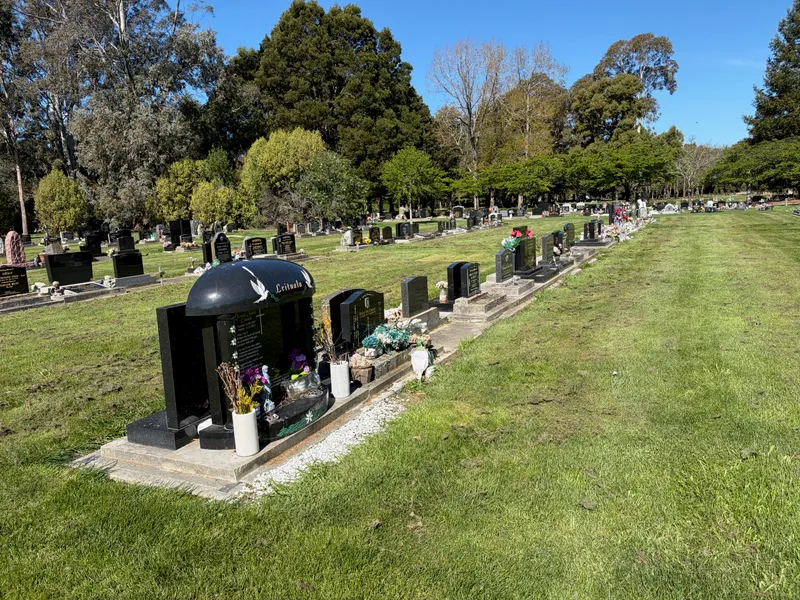
I arrive at Avonhead Memorial Cemetery on a springy Thursday afternoon. You’d be forgiven for thinking it was the venue for a lawnmower convention. I count (and hear) five ride-on mowers cruising between the plots. One driver looks up, nods and gives me a broad grin. Disarming. Still, I’m frustrated by the drone and wonder when it will be peaceful enough for me to fully arrive in this space. I came here for silence and reflection, and instead I’ve got the soundtrack of a suburban Saturday morning.
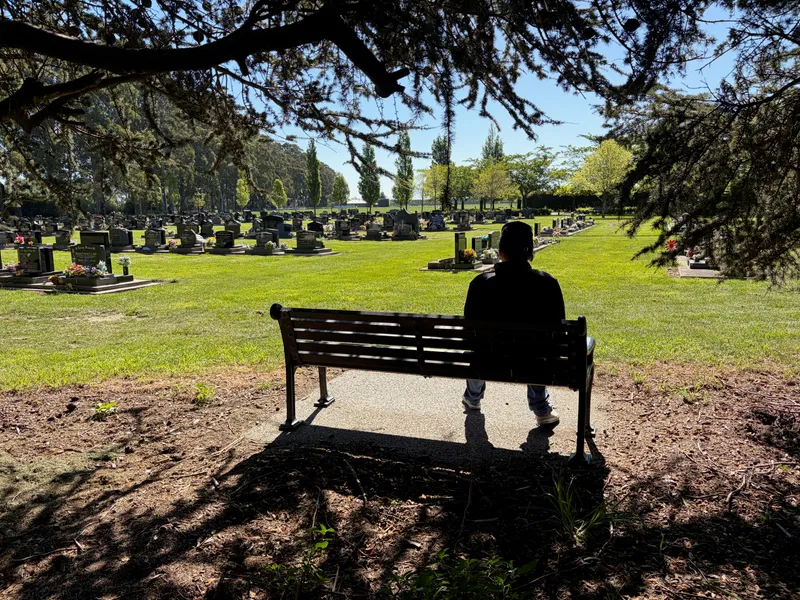
Eventually the mowers move on, and I settle in. Covering 7.1 hectares, it’s got a beautifully ordered feeling about it. I sit on a clean, Council-issued park bench not far from where I’ve parked and breathe in the freshly cut grass. It’s sparsely populated (above ground, at least). I can see a jogger with her large dog, an older woman sitting in her car with the windows down, and a man leaning forward on a bench, elbows on his knees. Lots of aloneness. Nobody in a hurry.
A gentleman approaches and tells me, kindly, that my park lights have been left on. I thank him, and he moves on to chat to the lady in her car, who tells him she’s reading her book. He says, “See you tomorrow”, and waves goodbye to both of us. See you tomorrow. He’s a regular, then. So, I suspect, is she. A small, gentle exchange, and oddly touching.
Emboldened, I get up and wander. I’d expected to feel like an intruder, tiptoeing through other people’s grief. Instead it feels more like walking down a street where everyone has left a note on the door.
Some of the notes are brief: a name, two dates – the dash between them doing all the heavy lifting. Others say more. A couple who were married for more than four decades now share a plot as they once shared a bed. A grandfather who was, according to his headstone, “a great bloke”. A young man with a rugby ball carved and a can of bourbon and Coke left by his headstone, still unopened. A tiny plot with a pinwheel spinning wildly in the light breeze.
I do the maths on some headstones. I can’t help myself. Too young. Good innings. Way too young. Each one is a whole life compressed into a few lines, and none of them, as far as I can see, includes a job title.
My bad news hasn’t completely dissolved. It’s still there in my pocket like a stone, but it’s shifted into perspective. Nobody here is remembered for the quiet months, the jobs that didn’t come through, or the email they dreaded opening. They’re remembered as a mum, a dad, a much-loved sister, as a great bloke. The rest has been mown over, along with the grass.
I find myself back at the bench. The woman with the book has her head down, and I hear her leafing the pages. The man who was leaning forward has sat back now, face tipped to the sun, arms outstretched. Maybe he came here with his own stone in his pocket. Maybe he just likes the view. Either way, nobody is asking anyone what they do for a living.
In the evening, I ring my new friend and ask her: What’s it really like, living next door to a cemetery?
She laughs. “Best neighbours I’ve ever had.” She tells me she walks through it most mornings. She knows some of the regulars’ names now and nods to them as you would to anyone on your street. On a bad day, she says, it’s the most reassuring place she knows. “It reminds me that it all passes. The good and the bad.”
The next day I ask about what it’s like for the workers. “Working in this environment reinforces just how precious life is and reminds us to value each day and the people around us,” says Katrina Cowie, cemetery support officer.
Linda Waterman, another cemetery support officer, tells me her experience. “One of the most moving traditions at Avonhead Memorial Cemetery is the annual gathering at the earthquake interment site, where families, students, community members and dignitaries come together to remember those they lost in the 2011 Christchurch earthquake. During the service, students read the names of all 185 victims, often in their first languages, including English, te reo Māori, Japanese, Chinese, Korean, Filipino and Thai. It’s a simple but powerful tribute that keeps each person’s memory alive and helps younger generations understand an important part of Christchurch’s history.”
So, weird? No, not really. Spooky? Not in daylight, anyway. Quiet? Yes, once the mowers knock off for the day. But mostly it’s a kind place: a nod, a small greeting, a noticing. People come here to sit with what they’ve lost, and in the process become a little gentler with themselves and whoever’s on the next bench.
Humans are kinder to each other here. Perhaps that’s because everyone who walks through the gates is reminded that this is how it ends for all of us. Why don’t more of us hang out here? The world would be a better place.

Kathy Young
Kathy Young is a freelance writer, magazine editor and proofreader.


