

A documentary about his life was inevitable, but Lomu will mean different things to different people.
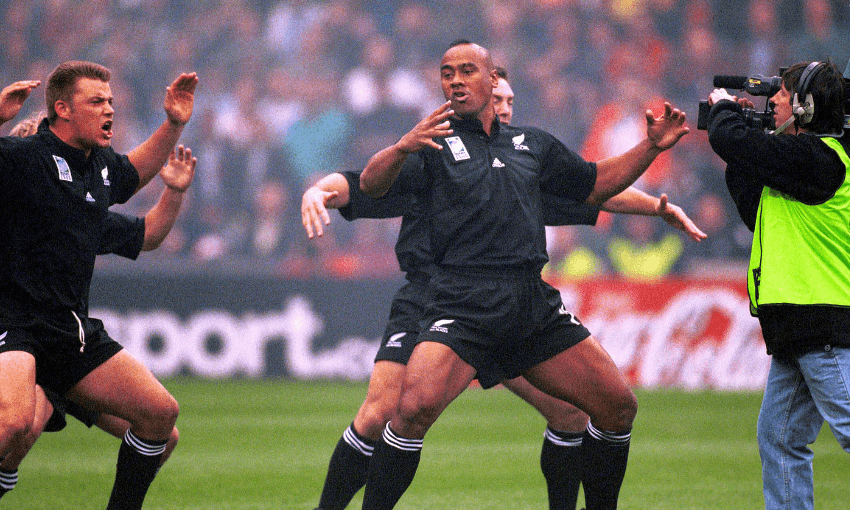
“Lomu! Oh! Oh!” That famous line of rugby commentary from Keith Quinn manages to describe nothing and everything about Jonah Lomu’s most viewed highlight, where the All Black physically ran over English fullback Mike Catt. Quinn, himself considered one of sports great articulators, was moved to raw emotion – not a natural state for Kiwi men in the 90s – by Lomu’s feats. So while people listening on the radio may have been wondering what was going on, those viewing the spectacle on television had the perfect audio accompaniment to something world rugby had never seen before.
And yet he was also known as a “gentle giant”, softly spoken with perhaps his loudest off-field statements delivered via his fashion choices.
Such was Lomu’s power and reputation that fans felt genuine excitement whenever the ball landed in his hands. No All Black – not Richie, or Dan, or Ma’a, or Ardie – has captured the imagination of the international rugby fans like the Tongan/Kiwi winger. He remains genuinely revered.
A documentary about his life was inevitable, given his profile and the tragic end of his career and eventually his life at the cruelly young age of 40. In some ways, the fact he is no longer with us only adds to the myth, because part of understanding the awe with which he is spoken of by fans, former colleagues, and commentators around the world is experiencing the explosive jolts of his physicality on the big screen. Filmmakers Vea Mafile’o (For my Fathers Kingdom) and Gavin Fitzgerald (Connor McGregor: Notorious) shows us this from the outset of Lomu, balancing archival footage with interviews and modern location shoots.
The duo juxtapose the loud physicality of the arenas with quieter family moments trying to see what powered the man not just to the heights of his sport, but to continue playing at a competitive level even with his body failing him. In doing so they find the tensions that many in the Pacific diaspora, not just the rich and famous, will be all too familiar with – and the film is stronger for it. The finale of the film feels like the culmination of their thematic explorations.
If you are a rugby fan then this film is a wonderful, pensive, but ultimately celebratory look at, depending on your age, one of your favourite players. There will be plenty of Kiwi sporting parents that can sit down with their budding athletes to watch highlights and insights on a genuine home-grown global phenomenon. There will be plenty of Pacific parents who will nod in appreciation.
If rugby isn’t your thing, then the film can offer an understanding of the sport’s first true pop icon. It may make you question how Pacific athletes are treated in sport. It may give you a better understanding of why “sports diplomacy” is currently being deployed by countries like Australia and France in the Pacific region. Lomu’s own struggles with navigating the space between culture, family, professionalism and fame are a welcomed extra layer to what could have been.
That’s not to say Lomu is in anyway a political film. Yet if you understand, through watching, the way in which Lomu tried to balance work, familiy, fame and culture, as he became the poster boy (and in some ways archetype) for modern Pacific athletes – and a legend in his own sport – you might just gain a better understanding of western views on Pacific people.
It might seem a dramatic load to put on a film about a man who ran an oval ball up and down a field, but that’s simply a testament to how iconic Jonah Lomu remains.
Lomu is showing in cinemas now.