


The old adage ‘no scrum, no win’ has never been truer than right now, writes Paul Thomas.
The All Blacks are hardly walking into an ambush. Last year forwards coach Jason Ryan described an embarrassing scrum against South Africa at Eden Park as a “never again moment”. That made him, briefly, the only adult on earth who didn’t know you should never say “never.” A week later in Wellington the All Blacks were left clinging to the wreckage of their monstered scrum like shipwrecked sailors as they sank to their worst-ever defeat.
So when the Greatest Rivalry tour gets under way in Cape Town this weekend against the Stormers, there’s one area of the game that’s sure to come under plenty of scrutiny.
The scrum has always been the core of South Africa’s rugby identity. After his team had narrowly lost to the All Blacks in Christchurch in 1996, Springbok coach Andre Markgraaff warned his counterpart John Hart, “Wait till you get to South Africa – we’ll show you what scrumming really is.”
When the expected dominance didn’t materialise in the first of four subsequent tests in the Republic, Markgraaff went to plan B in the form of notorious Northern Transvaal hooker Henry Tromp.
The Irish Times’ punchily headlined its report “Springboks select killer”. A few years earlier Tromp and his father had “punished” a black farm worker accused of stealing by thrashing him with a fan belt. The man later died. The transition from apartheid regime to Rainbow Nation was barely underway but, even by the old system’s standards, this was regarded as a bit heavy-handed. Convicted of manslaughter, Tromp served four months of a two-year jail sentence.
Blessed with a generation of tight forwards who were born to scrum, the Springboks have taken the set piece to a new level in recent years. Player depth and a six forwards, two backs split on the bench has enabled the “Bomb Squad” gambit – swapping out the tight five for another supersized quintet early in the second half to ensure the intensity of the confrontation is sustained till the final whistle.
Recently retired England prop Dan Cole is well-placed to assess the Springbok scrum. On the bench for the 2019 World Cup final, he came on as an injury replacement in the second minute and had a torrid time. The Boks took control on the back of a string of scrum penalties, Cole was made the scapegoat and it took three years and a change of coach before he reappeared in his country’s colours.
A lot of it, he says, is down to sheer size: “incredibly large men” in the front row with massive locks behind them generating thrust. “Mass moves mass and, at some point, they’ve got a ginormous pure mass.”
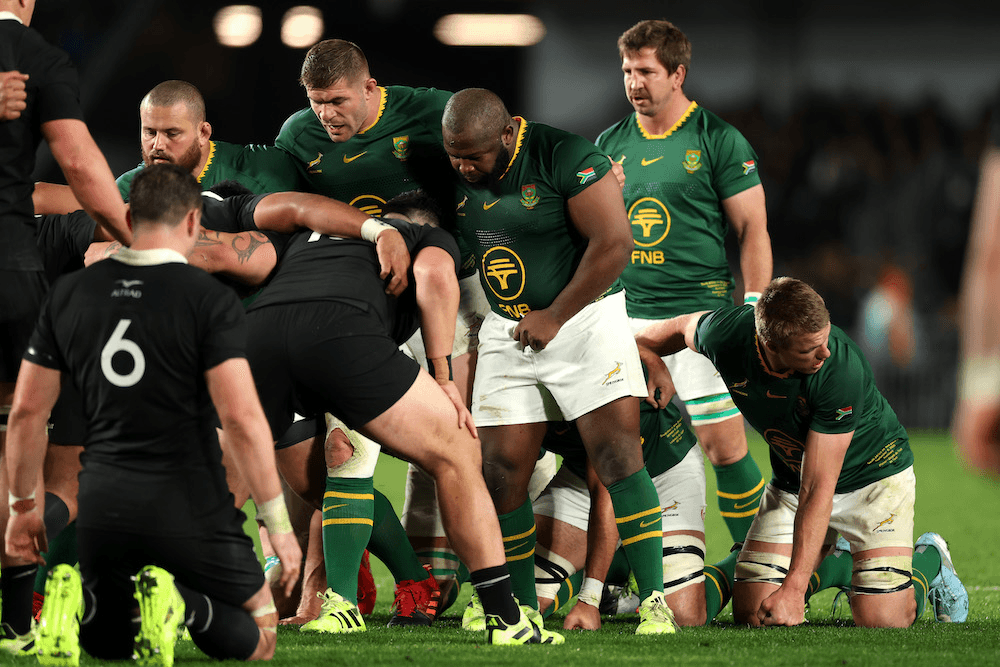
Enter the Bomb Squad: “So they almost have a strength on a strength and they double down on that strength knowing you might be able to last with them for 50, 60 minutes but, actually the full length of the game, they will get you and punish you.”
Ever the pragmatists, the Springboks understand that, in this era of activist officials on the pitch and poring over screens in the grandstand, discipline is everything. If you give away significantly more penalties than the other team, you gift them possession and field position. If you have players in the bin you’ll almost certainly concede points.
Relentless physical pressure can cause discipline to crumble. The heat comes on at scrumtime. A prop buckles, collapses or goes sideways: penalty. If it keeps happening, the prop is deemed a repeat offender and carded. The poor bugger may simply be unable to withstand the weight being brought to bear – perhaps because he doesn’t have enough counter-weight behind him – but that’s the way the law is applied.
The penalties set up attacking lineouts that become driving mauls, another area of the game where mass counts and it’s hard to arrest, let alone reverse, the momentum once you start going backwards. Collapsed mauls lead to penalties; repeated collapsed mauls lead to cards.
Arguably, the only way to escape this vicious cycle is not to get into it in the first place. The All Blacks will dig in, try to get the ball in and out of the scrum as quickly as possible and play a high tempo game using the width of the field to exhaust the Bok behemoths.
However, cynicism is pragmatism’s shady sidekick: the Springboks are masters at slowing the game down. You can’t set a scrum without there being six front rowers on their feet and ready to rumble so, if one feigns an injury and takes the knee, there’s an effective time-out.
The Greatest Rivalry series has been dubbed Mission Impossible. The degree of difficulty can hardly be overstated. But let’s not forget that, for all the heart-in-mouth moments, Ethan Hunt and his crew always come through in the end.