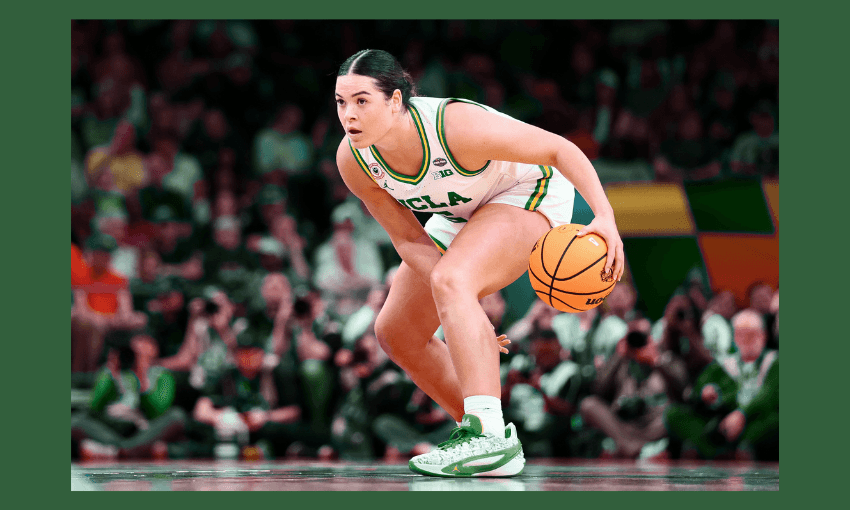



Get your Connecticut Sun merch because a New Zealander has made it into the WNBA! But you know why we’d never heard of Charlisse Leger-Walker until this month, eh?
“Fuck yeah” is what I thought when the Connecticut Sun selected Charlisse Leger-Walker at yesterday’s WNBA draft. And then the pride, warmth and hope flooded in.
Leger-Walker is the first New Zealander to be drafted and only the second to play in the WNBA in 30 years.
The news came just days after the 24-year-old Hamiltonian became the first New Zealand woman to win an NCAA title with UCLA during March Madness.
So, I did what every self-respecting women’s sports fan does: I hunted out a piece of kit on the team’s official website. It’ll sit alongside my merch for the Black Ferns, Kiwi Ferns, Silver Ferns, White Ferns, Football Ferns, and even Wellington women’s ice hockey.
But the orange Connecticut Sun singlet is more than just a piece of fabric. It carries the weight of everything that came before it, every “no, you can’t”, every eye roll, every moment women’s basketball was dismissed, diminished, or ignored.
And it carries the weight of every girl who’s ever picked up a ball and wondered how far it could take her.
Well, young one, lean in close: it can take you as far as you want to go, just ask Leger-Walker. But it will take hard work, and you will face challenges – sometimes simply because you’re a girl.
The WNBA is a big deal. It’s gone from overlooked to undeniable, and Leger-Walker is arriving at a pivotal time. For years it sat in the shadows of the men’s NBA, battling underfunding and limited media coverage and sponsorship investment. Women, like in most sports, were told to just be grateful for what they had. And yet they kept showing up.
On the court, players like Caitlin Clark, the 24-year-old Indiana Fever guard, are pulling in record crowds, driving sponsorships and forcing the world to pay attention.
Off it, the conversation is changing too. The work of Harvard and Nobel Prize-winning economist Claudia Goldin has helped shape the case for investing properly in women’s sport. It makes good business sense.
And the money is starting to flow. Commercial deals are increasing and for the first time, WNBA athletes will be able to thrive, not just survive, financially. Base salaries for the 2026 season are reported to have increased from US$66,000 to US$300,000. It also means Leger-Walker could, almost overnight, become one of New Zealand’s highest-paid women athletes.
There has also been rolling coverage and breaking news alerts around Leger-Walker’s drafting.
Megan Compain has watched the moment play out and noticed how much things have changed. When she made the WNBA in 1997, there was barely any coverage. Now, she says, we’re finally starting to understand the importance of visibility, not just for the athlete, but for what it represents. “It wasn’t until we started this conversation about women in sport and valuing the achievements … that I started owning the success,” she says.
But she says we’re not there yet. “If she hadn’t won [the NCAA], we wouldn’t have heard anything until her name was called [when she was drafted].” That’s how little attention we pay to women athletes.
That is exactly why this moment matters. Not just because Leger-Walker made it, but because, as Compain puts it, we shouldn’t “let the opportunity pass for the next wahine”. Before the moment the next New Zealand makes the WNBA “we better know her name”.
Rachel Taulelei, co-owner of the Tokomanawa Queens, says this moment matters. “[Teenage] girls drop out of sport at a more rapid rate. One of the reasons is the lack of role models,” she says. “[With Leger-Walker] you instantly have a new superhero. You can point and say, ‘look at that girl, she’s from New Zealand’.”
But inspiration alone isn’t enough. “Those moments are very few and far between,” she says.
If we want more Leger-Walkers, we need pathways. Right now, the clearest route to the WNBA still runs through the US college system. “Imagine if we really leant into that,” she says.
She hopes Leger-Walker might want to play in this year’s Tauihi pro basketball league starting in September. “Maybe for the Queens,” she laughs.
Basketball NZ (BBNZ) chief executive Belinda Edwards is thrilled for Leger-Walker and her whanau. “She’s an incredible person on and off the court. She’s shown that with belief and hard work, anyone from Aotearoa can make it. And that’s powerful for boys and girls across the country,” she says.
Leger-Walker is one of 170 Kiwis currently in the US college system; 90 are women. With a new BBNZ initiative set to better connect athletes with colleges and scouts, it won’t take another 30 years to see the next Kiwi in the WNBA, Edwards says.
On home soil, basketball is experiencing a rapid rise in participation amongst girls, with more than 13,000 girls nationwide participating in the 2degrees Girls Got Game initiative. The future is looking bright for the next Leger-Walker.
In the meantime, the BBNZ team is decking out the office with Connecticut Sun orange in time for Leger-Walker’s first game in a couple of weeks.
Megan Compain hopes other organisations might do the same to celebrate the important milestone, because moments like this shouldn’t live in a dark drawer. “Let’s hope that there’s singlets hanging up in Rebel Sport, just like there were for Oklahoma City when Steven Adams joined the NBA.”