

The new coach has announced his first squad – so what do the selections (and omissions) tell us?
In a sense a new All Black coach’s first squad announcement is as good as it gets: it’s not necessarily all downhill from here, but he won’t get patted on the back for doing comparatively little very often.
As former All Black coach Sir Steve Hansen conceded, most avid followers of the game could pick a fair chunk of a 30-plus man squad: it’s a big enough number to fit in most of the standout players plus a few left-fielders.
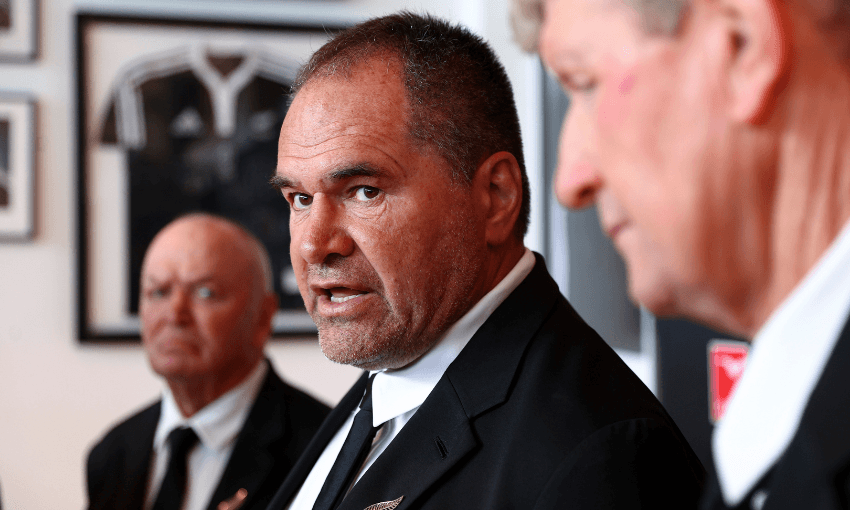
And, despite bullish noises about our depth, the reality is that we’re not massively spoilt for choice. New coach Dave Rennie has stated that “we’re a couple of injuries away from being exposed in certain spots.” Loose forward is probably the only area where several test-ready players missed out.
Nevertheless, at yesterday’s announcement, New Zealand Rugby (NZR) chair David Kirk effusively thanked Rennie and his fellow selectors and coaches for their herculean toil in settling on the chosen 34, 30 of whom were All Blacks during previous coach Scott Robertson’s truncated tenure.
But a new captain and four new faces provided the craved novelty factor and all and sundry duly professed to be “excited,” if not “very excited” or even “super-excited.” I, for one, would be fascinated to see Rennie and Taranaki dairy farmer Neil Barnes, his equally phlegmatic right-hand man, when they’re bored out of their skulls.
The selection of uncapped Hurricanes wing Fehi Fineanganofo and non-selection of 56-test first five Richie Mo‘unga highlights the contortions NZR has got itself into over eligibility.
Although Fineanganofo has signed with English club Newcastle and therefore, by NZR’s criteria, won’t be eligible for selection for next year’s World Cup, he can be picked now because he remains under contract to NZR until November. (Fineanganofo indicated he will honour his Newcastle deal if his agent can’t negotiate him out of it.)
New captain Ardie Savea and veteran midfielder Anton Lienert-Brown made the cut despite skipping Super Rugby Pacific to take lucrative “sabbaticals” in Japan. However Mo’unga, who has returned from an extended stint in Japan, isn’t eligible for next month’s Nations Championship matches or the subsequent “Greatest Rivalry” tour of South Africa because he hasn’t re-signed with NZR for long enough. Or something.
Arguably, the most significant aspect of the squad is the captaincy change. It doesn’t require 20/20 hindsight to see Robertson’s decision to make Scott Barrett captain as the first misstep of his progressively unsteady tenure.

While a fine player who, according to reports, possesses a sharp rugby mind, Barrett seemed inhibited by the captaincy. Put simply, he played better before he was captain than he did as captain which eventually and inevitably compromises your ability to lead by example. Furthermore, his laconic Pākehā farmer persona exacerbated the communication breakdown, internal and external, set in train by Robertson’s inarticulacy.
By contrast, Savea has always seemed galvanised by the captaincy, witness his inspirational leadership of Moana Pasifika in 2025. And while there may be some lingering resentment towards him in Crusaderland over his perceived – but denied – role in Robertson’s downfall, he has a head start, in terms of engaging with the public, by virtue of being a more charismatic and relatable figure than Barrett or the latter’s predecessor, Sam Cane.
(Rennie didn’t actually have to wield the axe as Barrett is unavailable for several months due to a back injury. As unsinkable and itinerant Australian coach Eddie Jones observed, “Injuries are nature’s way of rotation.” Jones’s critics, a sizeable and swelling cohort, would no doubt view this as a self-serving gloss on the carnage that accompanied his notoriously brutal training sessions.)
Although the squad announcement doesn’t give us much of a pointer on what to expect from Rennie’s All Blacks, one senses the atmospherics are about to change.
Robertson fancied himself as a story teller, a weaver of narratives and setter of motivational themes. He launched his much-heralded era with the mantra “Together We Walk”, which surely prompted as much bemusement among the players as it did indifference among the fans. If there was a theme for his second and last year at the helm we weren’t told about it.
Rennie, whose watchwords appear to be clarity and simplicity, has restricted himself to saying his All Blacks will play with optimism. It sounds facile but instilling the self-belief and confidence to play with the sort of accuracy, ambition and boldness we’ve seen from the Hurricanes is the essence of coaching.
It’s almost a decade since the All Blacks consistently played with the precision, power and flair the New Zealand public expects from their team. Indeed, for much of the time, they gave the impression of being a group whose default mindset was Murphy’s Law and playing accordingly. Replacing that straitjacket of funk with optimism won’t be easy, but it is essential.