
Five minor party leaders went head-to-head in The Press Kingmakers’ Debate last night. The panel declared Winston Peters the winner, but the ‘vibe tracker’ gave it to Opportunity’s Qiulae Wong, writes Henry Oliver in today’s excerpt from The Bulletin.
To receive The Bulletin in full each weekday, sign up here.
David Seymour (Act), Winston Peters (NZ First), Chlöe Swarbrick (Greens), Rawiri Waititi (Te Pāti Māori) and Qiulae Wong (Opportunity) met in front of a studio audience for The Press Kingmakers’ Debate last night, the first formal leaders debate of the campaign.
With the odd exception (mostly care of Winston Peters) it was a relatively quiet and polite affair, with more policy than politics and more calm than charisma. The Press’s editor Kamala Hayman and The Post’s editor Matthew Hooton both judged Peters the winner in the post-match round-table, with Hooton calling it “a well-mannered, sensible and serious debate” that exceeded his expectations. Te Ao Māori editor Māni Dunlop found it measured but wanted more fire: “It was very, very civilised.”
RNZ’s Russell Palmer wrote that Peters “seemed to think [it] was a waste of his time”. He dismissed Christopher Luxon and Chris Hipkins as “not in the same league” as other prime ministers he’d worked with, and was later seen checking his watch, telling moderators “you said 8.30” when asked if he had somewhere else to be.
Peters goes further on Working for Families
While the leaders mostly did a good job of articulating their parties’ already-known policies, a substantive moment came when Peters was asked whether he would keep the $50 weekly fuel subsidy boost to the in-work tax credit, due to expire in March. He went much further, The Post’s Anneke Smith reports. “We’re not talking about a couple of lousy dollars, it’s far more than that,” he said. Speaking to reporters afterwards, he confirmed he wanted to lift the Working for Families tax credit by $120 a week, “possibly more for some.”
Asked how he would fund it, he pointed to his proposed future fund and $100bn lined up for it, and accused reporters of ignoring his policies. Seymour estimated the promise would cost $500–$600m a year on top of the existing $400m, noting Act would publish a fully costed alternative budget.
Polite society
RNZ notes the debate was largely civil, with Wong and Seymour especially cordial. Wong told reporters afterwards: “I was expecting a little bit more bickering as we’ve been used to seeing on TV and in Parliament. But maybe that’s the influence that Opportunity is having on politics already.”
Seymour said he trusted Peters – a reversal of his position three years ago – though Peters did not return the sentiment. Swarbrick took the most jabs, particularly at Peters, sarcastically noting he “loves migrants,” to which he shot back: “The right migrant, not everybody, like you.”
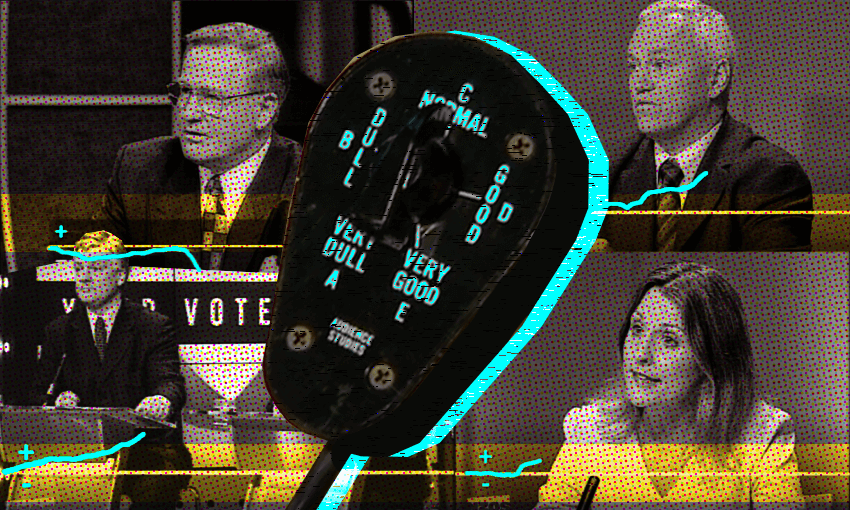
Wong (who the Herald’s Adam Pearse wrote was “largely crowded out” of the debate) won the most support on the “vibe tracker,” an interactive live reflection of audience opinion hoping to recreate the buzz of the infamous worm from the 2002 election debate. She got 35%, ahead of Swarbrick on 29%, Seymour on 23%, Peters on 9% and Waititi on 4% – which may or may not be due to the instructions Opportunity sent out to its supporters on how and when to up-vote their leader (not to say the other parties didn’t do that too, just that I haven’t seen screenshots of those emails).
The debate covered cost of living, health, superannuation, AI and jobs. Writing for The Post, Luke Malpass noted the smaller parties are on track to take about 50% of the vote between them, and that the smaller-party format has advantages: “rather than trying to appeal to the big flabby middle of politics, they are appealing to narrower groups of voters.”
In the post-debate analysis, Hooton declared Luxon and Hipkins the real losers of the night, saying “any one of these people would be a better prime minister than them.” It’ll be interesting to see how the two major-party leaders perform by comparison when they go one-on-one on TVNZ next Tuesday.