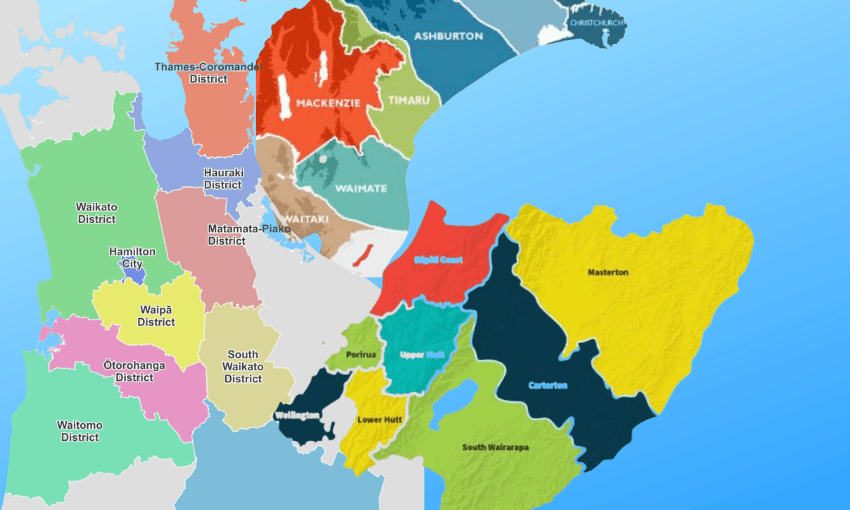

With just over a fortnight until the deadline, the question is no longer whether all regions will meet it, but whether ministers will impose their own solutions on the regions that don’t, writes Henry Oliver in today’s excerpt from The Bulletin.
To receive The Bulletin in full each weekday, sign up here.
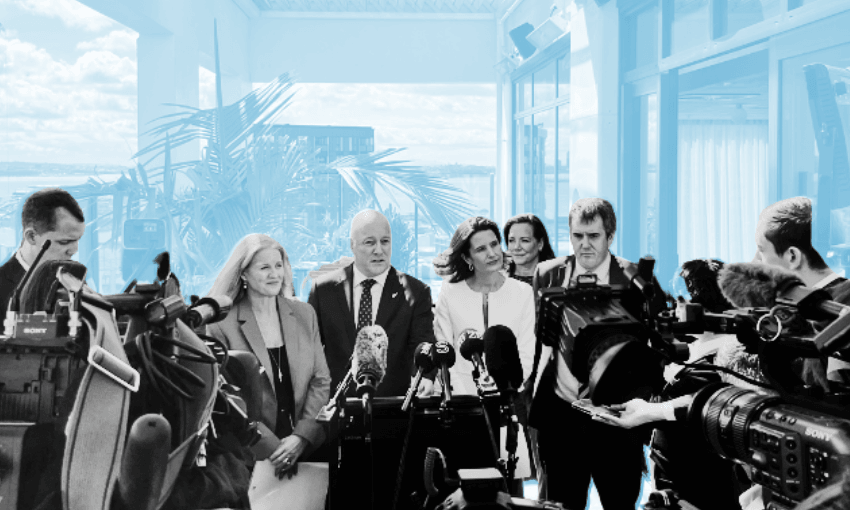
When ministers Simon Watts and Chris Bishop gave every non-Auckland council three months to develop amalgamation plans or face an imposed government model, they set off a scramble that the local government sector – not known for its speed – has found deeply stressful. As the 9 August deadline looms, The Spinoff’s Joel MacManus has graded the national progress, finding that while some regions are earning gold stars for playing nicely, others are in “absolute shambles”, with warring councils hitting impasses or simply too far behind on their homework.
The picture is one of reluctant siblings being ordered to get along, with the government learning that amalgamation is not as simple as it seems. MacManus rates Hawke’s Bay and Northland as “on track” – each with three councils agreeing to single-council plans and lone holdouts (Kaipara and Wairoa) not expected to be major hurdles. Bay of Plenty’s three councils unanimously voted to pursue amalgamation, though reluctantly, with one councillor calling the process “blackmail”.
Regions “at risk of failing” include Wellington, where Upper Hutt remains sceptical and the Wairarapa may go its own way; Christchurch, with five competing options and Selwyn reluctant to take on city debt; and Hamilton, where a grab-bag of Waikato proposals includes the delightfully named ‘Megatron’ option.
The “absolute shambles” category covers Nelson-Tasman, Southland and Taranaki (all suffering town-versus-country divides), the Horizons area (whose councils don’t plan to submit anything at all), and Otago – deemed the most shambolic – where Dunedin, Clutha and Queenstown-Lakes cannot see eye-to-eye.
Wellington’s fracturing and the backstop threat
In the capital, a leaked email from Wellington mayor Andrew Little to his councillors – obtained by The Post’s Justin Wong – reveals Upper Hutt is “unlikely to agree” to join a proposed metro authority with Wellington City, Lower Hutt and Porirua. Upper Hutt mayor Peri Zee reportedly told the Mayoral Forum that inclusion against her council’s wishes would “amount to co-opting them against their will”, and has arranged for an amendment writing Upper Hutt out of any proposal. Little’s email also noted Horowhenua will not participate and the three Wairarapa councils are likely to form their own unitary authority.
The financial stakes are significant: MartinJenkins analysis projects a metro authority would cost $269m to establish but deliver $930m in efficiencies over 25 years – a net saving of around $159.80 per property per year. Councillor Andrea Compton asked whether Upper Hutt pulling out would risk the Government invoking the “backstop” – the provision allowing ministers to impose a structure themselves. Little said a fragmented proposal inconsistent with the government’s planning legislation “does pose a challenge”, implying that government intervention could follow regardless of local preferences.
Going it alone: Wairoa and Ashburton dig in
Wellington is not alone in facing holdouts. In Hawke’s Bay, the Herald’s Gary Hamilton-Irvine reported that Wairoa District Council has resolved not to participate in regional amalgamation at all, opting instead to investigate becoming a standalone unitary authority. While Napier, Hastings and Central Hawke’s Bay back a single Hawke’s Bay-wide council, Wairoa mayor Craig Little said efficiencies would flow to the centres, not to the edges: “Where we are… we will suffer.” Councillor Jeremy Harker added: “There is a real fear of the people of Wairoa that if we become part of a single unitary council, we will lose our voice.”
In Canterbury, The Press’s Luisa Girao reported that Ashburton District Council has delayed its decision, narrowing five options to three – standalone, a joint authority with South Canterbury, or a broader Mid-North Canterbury option – and will hold a meeting on 5 August, just four days before the national deadline. Mayor Liz McMillan said the delay was necessary to understand neighbouring councils’ plans, noting the Canterbury Mayoral Forum had agreed in principle to continue developing a regional approach under a “leaving no man behind” framework.
With just over a fortnight until the deadline, the question is no longer whether all regions will meet it – they won’t – but whether ministers will be forced to step in and impose their own solutions on the regions that don’t.