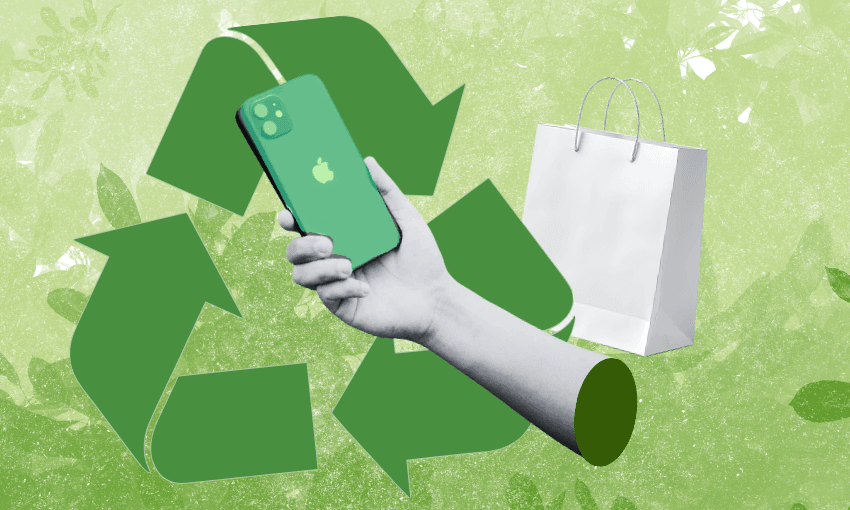



Need a new phone? A refurbished device is a greener option – and now, in an NZ first, you can buy one directly from One New Zealand.
Cast your mind back to 1994. IBM has just released what many consider to be the world’s first ever “smartphone” – a clunky touchscreen device that most people dismissed as a novelty and nobody knew quite what to do with. It took another decade for BlackBerry to turn the concept into something the business world actually wanted, and even then the smartphone remained firmly the territory of executives and early adopters.
Then came the iPhone in 2007 and everything changed. A single device that could make calls, send emails, take photos and play music – all via a touchscreen – was a revolutionary concept that created a global cultural shift. The rest is history: today, it’s estimated that around 70% of the global population owns a smartphone, long surpassing the humble PC in market share.
While the world has gained a lot from these advancements, there are costs to rapid growth. On an environmental level, manufacturing smartphones is a high energy, carbon-intensive process. From raw material extraction to the production of parts that make up your phone, manufacturing typically accounts for the majority of a device’s lifecycle footprint. Higher-end phones with more internal storage are usually at the higher end of that scale.
Mining for the metals and minerals needed to make phones has also had a serious impact on natural ecosystems, leading to habitat destruction, soil erosion and water contamination. And while many of these valuable materials can be reused when phones reach their end of life cycles, most devices simply end up going to landfill anyway.
But something is starting to shift. Cost of living pressures mean people are looking at ways to save money while also considering environmental impacts. In recent years, the assumption that you should upgrade your phone every year or two has started to lose its hold. Partly it’s economic: new phones are expensive – especially when the small improvements between generations make shelling out for a new one increasingly hard to justify. Partly it’s a cultural thing: there’s a growing “retrotech” sensibility among people, especially Gen Z, who aren’t particularly fussed about having the latest thing. Whatever the reason, people are holding onto their phones for longer – and when they do replace them, they’re increasingly open to a different kind of “new”.
That’s where refurbished phones come in. While it’s not exactly a revolutionary idea – secondhand handsets have been around as long as the mobile phone – what has changed is the size and scale of the market. The global market for refurbished devices, already growing rapidly, is forecast to be worth over US$200 billion by 2033 (up from US$88 billion in 2025).

In Aotearoa, refurbished phones have mostly been the domain of private resellers – fine if you trust them, but not always the most secure way to buy a phone. Now, decades after the first mobile phone user decided it was time for an upgrade, that’s finally changing. One New Zealand has become the first mobile operator in New Zealand to sell refurbished phones directly to customers, bringing a level of quality assurance to the secondhand market that it has historically lacked, with a 24-month warranty.
Nicky Preston, head of sustainability and corporate affairs at One New Zealand, says it’s not just about offering customers a more affordable option – though it offers that too. It’s about doing something that makes a real environmental difference.
“As a business, we really want to look at ways of encouraging sustainability that are practical and make sense, like here, where cost and carbon savings go hand-in-hand,” says Preston. “While initiatives like planting trees are great, as a telco we can have greater impact by focusing on what’s integral to our business. You can’t make the most of a mobile plan without a smartphone, so we’re helping extend the life of these phones.”

To quantify just how much of a difference it could make, One New Zealand commissioned independent strategy and technology company The Lever Room to crunch the numbers. Its results were striking: it found that, on average, buying a refurbished phone avoids 34kg of CO₂ emissions, representing 45% lower lifecycle emissions than an equivalent new device.
“We hear a lot about e-waste being a huge environmental issue, but from a climate perspective, a big part of the opportunity comes earlier,” says The Lever Room founder and CEO Rebecca Mills. “Keeping devices in use for longer can reduce the need for new manufacturing – and that matters, because our modelling shows manufacturing is where most of a phone’s carbon footprint actually sits. “Refurbishment helps shift the question from ‘what do we do with old phones?’ to ‘how do we get more value and longer use from the phones already in circulation?’”
For now, One New Zealand’s scheme uses phones it has collected from its trade-in programme, as well as overseas markets. “As we grow and mature the scheme, our hope is to source more phones traded-in by our customers, refurbish them, and then resell them,” says Preston.
“Our current scheme is still giving a second life to an old phone. This is a big step in creating that product circularity loop.”