‘Consider me bitten’: Stakes by Noelle McCarthy, reviewed

Noelle McCarthy in her element (Photo: Kristine Crabb)
Made possible by

Claire Mabey finds herself smitten with Stakes, the follow up to Noelle McCarthy’s award-winning first memoir Grand.
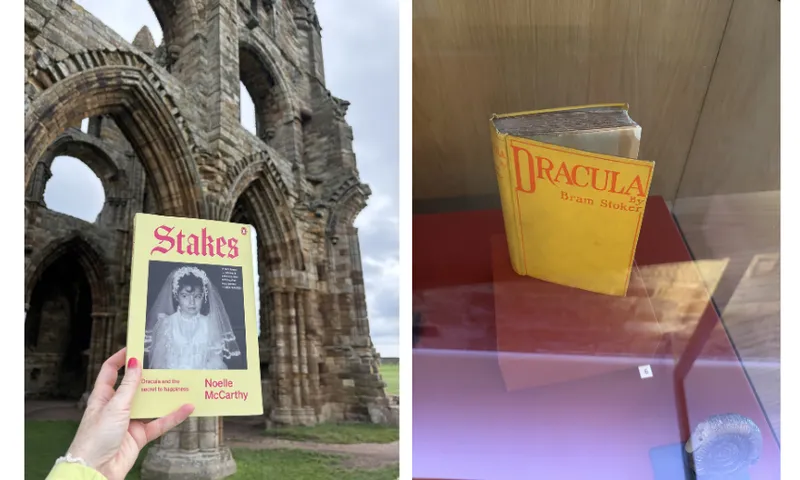
You can see the ruins of Whitby Abbey from miles away. The first time I spied it, out the window of a bus that lurched around Yorkshire’s narrow coastal roads, I got chills. It’s so big. A monumental, undeniable fact of the past watching over us from its many eyes. You can see why Bram Stoker imagined horrors doing mischief in its shadows. The second time I saw the Abbey, a day later and on foot this time, I took Noelle McCarthy’s Stakes with me. I carried the book in my backpack up the famous 199 steps, past St Mary’s church, into the arms of the Abbey and laid Noelle inside one of the rectangular depressions carved into its massive stony side. I took a photo, sent it to the author. I know what it’s like to have a book get under your skin, and through a book an author, and through an author a place. Bram Stoker’s Dracula pulses through Stakes. The story of a vampire, of fear of death, of bearing witness, of a writer trying to understand the impossible. In Stakes Noelle McCarthy writes her heart out to the thrum of Dracula in her veins and I am obsessed.
As McCarthy says, some books explain us to ourselves. Or at least their shadows, their complexities, put a mirror up to our own. Stakes is, like Dracula, essentially about death: the horror of it, the layers of it, the unlikeliness of it – what it does to the living. McCarthy opens her memoir with a small death – a hell of a hangover. She’s in bed, the Morning Report theme starts playing, “bright trumpets, tearing through the bat-wing membrane between sleeping and waking … And me, half-dead from the banging in my head, fighting consciousness. Every dirty part of me hurts.”
There are those sharp brushstrokes – the sentences that made Grand, McCarthy’s first book, so explosively good. There’s a force to McCarthy’s writing – not beautiful, but blazing, fang sharp, a restless layering and looping in service of memory. And what a fucking memory! At the 2025 Auckland Writers I saw her interview the great memoirist Leslie Jamison and in that conversation Jamison emphasised that it’s specificity that makes great writing. Every page of Stakes is an assemblage of specific detail – visceral, visual, so idiosyncratic and vivid I often forgot I was reading words, the images flying so fast I was there, with her, through it all.
“It all” is the long tail of trauma, to put it simply. In Grand we met McCarthy’s brilliant, hard, funny, kind, mean, wonderful, alcoholic Mammy Carol, and god I couldn’t get enough of her. In Stakes we get to go back and visit her again. Are two books even enough for such a person? When you read Carol you can see, hear, why McCarthy must write her, pour two books out in relatively quick succession. Memoir is an opportunity to raise the dead: resurrect them on the page and let them speak. It’s also a chance to turn those voices up, strain to listen to what they never quite said, or said when you weren’t in a position to listen. Assembling memories alongside the determined, conscious immediacy of putting one word in front of another is the privilege of being left behind bearing the wounds your ghosts have handed to you. The mission of Stakes, where the urgency comes from, is the confronting of those wounds – peering in, analysing the shape of them, the precise nature of their pain and opportunity.
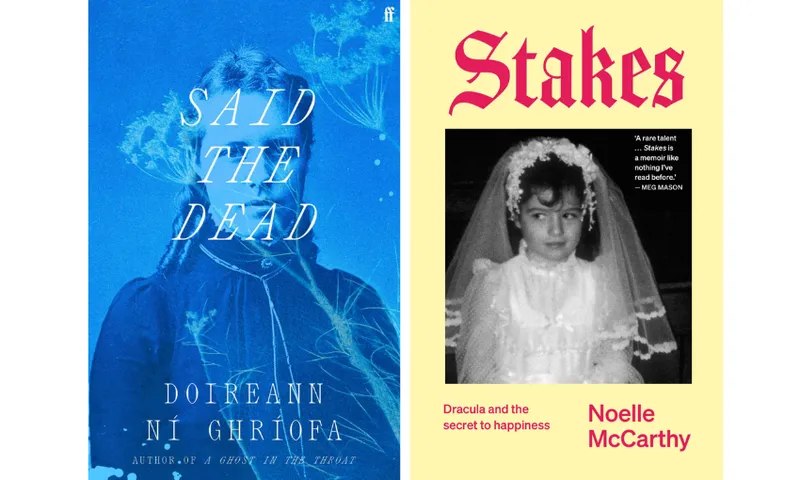
Published at almost exactly the same time as Stakes is Said The Dead, by Irish writer Doireann Ní Ghríofa. Said The Dead is a shapeshifter that blends fiction, research and memoir to tell the story of the patients of Cork Mental Asylum, known as Our Lady’s, the same asylum where Carol worked as a nurse. As the Abbey towers over Whitby, so Our Lady’s looms over McCarthy’s family, her Cork: “the power that place has always had, to mix up time and space … Grey stone walls and Gothic arches like witches’ hats, a tangle of stairs and floors and corridors. Like an Escher painting, Mammy in the centre.”
We visit and revisit Our Lady’s throughout Stakes at different times – a storied, scary place, an institution, then a ruin, then flash new apartments with a spa. It’s a site of violence against patients and against Carol. The violence reverberates out of Carol and down through McCarthy following her to New Zealand and back to Cork and into motherhood and onto the pages we’re reading and beyond.
Both Stakes and Ní Ghríofa’s Said The Dead are part of a growing collection of literary work by Irish writers reckoning with a trauma both collective and individual: Claire Keegan, Audrey Magee, Michael Magee, Anna Burns, Elaine Feeney, many more. McCarthy’s approach is through the lens of herself, the quickness of her mind, the close reader, the astonishing kaleidoscope of her memory, her rage, her grief. Ní Ghríofa’s way is to haunt backwards, slipping herself as “the Reader” into the hospital’s casebooks, hiding there, witnessing but not interrupting. Through their work, footsteps laid down word by word, the horrors clamouring to get out all these years come finally loose, turning towards the searchlight of the writer who is pained and angry and compassionate enough to hunt for them.

But what do you do once you know? Once you can see? What if there are mirrors in the shadows? Some of the most moving passages in Stakes are when McCarthy is a new mother, a kind of horror in itself, and the Me Too movement is exploding in that other world, outside of the bed and the baby. Rage crackles on the page, and it’s so fucking good to read it. “‘All I’m saying,’ I grit out through my burning chest, ‘is that it’s fucking complicated.'”
McCarthy is talking to her husband John about consent, the definitions. Women know this conversation. McCarthy says it all: “You can consent without necessarily wanting to have sex. It isn’t always some creep, holding you down, in a hotel or wherever…”. It’s sickeningly familiar. It’s a godsend to read a wife fight with her husband over it the way women do have to fight, even with the chosen, good ones. And the drink, too. Several times in Stakes I thought of the Mama Hooch case, of all the millions of women who are and have been made to feel like alcohol somehow eliminates their agency. It’s enough to drive you to madness.
As well as vampires and madness and fear of death, particularly women’s, I always thought Dracula was about writing. It’s a novel in letters, journal entries, newspaper articles and all compiled and shaped by Mina with the “man’s brain” so intelligent and resourceful. In the novel Mina is bitten, doomed to become a vampire, telepathically connected to Dracula, but is in the end freed from the bloody curse. With her freedom she makes literature, love and a baby. Mina … McCarthy. All great gothic literature pays attention to doubles.
When McCarthy gets sober, when the recurrent “bright shards of pain” (I winced every time – my 20s being a parade of mornings and days like this, feeling like shite with the only remedy being another night out) give way to AA meetings and daily runs down the tow path and newfound mental clarity, McCarthy is reborn as a writer. It’s one of Stakes’ great surprises to discover McCarthy was (is?) working on a novel about a woman obsessed with a vampire.
The clues of someone with a lifelong attention to fiction are there, though. “At nine o’clock every night, a tiny man comes out of the house in front of my cottage and locks the two big black gates at the bottom of the Rock Steps with a giant padlock, like something from the Brothers Grimm.” And just down the page a bit: “I have a vision of myself going out in my pajamas in the middle of the night, passing 20 Euro through the bar to my brother, like a scene from Midnight Express.” Stakes is full of such comparisons: trying to land the truth of an unreal situation by calling on fiction. Stories, films, books are as powerful as memories. When you strike those moments in life that are slippery, uncanny, it’s art that anchors. Here’s a moment from the birth scene (of Eve, McCarthy’s baby): “Doctor Cat, the sheep on her surgical cap saying calmly, ‘I’m going to cut you now, or else you’ll tear.’ Bringing the scalpel down on me, a wicked little slice. Drugged, Pet Sematary came into my head.”
When you think about it, life can only be surreal. Memories don’t return in a linear way even as they’re happening. There’s always a double, triple, view: stories sliding into stories. McCarthy is an absolute master of the memory surreal. I read Stakes in the UK, on my own literary pilgrimage/obsession for a novel that lives in my bones, and was both there and not there. At Whitby Abbey I was half wandering inside a novel about St Hild I’d read only weeks earlier, and partially with Noelle McCarthy, and some part of me was trying to call up home because, as McCarthy says when she leaves John and Eve for Cork alone, home ceases to exist when you’re not there. What is it like then to grow up in one country but live so much of life in another? In Stakes, Ireland and Aotearoa meld, like two blobs of oil sliding around each other with nothing in between.
At the end of Stakes, during the visit to Whitby Abbey, thoughts of bats give way to thoughts of kingfishers “flying low over the stream that crosses the paddock. Past the cabbage trees.” We’re in Whitby and we’re in McCarthy’s home in Featherston; we’re with the goths in Whitby committing to the bit; we’re with Mammy who “kept every card I ever sent … Every Christmas card and birthday card and every dumb no-reason card with New Zealand birds on it. Tűĩ and korimako, and little blue penguins.” Time and space are slippery and can’t be kept separate or quiet. “Gothic is the mode that contains the unspeakable. That contains titanic forces: life and death, good and evil. That mixes up time so it’s never a straight line.”
With Grand, McCarthy announced her talent. With Stakes she’s driving it home. Consider me bitten; another, truly brilliant, book enters the blood.
Stakes by Noelle McCarthy ($40, Penguin NZ) is available to purchase from Unity Books.
The Spinoff Books section is proudly brought to you by Unity Books and Creative New Zealand. Visit Unity Books online today.

Claire Mabey
Claire Mabey is a children's author of The Raven's Eye Runaways, The Raven's Eye Rebellion, and a picture book Cass and the Beast illustrated by Jill Calder. For a long time Claire worked on literary festivals and is the founder of Verb Wellington. She lives in Te Whanganui-a-Tara with her partner and son.


