The mysterious origins of the NZ meat pie

The meat pie is a national treasure across two nations. Image: Tina Tiller
For a dish that is so important to our nation, precious little is known about the development of the meat pie.
The meat pie is one of the unofficial national dishes of New Zealand and Australia: popular both as a cheap, everyman food and as a pricey artisanal creation. And yet, it’s hard to nail down exactly what makes it different. Various forms of pies with meat fillings can be found in almost every cuisine on earth, from empanadas in Latin America to kreatopita in Greece and lihapiirakka in Finland.
The New Zealand and Australian version of the meat pie, with its frustratingly vague name, is difficult to separate from other forms. Much like the US Supreme Court’s definition of pornography, it’s difficult to describe but you know it when you see it.
To put some strict criteria on it, the meat pie we’re talking about should be a single-serve size, encased by pastry on all sides (the Bakel’s Pie Awards specify that flaky pastry may be used on the top and shortcrust must be used for the base), it is cooked in a pie mould rather than being hand-raised, and it contains a saucy filling (such as meat with gravy, cream sauce, or curry).
There is something undeniably unique about this regional variation of the meat pie. But for a dish of such cultural importance to two nations, precious little is known about its development. So The Spinoff has had a crack at tracing its origin.
The history of pies is almost as long as the history of agriculture itself. As soon as humans developed bread, the idea of wrapping it around a filling was rather obvious. There is evidence of a honey-filled bread “pie” in ancient Egypt and a Sumerian recipe dated to 2000BC describes a pie made of chicken gizzards with sauce covered with a crust.
Pies made for a nutrient-dense food that could utilise meat off-cuts, the bread or pastry exterior helped to preserve the filling, they could be eaten hot or cold and, depending on the style, were portable for a labourer working away from home.
In British culinary tradition, meat pies have historically occupied a rare status across classes; serving as both a working class staple and a special dish that could be prepared for high-ranking people on special ocassions. In the Canterbury Tales, 14th century English writer Geoffrey Chaucer described a talented chef who could “wel bake a pye”.
When European immigrants began moving to New Zealand and Australia, they brought with them the pie traditions of their homelands: Melton Mowbray pork pies, scotch pies, steak and kidney pies, Irish Dingle pies and many more.
The first recipe for meat-based “pie” in a New Zealand newspaper is a rice-based monstrosity which appeared in an 1843 edition of the Nelson Examiner and New Zealand Chronicle.
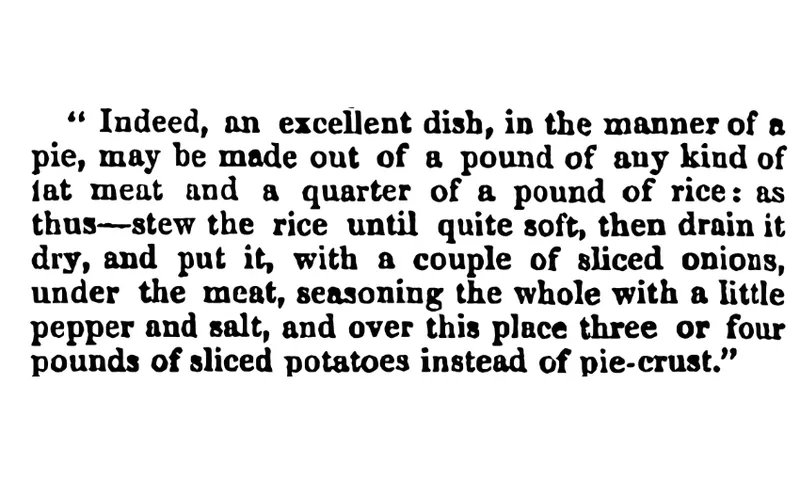
Several advertisements for pie dishes and crockery appeared in newspapers from the first decade of British settlement, and pie-related idioms such as “eating humble pie” and “finger in the pie” were common – clearly, the British pie-making tradition had made it across the world.
In Wellington that same year there was a mention of pies being consumed at a council meeting at Barret’s Hotel, but the 1840s are otherwise a dark age for pies in New Zealand. The primary mention of pies in this period came from crockery suppliers advertising pie dishes.
The first ad for a meat pies in New Zealand comes from 1856, when the Temperance Coffee Room on High Street Dunedin, advertised “hot pies” alongside soup and sausages, though there is no mention of what kind of pie this was.
In Nelson, founded by primarily English settlers, butchers started advertising pork pies as early as 1858. In Dunedin, made up of a Scottish diaspora, mutton pies reigned supreme – drawing their influence from Scotch Pies.
These pies are made from a hard crust known as hot water pastry, were raised by hand, and filled with a solid chunk of spiced minced meat rather than chunks of braised meats in a saucy gravy. You can still find evidence of the tradition in small towns in Otago, where many bakeries pride themselves on their mutton pies. The big difference is that the modern version uses the softer shortcrust and flaky combination common for other New Zealand meat pies.
From the 1860s onwards, ads for mutton pie settlers became a regular feature in newspapers from Dunedin, Timaru, and Queenstown, and the West Coast. In 1876 the Otago Daily Times reported on a fire in Dunedin which burned down a “travelling mutton pie shop and coffee stall” – the first clear New Zealand evidence of pies being sold as a portable takeaway food.
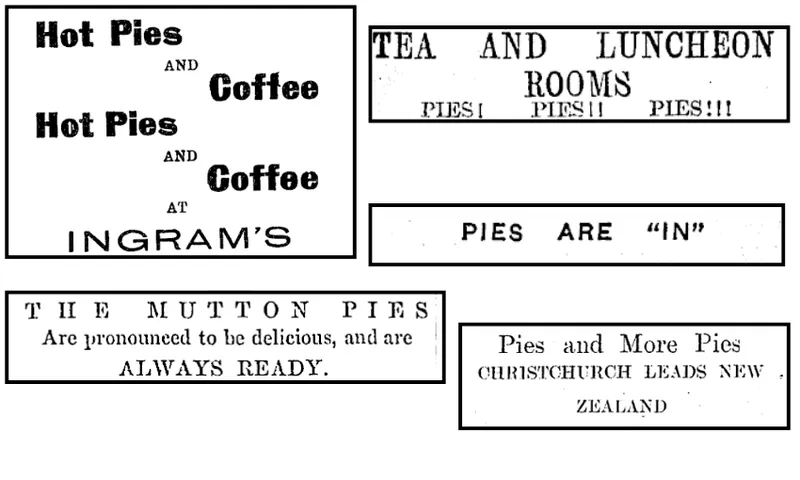
Beef and steak pies appeared on the occasional ad in the 1860s and 70s but seem to have become increasingly popular around the turn of the 20th century. In 1887, Ngā Puhi leader and Māori MP Ihaka Hakuene died of suspected poisoning from a beef steak pie.
The earliest New Zealand recipes for beef pies were large family-style pot pies topped with a layer of pastry – one recipe from 1891 even called for the inclusion of four hard boiled eggs and a few oysters.
When it comes to the classic New Zealand meat pie, there is no clear origin point. There was no invention, no eureka moment. It was a product of evolution, a gradual iteration on millenia of pie tradition that eventually led to the creation of a subtly unique dish.
However, if you are the kind of reader who demands more specific answers, then here’s my best theory: In 1898, the Otago Witness published a recipe for Little Meat Pies. It called for the pies to be cooked in patty pans, with thinly-rolled pastry on the base as well as the top, with various minced meat and “a little good gravy”. It’s the earliest example I’ve found of a recipe which is fundamentally identical to a modern New Zealand meat pie.
Joel MacManus
Joel MacManus is a senior writer for The Spinoff. He previously worked at RNZ and Stuff, and began his career at Critic Te Ārohi. His writing explores the political, economic and cultural systems that underpin modern New Zealand. He won the 2025 Voyager Media Award for Best Columnist, Opinion or Critique.


