On this day in 1835: He Whakaputanga and the vision of a whenua rangatira

The pou that stand at Te Tou Rangatira at Waitangi, where He Whakaputanga was signed. (Design: The Spinoff).
Signed on this day in 1835, He Whakaputanga declared Māori independence and laid the constitutional foundations for te Tiriti o Waitangi.
One hundred and ninety years ago, on the 28th of October 1835, a group of 34 rangatira signed He Whakaputanga o te Rangatiratanga o Nu Tireni – the Declaration of Independence. In the years that followed, a further 18 rangatira added their signatures, though copies were not taken around the country as would be done later with te Tiriti o Waitangi. At the time, this declaration was a significant statement of the country’s independence. Subsequently, He Whakaputanga came to be seen as an essential precursor to te Tiriti o Waitangi and it remains an important constitutional reference point, informing our understanding of te Tiriti and the ways in which Māori political authority can be expressed.
He Whakaputanga is a different type of legal instrument than te Tiriti o Waitangi. It is a declaration, rather than a treaty. A treaty involves two or more sovereign parties coming together in a negotiated agreement. You might expect to see give and take, compromise and exchange, ultimately, for the mutual benefit of the parties. A declaration, on the other hand, is a unilateral statement made by the signatories to the rest of the world. No agreement or permission from anyone else is required. He Whakaputanga is a statement made by the rangatira who signed, which declares New Zealand (Nu Tireni) to be an independent state.
Furthermore, it declares that it is the rangatira themselves who collectively hold constitutional authority in this independent state and, importantly, they stress that nobody else exercises that kind of authority here. He Whakaputanga contemplates that the rangatira will exercise that collective authority by coming together every year to pass laws. This didn’t end up taking place, at least not in the form of a Westminster-style parliament. However, Ngāpuhi evidence to the Waitangi Tribunal noted that the hapū of Ngāpuhi had already started coming together in new ways prior to 1835, as a response to the arrival of Pākehā, and that these new forms of political relationships continued to develop after the signing of He Whakaputanga.
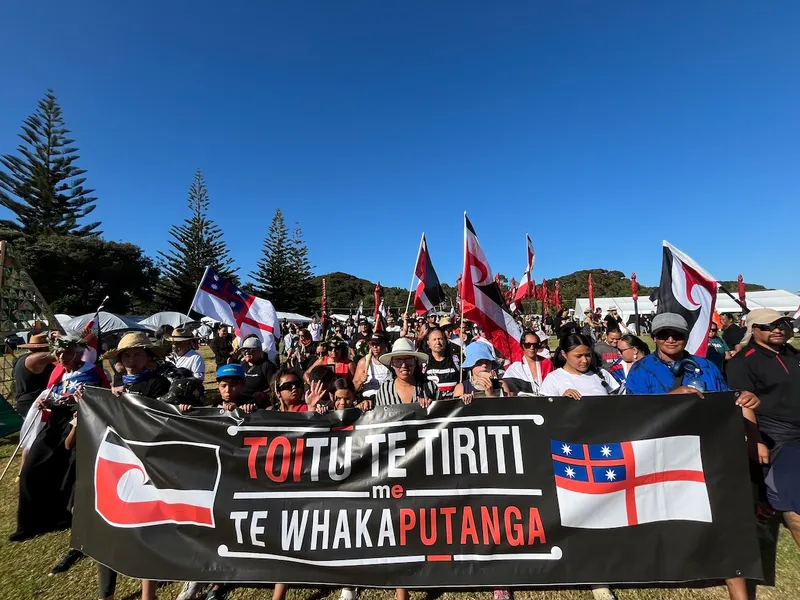
In He Whakaputanga, the rangatira thanked King William for his acknowledgement of the flag of the United Tribes of New Zealand that they had adopted the previous year and sought the King’s protection to threats against their independence. Copies of He Whakaputanga were sent to the New South Wales government and the Colonial Office in London.
James Busby, the British government official in Aotearoa at the time, had drafted the English version of the declaration, called the rangatira together to discuss it and encouraged them to sign. Busby was concerned that another country might try to intervene in New Zealand and also saw the declaration as a way of tying New Zealand closer to Britain. But it would be a mistake to see He Whakaputanga simply as Busby’s creation.
While Busby authored the English text, there is evidence that indicates Eruera Pare Hongi, described as “te kaituhituhi” or “the scribe”, had a role in determining the concepts and phrasing used in the Māori text. It is certainly notable that, although often addressing similar matters of constitutional authority as te Tiriti, He Whakaputanga uses very different language, which suggests the substantive involvement of Hongi.
For example, in He Whakaputanga, Kīngitanga and mana are key concepts used to translate the English phrase “all sovereign power and authority”. One can see immediately that the kāwanatanga granted to the Crown in te Tiriti would be understood as being something other than sovereignty. Otherwise Kīngitanga and mana surely would have been used again. And the term “kāwanatanga” was used in He Whakaputanga to describe a function of government.
Another term that is used in He Whakaputanga, which is very significant, is “he whenua rangatira”. This term is used to describe New Zealand as “an independent state”. Again, the input of Eruera Pare Hongi can be seen in this term. It draws on two profoundly Māori concepts: “whenua” – the word for land, expressing the deeply layered relationships between people and land that are embedded in te ao Māori; and “rangatira”, a leader whose authority also sits within a relational network of kinship. Manuka Henare described “he whenua rangatira” as “the most noble of land; inclusive prosperity and wellbeing in a time of peace and harmony”. This vision of an independent nation state provides us with a constitutional foundation that is radically different from a sovereign asserting control over people and land in a hierarchical power structure.
First signed less than five years before te Tiriti o Waitangi, some see He Whakaputanga simply as a stepping stone towards te Tiriti. I think it is certainly more than that – it is not only one of the reasons that a treaty became necessary for the British Crown to exercise some authority in Aotearoa, but it also provides context for how we interpret important terms in te Tiriti. When the Waitangi Tribunal examined te Tiriti in light of He Whakaputanga, its conclusion was unequivocal: Māori did not cede sovereignty by signing te Tiriti.
He Whakaputanga expressed Māori authority in a way that could be understood and recognised by the British Crown and other colonial powers. It did not override the authority of individual hapū, but set out ways in which the rangatira could exercise their collective governmental authority. And it is explicit that no other governmental authority can operate here without the consent of the rangatira. In te Tiriti, the rangatira do consent for the British Crown to exercise “kāwanatanga”, but it is clear that this is a delegation or a carve out from ongoing Māori authority, expressed as “tino rangatiratanga”, and not the other way around.
Therefore, He Whakaputanga remains an important pillar in our constitutional architecture. It underpins and reinforces the rights in te Tiriti and other human rights instruments. Matike Mai Aotearoa, the Independent Working Group on Constitutional Transformation led by Moana Jackson and Margaret Mutu, used He Whakaputanga as one of four constitutional touchstones – the others being, kawa and tikanga, te Tiriti o Waitangi, and relevant international rights mechanisms. When New Zealand endorsed the United Nations Declaration on the Rights of Indigenous Peoples (UNDRIP) in 2010, Sir Edward Taihākurei Durie noted: “We have completed the trilogy. The 1835 Declaration acknowledged indigenous self-determination. The 1840 Treaty upheld it within the structures of a state. This Declaration [UNDRIP] now confirms it and says how it should be applied.”
The current coalition government has explicitly rejected UNDRIP and it appears to be doing everything it can to undermine Māori rights and weaken the recognition and implementation of te Tiriti. In this context, the powerful statement of independence in He Whakaputanga and its vision of a whenua rangatira is more important than ever.

Carwyn Jones
Carwyn Jones (Ngāti Kahungunu) is Kaihautū of Te Whare Whakatupu Mātauranga at Te Wānanga o Raukawa and teaches into the Māori Laws and Philosophy programme there. He is also an Honorary Adjunct Professor at Te Kawa a Māui (School of Māori Studies) at Te Herenga Waka – Victoria University of Wellington. He is one of the authors of Treaty Law: The Principles of the Treaty of Waitangi in Law and Practice.


