


You would think books would be full of wise mothers to learn from. Actually, they’re a library of missteps, aberrations and eccentricities.
In 2021 when I was pregnant and padding around with my expanding universe, I began to look in earnest for all my mothers in books. Let me bring them together, I thought. Let me gather their wisdom and harness it for my own good, and for the good of this child. I thought there would be dozens to prompt me about the powers of the maternal being, the irrefutable bonds of love between a mother and her child.
Instead, I had absorbed a library of missteps, aberrations and eccentricities.
I have been looking for mothers ever since.
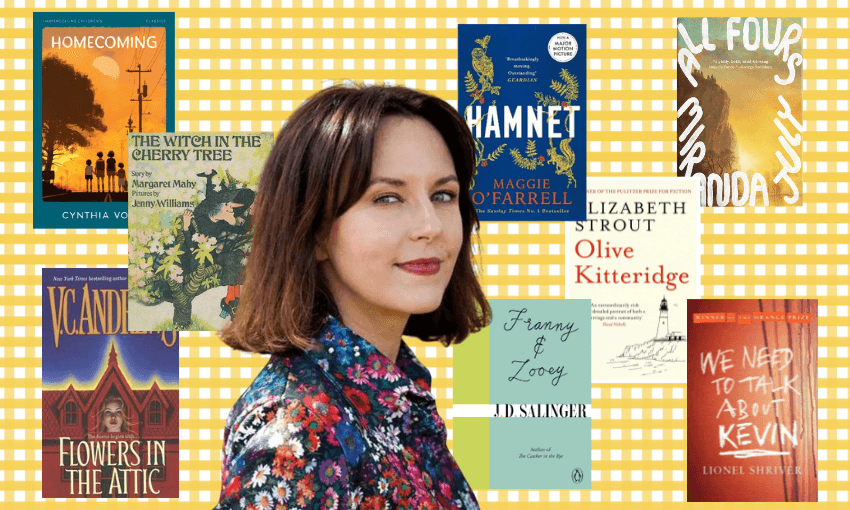
I nudged the book out from a dusty lineup of YA fiction and peeling picture books with my toe, and let it fall onto the carpet. Homecoming by Cynthia Voight. I didn’t even have to open the book to recall these things about her:
“She slung her purse over her shoulder and walked away, her stride made uneven by broken sandal thongs, thin elbows showing through holes in the oversized sweater, her jeans faded and baggy.”
She is the enduring memory of a literary mother from my adolescence; a fragile mythology walking away from her children in a carpark, disappearing in a heat shimmer above the concrete while they watch through car windows, not knowing it’s the last time they’ll see her.
In Homecoming, Dicey, the eldest of four children, leads her siblings across the country to find their grandmother, once they finally realise their mother is never coming back.

I first read that book when I was 11. My understanding of a mother on the edge was tromping downstairs to find my own sitting on the bottom step, wielding a mop like a weapon and growling “Do not even THINK about going past me,” while the wet cork tiles behind her shone, turning her silhouette into gleaming calligraphy. I still checked her shoes, though. Just quickly, as we’d pile into the car, I’d run my eyes across her sandals (ankle strap, tan) to check for wear and tear. Walking behind her at the supermarket I watched her gait for imbalance.
Reading the novel again at 41 I was struck by Voight’s accuracy. You do let things fall apart when you’re struggling with mental health. I did, anyway. In a darker place in my life, the idea of repairing a shoe or darning a hole in a jumper would have overwhelmed me to the point of paralysis. Check your sandals before this baby comes, I told myself.
Corrinne, in Flowers in the Attic, is another mother who took up real estate in my brain. Unspeakably gruesome to lock your children in an attic and poison them like mice. Her mother in turn, an utter monster. I was haunted by those women, by what could compel such cruelty. Had something happened to Virginia Andrews herself to prompt this? I became obsessed with that series. My mother, on yet another trip to the library, and assessing the pile of books in my arms with exasperation: “How many books can that woman write?”
Eva Katchadourian in We Need To Talk About Kevin, paralysed by the thought her child had become a school shooter because she didn’t love him when he was born; she did not have the vital maternal instinct that is apparently synonymous with motherhood, and felt the ostracism of the world around her as she cringed in shame and fear for what she grew inside her. This, I assured myself, could not happen to me. Absolutely not, when I so desperately wanted to be a mother. Thank you Lionel Shriver, I suppose, for the day I lost to research about the mothers of psychopaths. I looked up their traits and behaviours after I had recurring nightmares while pregnant that my child might end up like Kevin.

My own mother really enjoyed that book. She has always liked alarming books, come to think of it, which is so at odds with her kindness. The missing shrew in that book came back to haunt me. Much has been noted of the direct link between animal cruelty and human violence. The implication of that lost shrew is that Kevin killed it, signposting he was capable of much more.
“Remember that mouse you killed, Mouse?” Mum asked me after a discussion about Shriver’s shrew. I smiled and winced at how neatly my nickname matched my misdemeanor. In kindergarten I killed a mouse by holding it too tightly, by loving it too much. According to the kindy roster it was my turn to have a mouse weekend, and I was thrilled. Then I was destroyed by the sight of the insides of a mouse on its outside, bulging through an impossibly tiny mouth. Then I was grateful, because my mother took me to the pet shop and bought an identical white mouse, and in the car on the way home, she turned in her seat at the lights and said “We won’t tell kindy about the mouse. Nobody has to know.”
You never know where a sliding door might take you. That mouse could’ve been the beginning of something other than a fierce love and protection for every animal, insect, crustacean and life form on the planet. But I got lucky twice: my mother loved me, and she was my comrade.
When I find out I’m having a boy I think of her straight away: Olive Kitteridge, implacable, and disconnected from her grown son Chris. He barely likes her. The strain of their relationship hovers in her weather system. She has regrets she will not address. I love Olive, but I recognise myself in her short temper, and unrelenting stubbornness. I mirror her fierce love that is cooled by recalcitrance. She’s impossible. I am determined my relationship with Sunny will not mirror hers. But how do you hold on to a grown boy without smothering him? How do I avoid fucking him up with my wayward personality?
I read Hamnet when my son was a newborn. Possibly a mistake. I read it at night, while I breastfed in the spare room. I read it in one night, actually. A particularly fussy feeding night, awake for many more hours than asleep, and then holding him as he dozed, keeping vigil with Agnes through her terrible grief. I could not tear myself away and I felt the parts of me that matched her — a saturation of feeling and wildness — reach out from my reality to her own.
Though I did not want her grief (please God, not my little boy), I wanted my inner wildling to direct my outer expression the way hers did: in playfulness, nurture, in expression. I wanted to be able to live the way Agnes did — a divining rod for intuition — but for it to be all right; no tragedies, no broken pieces.
Now when my son and I make sleeping spells from the flowers he grows, I think of Agnes and add things I think she’d choose: dandelions for optimism, lavender for calming. I want to press my fingers into his hand, to search through skin for his lifeline and his future in the way Agnes does in the book. I don’t do it. Agnes can see the future. I am just looking for reasons to be scared of motherhood.
My son and I grew up together and I read All Fours by Miranda July and disrupted the tucked-in quilt of my existence with howlful examinations of the beautiful domestic trap I have laid for myself. My creative spirit is yelling, torn between her child and her work. The parts of myself that wander off with regularity to daydream are in the motel room July has furnished, where I crave art and heat, even as huge chunks of my brain and body reside in the hemisphere of home. I ride on July’s pendulum that incessantly swings between the blood-certain devotion she has for her child, and the fixation with creating for herself again. Nowhere else do I find the obsession and tenderness of motherhood, even as it seethes with acid rage at the time that has been lost.
I wonder sometimes how my son will see me when he’s older. His friend’s parents might ask if he’s seen any of the shows I did. He might think I’m embarrassing. He might think I’m cool. More likely, I am afraid I will resemble JD Salinger’s Bessie Glass in more ways than is comforting.
In Salinger’s Franny and Zooey, Bessie, a former Vaudeville performer, is out of time with her children. They don’t particularly love her and she does not understand them. Haunted by the loss of two kids, and panicking for the remaining, Bessie understands she is not quite the right kind of smart for the things her son Zooey and daughter Frances need in this stage of their lives.
Bessie making broth and fretting over appetites; merely wanting her children to eat and sleep, as if those two things are the cure for every ailment. Bessie sitting crosslegged on the bathroom floor, imploring her difficult and distant boy in the bathtub to help his sister. Bessie, chain smoking — her house coat stuffed with cigarettes and gadgets — worrying for the minutiae of existence.
In the end we discover the best mother together. The mother in The Witch in the Cherry Tree. In Margaret Mahy’s picture book she’s the most agreeable version of a mother you could imagine. She’s in the day with her boy, in his world with the witch outside the door, who is desperate for cakes. She empowers him when he tells the witch she cannot have his cakes, because they are family cakes. “I like the way you put that,” she says, admiringly.
She breaks the rules in the best way: eschewing patience and eating the cakes while they’re still warm; a whole plateful between them, not a miserly one each. She is a co-conspirator, an ally and a friend, and that is the best kind of mother. I think of her almost every day when I plunge into my son’s imagination, accepting all offers and justifications, along for his ride.
When I was small I went through a phase of scattering imaginary corn and oats to a field of imaginary chickens, inspired by a hand-me-down brown suede vest with fringing. Caught in some kind of homesteader dream, in and out the laundry door I’d go all winter long, with arms purple from cold and freezing bare feet, calling “oats and wheat and baaaaaarley!” flinging the food to my flock. My mother appeared at the laundry door. She didn’t ask what I was doing. She didn’t say anything about the cold or my lack of warm clothes. She just smiled and tied a tea towel round my neck to resemble a kerchief. “Hot work out there today,” she said.
That is the best kind of mother.