Live updates from the 2025 Ockham New Zealand Book Awards

All the finalists in this year’s Ockham New Zealand book awards. Image: Tina Tiller/Claire Mabey.
Made possible by

Books editor Claire Mabey blogs this year’s Ockham New Zealand Book Awards ceremony live from Aotea Centre, Tāmaki Makaurau.
Welcome to the 2025 Ockham New Zealand Book Awards! These are the awards for writing for adults across fiction and nonfiction. The prize money is the largest in the land and a win can change a book’s life.
Tune in from 4pm for some warm-up posts, and from 7pm for a blow-by-blow of the ceremony as it unfolds.
A refresher on the shortlist

Sixteen books are in the running to win the big prizes in their respective categories and here they are (you can also read The Spinoff’s report on the shortlist, right here):
Jann Medlicott Acorn Prize for Fiction ($65,000 prize)
At the Grand Glacier Hotel by Laurence Fearnley (Penguin, Penguin Random House)
Delirious by Damien Wilkins (Te Herenga Waka University Press)
Pretty Ugly by Kirsty Gunn (Otago University Press)
The Mires by Tina Makereti (Te Ātiawa, Ngāti Tūwharetoa, Ngāti Rangatahi-Matakore, Pākehā) (Ultimo Press)
Mary and Peter Biggs Award for Poetry ($12,000 prize)
Hopurangi – Songcatcher: Poems from the Maramataka by Robert Sullivan (Ngāpuhi, Kāi Tahu) (Auckland University Press)
In the Half Light of a Dying Day by C.K. Stead (Auckland University Press)
Liar, Liar, Lick, Spit by Emma Neale (Otago University Press)
Slender Volumes by Richard von Sturmer (Spoor Books)
Bookhub Award for Illustrated Non-Fiction ($12,000 prize)
Edith Collier: Early New Zealand Modernist by Jill Trevelyan, Jennifer Taylor and Greg Donson (Massey University Press)
Leslie Adkin: Farmer Photographer by Athol McCredie (Te Papa Press)
Te Ata o Tū The Shadow of Tūmatauenga: The New Zealand Wars Collections of Te Papa by Matiu Baker (Ngāti Toa Rangatira, Te Āti Awa, Ngāti Raukawa, Ngāti Whakaue), Katie Cooper, Michael Fitzgerald and Rebecca Rice (Te Papa Press)
Toi Te Mana: An Indigenous History of Māori Art by Deidre Brown (Ngāpuhi, Ngāti Kahu) and Ngarino Ellis (Ngāpuhi, Ngāti Porou) with Jonathan Mane-Wheoki (Ngāpuhi, Te Aupōuri, Ngāti Kurī) (Auckland University Press)
General Non-Fiction Award ($12,000 prize)
Bad Archive by Flora Feltham (Te Herenga Waka University Press)*
Hine Toa: A Story of Bravery by Ngāhuia te Awekōtuku (Te Arawa, Tūhoe, Ngāpuhi, Waikato) (HarperCollins Publishers Aotearoa New Zealand)
The Chthonic Cycle by Una Cruickshank (Te Herenga Waka University Press)*
The Unsettled: Small Stories of Colonisation by Richard Shaw (Massey University Press)
Haven’t read the books? Here are the reviews
Here are reviews of books on this year’s shortlist rounded up from here on The Spinoff and from round the web.
At the Grand Glacier Hotel by Laurence Fearnley was reviewed by Sally Blundel on the ANZ Review of Books.
Delirious by Damien Wilkins was reviewed in conversation form by me (Claire Mabey) and Gabi Lardies on The Spinoff.
Pretty Ugly by Kirsty Gunn – here’s an astute review of this short story collection, by Wendy Erskine.
The Mires by Tina Makereti was reviewed, rapturously, by HJ Kilkelly on The Spinoff.
Hopurangi – Songcatcher: Poems from the Maramataka by Robert Sullivan – lovely review by Tru Paraha over on ANZ Review of Books.
In the Half Light of a Dying Day by C.K. Stead was reviewed by Scorpio Books staff member and poet, Claudia Jardine, right here.
Liar, Liar, Lick, Spit by Emma Neale – Sophie van Waardenberg went in depth in her review of this collection.
Slender Volumes by Richard von Sturmer – not so much a review as a reading of three of the poems in this remarkable book, right here on The Spinoff.
Edith Collier: Early New Zealand Modernist by Jill Trevelyan, Jennifer Taylor and Greg Donson was reviewed by Linda Herrick over on Kete Books.
Leslie Adkin: Farmer Photographer by Athol McCredie – this review by Rebekah White for New Zealand Geographic is superb and includes a bunch of photos from the book.
Te Ata o Tū The Shadow of Tūmatauenga: The New Zealand Wars Collections of Te Papa by Matiu Baker (Ngāti Toa Rangatira, Te Āti Awa, Ngāti Raukawa, Ngāti Whakaue), Katie Cooper, Michael Fitzgerald and Rebecca Rice – reviewed on Kete Books by David Veart.
Toi Te Mana: An Indigenous History of Māori Art by Deidre Brown (Ngāpuhi, Ngāti Kahu) and Ngarino Ellis (Ngāpuhi, Ngāti Porou) with Jonathan Mane-Wheoki (Ngāpuhi, Te Aupōuri, Ngāti Kurī) – two of the authors of this incredible piece of work (Brown and Ellis) wrote about their approach to this pukapuka right here on The Spinoff.
Bad Archive by Flora Feltham was reviewed brilliantly by Maddie Ballard on The Spinoff.
Hine Toa: A Story of Bravery by Ngāhuia te Awekōtuku was reviewed by Matariki Williams on The Spinoff.
The Chthonic Cycle by Una Cruickshank – Kelly Ana Morey wrote about this collection for Kete Books.
The Unsettled: Small Stories of Colonisation by Richard Shaw – Paul Diamond’s review in ANZ Review of Books is superb.
This year’s controversies
This year’s Ockhams have not been without the usual controversies. Many were surprised that Saraid de Silva’s debut novel, Amma, didn’t make the fiction shortlist. Though de Silva has been consoled by being longlisted for the prestigious Women’s Prize for Fiction, a tremendous vote of confidence in the strength and impact of her work. There’s always that phrase that hangs over scenarios like this: it goes something like, “wow, not shortlisted in New Zealand but gets into an international awards list”. I can’t quite get the logic given the contexts for prizes are wildly different (the books in consideration, the judging, the purpose). But still, it does illustrate just how dynamic publishing can be and how important it can be for a book to move in different markets and find a variety of readers who will bring to it various kinds of meaning and importance.
In the world of nonfiction I, like many Dunn fans, was surprised that Megan Dunn’s The Mermaid Chronicles didn’t make the general nonfiction shortlist. It’s Dunn’s best book: a searching memoir about what it means to have artistic dreams in a dying world; and what it means to be mothered, and daughtered and to be mother, and daughter. Dunn has that thing, and she has it in spades, that all writers want: a singular, attention-holding voice.
Controversies always reveal the evergreen nature of awards: the misses are always going to provoke debate among readers. Which is good. If nobody cared about who makes it and who doesn’t then we’re probably failing at being attentive readers.
On having an international judge for the fiction category
There have been murmurs about international guest judge Georgina Goodwin (who helped pick the winner of the Jann Medlicott Acorn Prize for Fiction which comes with a cash award of $65,000) after she said in an interview with The Sunday Star Times: “I hadn’t really thought of literature from New Zealand as a whole before. I’d been considering individual books when I came across them, and to find this whole trove of literature was a wonderful thing.”
A curious statement that could be read in a couple of ways: startlingly thoughtless (this bit: “I hadn’t really thought of literature from New Zealand as a whole before”) given the stakes at play and the honour of being a judge of our nation’s best novels; or refreshingly honest and confirmation that bringing in an outside perspective is a sure-fire way to inject objectivity into the judging process.
Bringing in an international judge at the shortlist phase for the fiction prize is a long-running practice for the New Zealand Book Awards. In 2024 we had Natalie Haynes, a best-selling British author, broadcaster and performer; 2023 saw John Mitchinson (publisher and host of exceptionally good book podcast, Backlisted) join us; in 2022 it was US publisher John Freeman; in 2021, indigenous American novelist Tommy Orange. In the Covid mired year of 2020 we had acclaimed Australian (Wiradjuri) writer Tara June Winch.
Over six years that’s an interesting group: diverse in terms of knowledge areas, place and contexts. In general an international judge seems a positive idea: a dose of perspective; someone who can come in fresh, without being laden with relationships or long histories that comes with being inside a close literary community. There’s also the building of international networks: an invitation to say “read at our books, they’re really good, you should notice them!” On the other hand there’s something old-fashioned about it: like we are still seeking some kind of far-away validation of our wares.
At any rate, I cannot wait to see which novel the four judges landed on so quickly (Goodwin said to The Sunday Star Times that it was a rapid and unanimous decision) as this year’s fiction winner.
The pre-ceremony ceremony
I’ve made it to Auckland unlike Damien Wilkins (on the fiction shortlist for Delirious) who, rumour has it (I ran into his family in the lift at SkyCity Hotel) is stuck in Wellington thanks to hi-jinks with flights. Massive shame – we hope you make it to Auckland on time to read from Delirious, Damien!
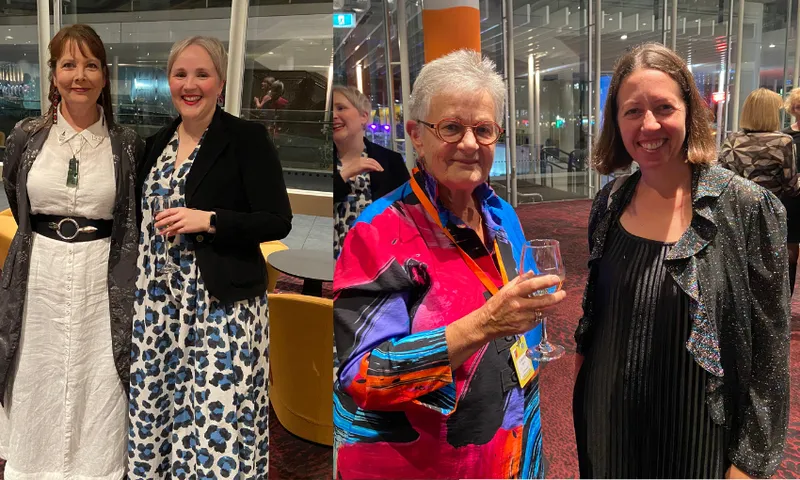
In the meantime judges and fancy people are snacking in the lounge and enjoying some pre-ceremony chat. Here’s some evidence:
There’s another pre-ceremony ceremony
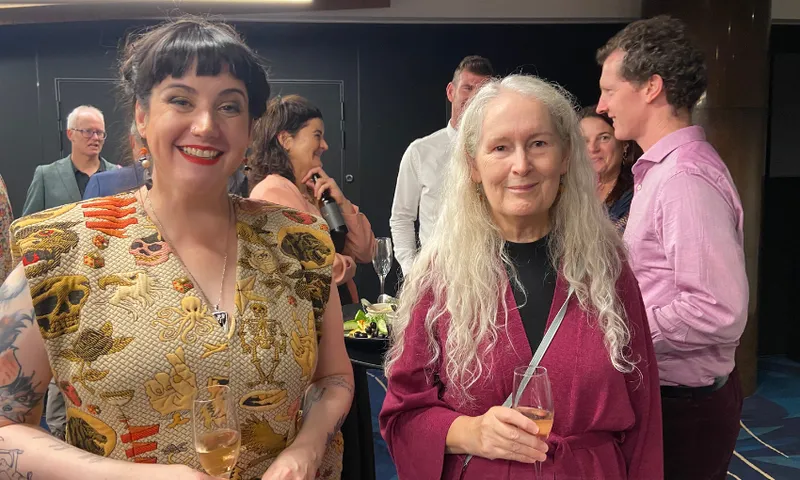
Turns out I was at a pre-pre ceremony and then I found the one I was meant to be at. Lucky I did because I found Una Cruickshank, author of The Chthonic Cycle with a whole load of great writers from Wellington including Elizabeth Knox and Nick Ascroft and Ashleigh Young.
We have kick off
“Ooooohhhh! Woooohh!” the crowd is a smidge rowdy already and mates, we’ve barely begun. There’s at least two hours (pray for my fingers).
The band played a jaunty reel while the names of previous winners flicked through the screen followed by the images of this year’s shortlist – covers and authors.
I really feel for the writers tonight – it’s such a joyful celebration of their hard work but also so nerve-wracking! Winners every one just for making it this far.
The speaking started off with a beautiful mihi from a representative of Ngāti Whātua Ōrākei, CJ, who welcomed manuhiri and acknowledged Hon Paul Goldsmith, and Rachel Boyack, opposition spokesperson for the arts, who are both in the audience tonight. Chair of the New Zealand Book Awards Trust, Nicola Legat, reminded us that this is the 57th annual awards, and ran through the heroic sponsors including Mary and Peter Biggs who sponsor the poetry award and who sadly were stuck in the same flight mess that Damien Wilkins is and are not here. Which is a massive shame as they’re due a celebration they’re not organising given their efforts at Featherston Booktown last weekend.
Big shout outs too to Chris Chan and Belinda Cooke who run this whole shebang at the admin end – massive, delicate work.
Legat also shouted out to the authors, publishers, librarians and booksellers who get the books to the people. Final thanks went to the judges who did the hard yards picking the winners tonight.
What the Minister for Arts said
Hon Paul Goldsmith made it from Wellington (unlike Damien Wilkins, and Mary and Peter Biggs) so that’s cool. He said it was “a boisterous day in the house”. IDK – I’m only here for the book argy bargy.
Look, the Minister talked quite fast but this is the gist:
- He acknowledged Ockham as the main sponsor and how the arts rely on the generosity of such sponsors
- He acknowledged book buyers too and “the government in a small way through Creative New Zealand”
- He said he read Lioness by Emily Perkins which won the fiction award last year
- He said he remembered that last year some od the writers took the opportunity to share their views on stage (some supportive clicking from the stage)
- He said he could go on about the government arts strategy called Amplify strategy but said we could go look that up if we get a chance
- Finally, he acknowledged the finalists and what they’ve put into their books, “heart and soul” he said.
- ⟦MGIMG:3f0522ef15e85f46afd38f2e⟧
Mark Todd from Ockham Residential
“Fuck, it’s good!” he said about the John Steinbeck book he’s been reading. He said it’s about how things echo down generations and that’s relevant to New Zealand because we’re such a young country. Todd said he’s proud to be involved in these awards and good writing does so much to help us understand ourselves.
Well said, Todd!
Now there’s a musical interlude: cue the Chocolat boat party dance!
Miriama Kamo kicks off the business end of the 57th awards
Miriama Kamo called on a whakataukī about how the different manu sing to reflect on why we need diverse voices, and voices at all, when there are some around the world today who are seeking to “dull the choir”.
“Books teach us nuance; in times of ugliness, books teach us beauty,” said Kamo. This is a rousing start!
“Life is hell but at least there are prizes,” Kamo quoted Janet Frame before asking us all to applaud the shortlisted contenders for the awards tonight.
Now we’re onto the First Book Awards …
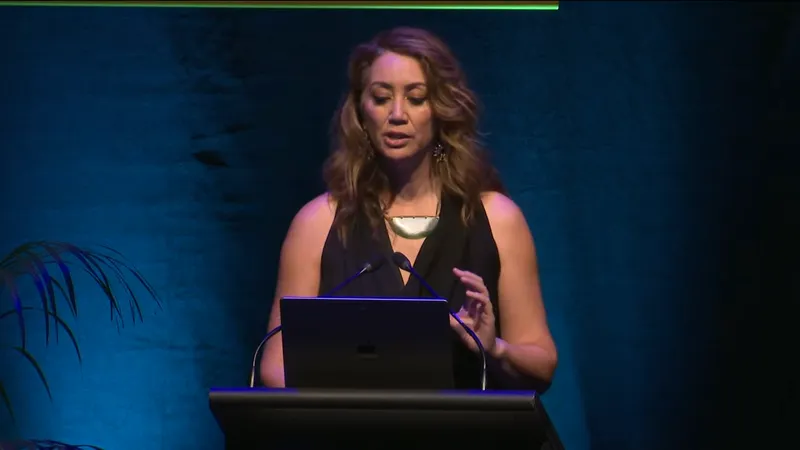
The Mātātuhi Foundation First Book Awards
The Best First Book Award winners tonight receive $3000 dollars. And the winners are:
Hubert Church Prize for Fiction
Poorhara by Michelle Rahurahu (Ngāti Rahurahu, Ngāti Tahu–Ngāti Whaoa) (Te Herenga Waka University Press).
Jessie Mackay Prize for Poetry
Manuali’I by Rex Letoa Paget (Samoan/Danish) (Saufo’i Press)
Judith Binney Prize for Illustrated Non-Fiction
Sight Lines: Women and Art in Aotearoa by Kirsty Baker (Auckland University Press)
E.H. McCormick Prize for General Non-Fiction
The Chthonic Cycle by Una Cruickshank (Te Herenga Waka University Press)
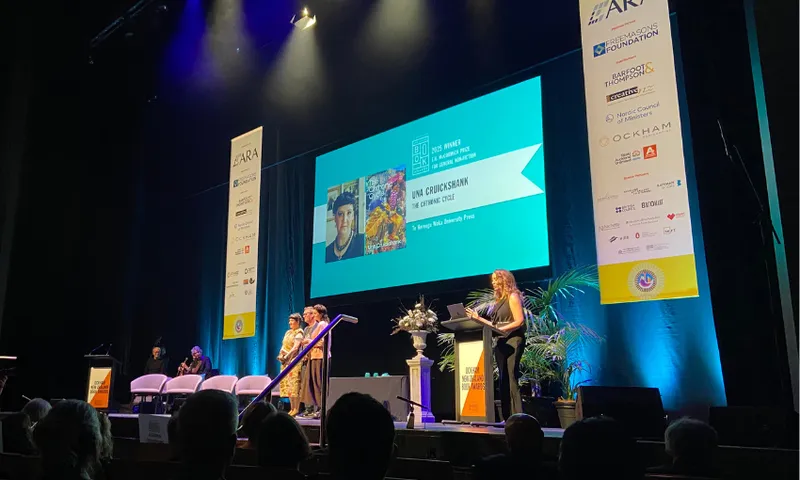
Strong message of resistance so far
All of tonight’s Best First Book award winners referenced just how hard the world is right now and how it’s so often writers and artists who speak the truth, and resist, and provide ways to think and act. Lots of support for those sentiments from the audience, too.
Onto the general nonfiction award…
The General Nonfiction Award – readings
So if you’re new to the Ockhams you might not know that all the finalists have to do a reading before the winner is announced. I like it. I think it acknowledges the writing and how it’s that that’s being judges, not the writers. Also they’ve really got the readings down to tolerably short – sub one minute by the feel.
Flora Feltham read from her essay about seagulls, called Bogans of the Sky, in her book Bad Archive which really went off last year in a way unusual for literary essay collections.
Ngāhuia te Awekōtuku read from Hine Toa in her sonorous voice that I could listen to all night. She’s reading from a bit about a Vietnam War protest and how 40 people were draped in white sheets smeared with tomato sauce and canned tuna. It’s vivid, it’s evocative.
Una Cruickshank read a sobering section of The Chthonic Cycle – about carbon and how we’re fucking with the balance of it. Such lyrical, powerful writing and so unique.
Richard Shaw (one of the nicest people in literature) reads from The Unsettled – in my opinion a crucial text for all Pākehā who need to get to grips with the facts and impacts of our settler ancestors. It’s a gentle book in some ways – it’s about facts, and curiosity and trying to get subjective about it while saying it’s ok to feel things, too.
TOUGH CALL! Who will win? Find out in just a tic!
Ngāhuia te Awekōtuku (Te Arawa, Ngāpuhi, Waikato) wins General Nonfiction Award
General Nonfiction convenor of judges Holly Walker says Hine Toa is a rich, stunningly evocative memoir that defies easy categorisation.
“As well as painting a vivid picture of Ngāhuia te Awekōtuku’s early life, from her childhood on ‘the pā’ at Ōhinemutu to her many creative and academic achievements, it is also a fiery social and political history that chronicles the transformative second half of the 20th century in Aotearoa from a vital queer, Māori, feminist perspective.
‘From its extraordinary opening sentence, it weaves Māori and English storytelling traditions: “Once upon a time there was a pet tuatara named Kiriwhetū; her reptile skin was marked with stars.” Hine Toa is both a personal testimony and a taonga.”
Walker said it was hard to judge such diverse entries but said what stood out was how our writers could take on such big subjects and tousle with them and find the write container for them. “It was a joy to read these books,” she said.
This is a GREAT call. Ngāhuia te Awekōtuku is one of our greatest thinkers, and doers!
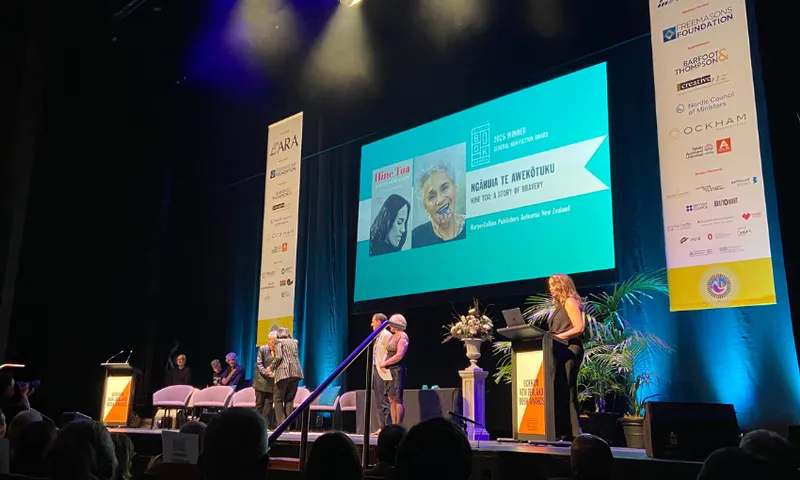
Ngāhuia te Awekōtuku thanks community of writers, visionaries and art makers
“I’m rather shattered here tonight,” said te Awekōtuku after acknowledging recently passed Fred Graham, Morehu McDonald and Robyn Kahukiwa. She also thanked readers, the musicians, and to everyone in the venue for making what writers and creators do possible.
“As our Poorhara winner reminded us,” she said, “we will never go away.”
Perfect.
‘I’m going to do something brave’ – Mary and Peter Biggs Award for Poetry readings
“I’m going to do something brave,” Robert Sullivan said, as he pulled out a taonga pūoro and said he was going to hold it like a cigar. His poem is gorgeous – Mutuwhenua – who Sullivan said is for his mum. I remember meeting Sullivan’s mum at LitCrawl one year when Sullivan one the Lauris Edmond Award for Poetry and we did a ceremony. He has a lovely family, I bet they are proud.
CK Stead read three short poems. The first is edging around death: coffins, and the phrase “elsewhere, other where, nowhere.” Stead reads well – strong and clear. He’s 92 year old, the oldest person to be shortlisted in the NZ book awards which is an award itself. All a writer wants is longevity – to still have readers.
[Must say the poetry readings are far longer than the general nonfiction; or am I fatiguing too early?]
Emma Neale warned us that she’s reading a poem called ‘Scapegoat’ that she wishes was more of an historic anecdote. A magnificent collection, this. Powerful, and such nimble language. Nipples that “struck like rock against the flint of their thoughts.” This is a poem about witch hunts – how women’s bodies were interrogated and lied about.
Richard von Sturmer’s collection, Slender Volumes, is remarkable, delightful, soothing. I loved it. He is wearing a superb sparkly vest and reads three of his poems. The first one announces how he gave up performing to study Zen (true story, the poetry in this book are based on the Koans, which are a Zen Buddhist text).
I’d be delighted if von Sturmer took this one but … we shall see in three, two, one …
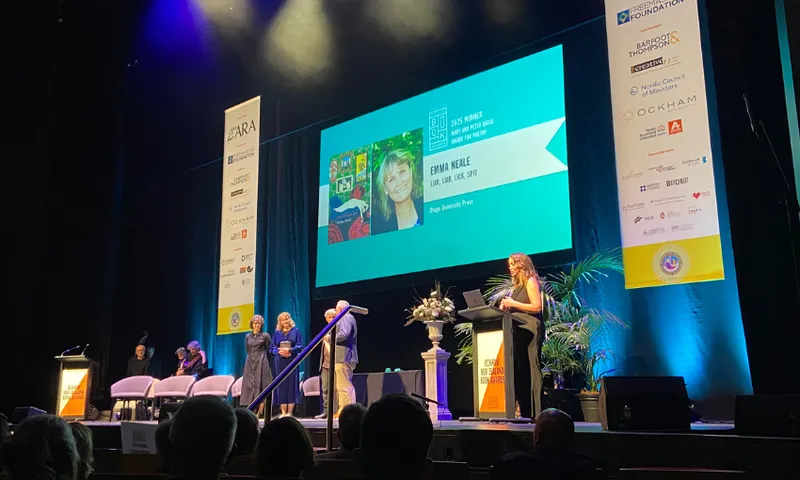
Emma Neale wins for Liar, Liar, Lick, Split
Yuss witches!
“Poets are heretics,” said Poetry category convenor of judges David Eggleton. He also said that Liar, Liar, Lick, Spit (Otago University Press) is “a book about fibs and fables; and telling true stories which are perceived by others as tall stories; and the knock-on or flow-on effects of distrust, the scales dropping from one’s eyes. It’s about power and a sense of powerlessness; it’s about belief and the loss of belief, it’s about trust and disillusion; it’s about disenchantment with fairytales. It’s about compassion. Emma Neale is a writer fantastically sensitive to figurative language and its possibilities.”
Richard Pamatatau stood in for Mary and Peter Biggs to hand Emma her award. Do you know doesn’t get an award? Jetstar and Air New Zealand.
‘I’m going to read from page 537’ – BookHub Award for Illustrated Nonfiction readings
This is the category for all the fancy books with hardcovers and shiny paper and colour images. And this is the point of the night where you realise a whole hour and 20 minutes has gone by and you should have eaten more than a singular piece of capsicum for dinner.
Nevertheless, Jill Trevelyan’s reading from Edith Collier: Early New Zealand Modernist is lively and kind of rousing in the way that stories of brave, early woman artists often art. Collier was prolific but for a long time largely unknown. I definitely would like to own this one.
Athol McCredie has spiked his reading with some AV! Photos by Leslie Adkin. This farmer photographer was something else. I love this book. It’s so eerie and magical. The back and white portals into the past. The clothes, the stances, the style, the staging. Go and get this book honestly. It’s really moving just to see people so clearly who lived in the fog of the past.
Matiu Baker reads from the monumental Te Ata o Tū The Shadow of Tūmatauenga: The New Zealand Wars Collections of Te Papa by Matiu Baker (Ngāti Toa Rangatira, Te Āti Awa, Ngāti Raukawa, Ngāti Whakaue), Katie Cooper, Michael Fitzgerald and Rebecca Rice (Te Papa Press). He reminds us about how so many of our history books with collections say more about Pākehā collectors than the taonga themselves. This book changes that with a te ao Māori approach to tell the stories of taonga rightly – through a process of collaboration and consultation, said Baker.
Deidre Brown and Ngarino Ellis stood together to read from their groundbreaking art history book, Toi Te Mana: An Indigenous History of Māori Art. I wish I could go to my art history degree again with this book. “I’m going to read from page 537,” said Ellis, to not a small amount of amused, maybe also awed, murmurs. Ellis explained the approach they took to create this epic resource. Super moving when Ellis acknowledged Jonathan Mane-Wheoki who has passed.
Toi te Mana: An Indigenous History of Māori Art wins Illustrated Nonfiction
Yep, absolutely. This book took 12 years to make (it’s 600 pages) and it will be a foundational resource for years to come, transforming how we, and the world, see Aotearoa’s history of art.
Illustrated Non-Fiction category convenor of judges Chris Szekely said the judges opinions were not always uniform. “It’s comparing apples to oranges,” he said. “How to compare books that aim to entertain with the erudite tongues of academia.” But in the end it came down to what book has impact. And in that, he said, they were unanimous:
“Toi te Mana is extensively researched and thoughtfully written, casting a wide inclusive net. The result is a beautifully designed visual tour de force, and a cultural framework that approaches toi mahi with intelligence and insight.
It is dedicated to the late Jonathan Mane-Wheoki (Ngāpuhi, Te Aupōuri, Ngāti Kurī), one of the three authors responsible for this magnum opus. Congratulations to Professors Deirdre Brown and Ngarino Ellis for carrying the baton to completion, a herculean task akin to the mahi of Maui himself.”
So will this mean a boost for art history studies?
It was very moving to listen to Deidre Brown (Ngāpuhi, Ngāti Kahu) and Ngarino Ellis (Ngāpuhi, Ngāti Porou) honour everyone who contributed to this huge work, and say how they hope this book will encourage more discussion about toi Māori. I felt very moved as an art history grad who would encourage any kid to study it at school, and uni. Otago no longer runs an Art History department (where I got my degree). I hope this book and the work of the authors boosts interest in the subject at all levels.
Onwards to the Jann Medlicott Award for Fiction, the last award of the night. Shit this is going fast?!
Is Damien Wilkins in the house?
His name has been called but no sign of him. Instead his publisher Fergus Barrowman has taken the stage for the readings.
Musings whilst listening to the fiction readings
I love fiction. I read it the most. Nonfiction has to work hard to take me away from being taken away. To judge, pit novel against novel, seems so brutal. Necessary and doable because with fiction you can look at all the tools and if they’re working in a book.
Laurence Fearnley is a wonderful writer. Funny, sad, real. Damien Wilkins, you could say almost the same, but also specificity – such detail. Kirsty Gunn, sharp, even cold, but incredibly skilled. Tina Makereti – elegant, ambitious in ideas, close and truthful in execution.
How the fuck do you pick one? I could maybe pick one of these four if I was held at gunpoint and allowed five minutes to argue all cases. But let’s just take a moment to honour the project of fiction: Making stuff up from the stuff you haven’t made up. Magic.
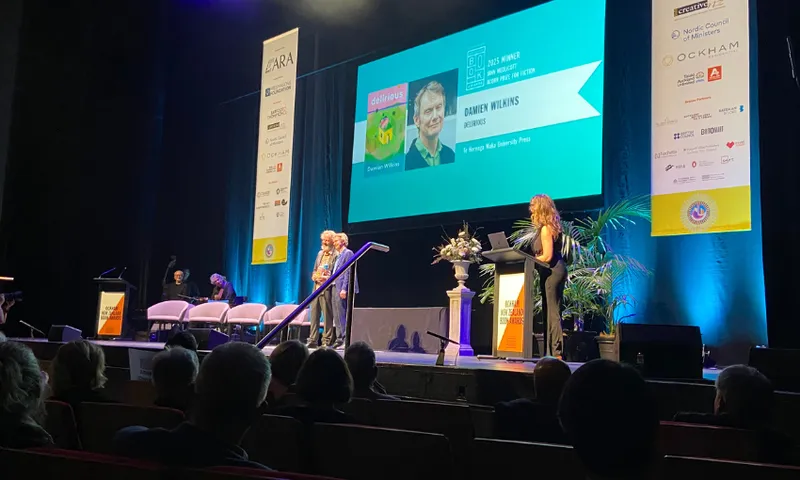
The one writer who is not here has won: Delirious by Damien Wilkins
Damn you, Air New Zealand!
Damien has won! I bet his family are texting him madly right now. Maybe even calling!
It’s been 22 years since he last won for The Miserables and has been shortlisted twice since. This is your year, Damien, and you’re not here but everyone in this room is delighted!
This is excellent. Delirious is a whole experience: it’s so funny, it’s so, so sad. It’s so honest. And surprising. You’ll not not think about Mary and Pete and Colin and Claire, and Will long after you’ve finished the book.
Thom Conroy (Convenor of judges) said he and his fellow judges found the longlisting the hardest part, the shortlist too.
“With a gift for crisp, emotionally rich digression, Damien Wilkins immerses readers in Mary and Pete’s grapples with ageing and their contemplations of lost loved ones who still thrive in vivid memories,” said Conroy.
“What stood out to the judges was the assured but understated touch of prose as it flows elegantly across decades, threads the intricacies of relationship, and fathoms the ongoing evolution of a couple’s grief.”
So now we’re just waiting for Damien
The musicians are playing more jaunty jazzy tunes just like in the movie Chocalat and we’re all hanging out waiting for Damien to arrive.
This could be a long night. Even longer than we thought. Please bring me more capsicum.
Wait, he’s here!
Damien is here! Hold the line for report on what he says about his Odyssey today.
I’m crying, you’re crying, Damien is not crying
Ok so my maths is reliably shite. But it’s been over 30 years since Damien wrote The Miserables. He remembers being shortlisted with Dame Fiona Kidman and Maurice Gee (this is where I started crying).
He recalled how back then, you could see NZ literature on one bit of paper (or something like that). What he’s getting at is how much it’s changed, expanded. He said after a decade of writing he got negative royalty statements and said it was like having your soul rejected. The writer’s lot, if you’re lucky, “and I have been so lucky,” he said.
Wilkins thanked Jann Medlicott (hope you’re watching from up there, Jann!), thanked Fergus Barrowman, and editor extraordinaire, Jane Parkin. He thanked all of his siblings, his father, his sister Miriam and his mother to whom he dedicated Delirious, and all of his family who are here who have been texting him crazily.
“I stole so much to make this novel and now I feel even more like a pickpocket. Kia ora.”
Oh mate. What a RIDE. You made it!
Goodnight and thanks for joining us
They let off really loud, gun-sharp streamer explosions and now I have to go have a beer to calm my beating heart.
We’ll be publishing more Ockhams-related articles over the coming days. Go buy the books! Read! Enjoy!
The Spinoff Books section is proudly brought to you by Unity Books and Creative New Zealand. Visit Unity Books online today.
Claire Mabey
Claire Mabey is a children's author of The Raven's Eye Runaways, The Raven's Eye Rebellion, and a picture book Cass and the Beast illustrated by Jill Calder. For a long time Claire worked on literary festivals and is the founder of Verb Wellington. She lives in Te Whanganui-a-Tara with her partner and son.


