‘A reader reads a reader’: Sophie, Standing There by Meg Mason, reviewed

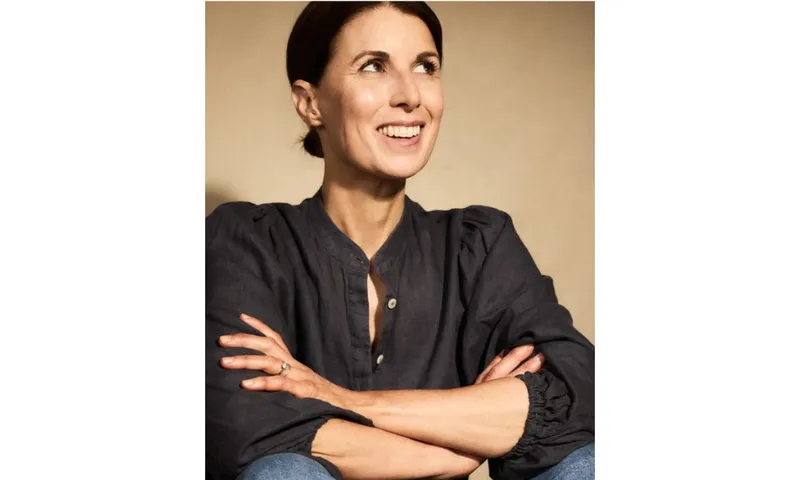
Sophie, Standing There by Meg Mason is just about out. (Photo: Anne Peeters)
Made possible by


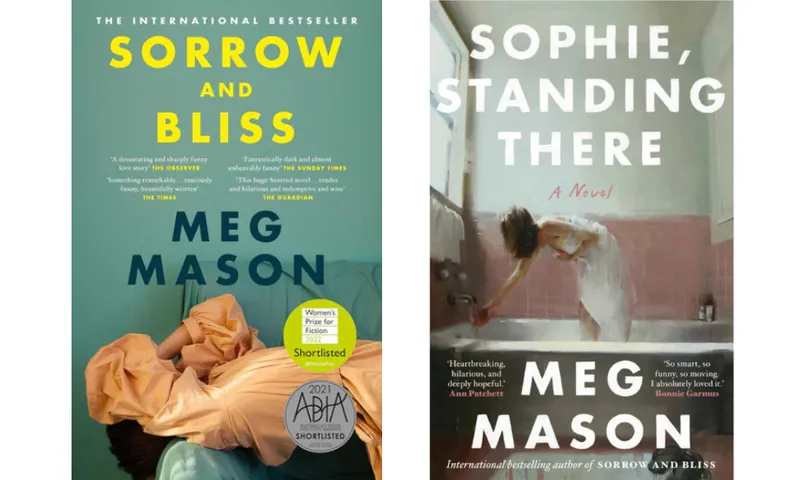
Claire Mabey reviews Meg Mason’s beguiling follow-up to her smash hit novel, Sorrow and Bliss.
You, dear reader, are often in conversation with the famous author Meg Mason. “As I’m writing my reader is right there,” Mason tells me on our video call, beaming in from her book-lined home-office in Sydney. “And I’m constantly saying, ‘Is this OK? Do you understand this? Have I made it clear enough?'”
Parasocial relationships are at the heart of Mason’s absorbing new novel Sophie, Standing There: a gentle, intimate portrait of a kind, stoic and heartbroken person who becomes obsessed with a famous writer. For all its simplicity – a deliberate choice for Mason, who doesn’t want her readers to have to do more work than is necessary – Sophie’s story is a layered exploration of life’s most profound relationships both real and imagined.
“I often reflect on the fact that my life was changed by a Word document that I must have sat down and opened one day. And that Word document evolved into a book that expanded my world to the most extraordinary extent,” says Mason as we discuss the fact that her previous novel Sorrow and Bliss propelled her into A-list literary company both on the bookshelves and in real life. Mason, who, like most famous authors, is uncannily personable, is still in wonderment over her great success.
“I’ve somehow been given this window into this world I never would have dreamed of being part of,” she says. “Even though the natural thing might have been to write [Sophie, Standing There] from the perspective of the author, there was never any question that it was going to be much more from my own standpoint, in the sense of being that person who’s looking into this world from the outside and is in the recesses and the darkness of the wings.”
Mason’s hero, Sophie, works in the backstage crew of a writers festival large enough to welcome some of the biggest names of our current moment. When reading the opening pages of Sophie’s story, readers would be forgiven for worrying they might be in for one big industry in-joke. By page three Sophie is remembering the time George Saunders “got snappy” (“I know,” Mason laughs when I bring it up, “the nicest author in the entire world, and I have him tantrumming backstage”; though a conversation I had with Saunders earlier in the year suggests he might enjoy this satirical rehabilitation of his reputation); then Sophie recalls the time another tech called Dev got overly familiar with David Sedaris and Douglas Stuart; and the time Dev asked Ann Patchett if he could email her his unfinished short story to read.
As someone who worked in the back-end of writers festivals for many years this made me feel ill. It’s just not done. Luckily for us Sophie knows this, too: “She had never ‘done a Dev’, as everyone started calling it once he’d been formally released from his contract, except for Sophie because he was a good person and had seriously saved her life that night.”
It’s Sophie then, who blessedly steers the story away from those starry names and into territory more familiar for Sorrow and Bliss fans: private pain and heartache conveyed through Mason’s irresistibly wry humour (Sophie’s crappy ex husband Paul ends it by saying “I’d love not to live with you anymore”). The kind of comedy that slides between hopeless and humorous and keeps us, that ever-present reader, enchanted by Mason’s deft handling of universally relatable emotional turmoil.
Sophie is one of life’s rare, ego-less good eggs who happens to be going through a cruelly lonely time. Books are her passion and escape and in many ways this is a novel about books as refuges, and about how we read, and why. Sophie’s obsession with fictional novelist Lilac Dunn is born out of a deep sadness. “She’s been absolutely dismantled, obliterated by this relationship with her husband,” says Mason. “She’s lost her sense of herself because he’s dismantled her self esteem over the course of their eight-year marriage.”
Mason was extremely conscious that she was exposing her beloved character at one of the lowest points of her life. “I needed to orient her so that she never seems pathetic. It’s a way of showing how we all have that power to compartmentalise; she’s not someone who takes her suffering to work. She absolutely contains it. She’s self possessed, which is an extreme skill and maturity: putting a brave face on and making sure she doesn’t inconvenience anyone with her soul, and going back to this desperately empty flat to eat packet ravioli and try and put her life back together.”
Mason is a master of texture. Food, fleeting thoughts, hair bands, trays of coffee, clattering knives, tote bags, Gucci trainers, Duolingo streaks. Detail defines character in ways both plain and subtle. This a novel that is lived in, so familiar in its observations that we’re immediately at home. The festival environment was so perfectly rendered I felt I was there in the labyrinthine bowels of Aotea Centre where the Auckland Writers Festival takes place (and where Mason first caught her inspiration for this story: standing backstage, about to go on with famous friend Ann Patchett, and seeing an old school friend working in the wings). I particularly loved the bookshop scenes where Sophie is welcomed heartily by booksellers Rob and Cass, utter delights, rays of comedy sunshine: so crisply depicted you feel you’ve met them, or truly might one day. They’re light characters but serve to remind us how loved Sophie is even when she doesn’t have the capacity to see it; and to honour the fact that bookshops are sanctuaries for many a lonely reader seeking like-minded company.
Where the novel takes an almost sinister turn is when imagined life and reality collide. When Lilac Dunn is programmed into the forthcoming writers festival to fill a sudden gap, Sophie must confront the corporeal truth of the author she’s been conducting imagined conversations with for months. Dunn is prickly, beguiling, steely and difficult to read (at least she is through Sophie’s unreliable eyes) despite pronouncing herself in no uncertain terms: “I told you so many times, Sophie. I don’t make friends.” I found myself thinking about her long after I’d finished the book, wondering who she really was. Dunn returns Sophie’s intense curiosity two-fold as she steadily cracks Sophie’s outer shell with demanding, direct lines of questions. Dunn’s probing, her supreme confidence made me want to swoop into the novel and shield Sophie whose naivety surfaces in the face of this calculating story-extractor. Mason orchestrates a fascinating position for us to find ourselves in: readers let into the precious, private life of a fellow reader so we’re right beside her to witness what happens when reality steps glamorously in.
Mason, who stresses over again that despite her success and fame she is really one of us, does worry that some readers might think she wrote herself into Lilac Dunn. So much so that instead she wrote elements of herself into Sophie: “I’m hiding there in plain sight.” Like Sophie, Mason had a very strict religious upbringing and came late to reading. Those kinds of childhoods, she says, “make you feel really other. So [Sophie] has this apartness, which I definitely have felt, and that informs all of her relationships.”
It’s Dunn’s attention that intoxicates Sophie: first in the form of her books, then in the form of the person herself. Books give us undivided attention. It is one of life’s mysteries that we can be absorbed into the lives of others simply by concentrating on words on a page. I haven’t fallen for a lead character as hard as I have fallen for Sophie in a long time. Much of that is down to Mason’s care of her. “I just loved [Sophie]. Even though the book is sort of satirical I knew I was never going to mock her, or embarrass or shame her.”
Dunn, on the other hand, was a mystery to Mason. The first half of the novel establishing Sophie was written in a matter of weeks while the second half took nine months because “Lilac’s motives were something I found really hard to assess. I knew what was in this relationship for Sophie but I didn’t know what was in it for Lilac.” After some back and forth with her editors who wanted Mason to clarify Dunn’s intentions, Mason decided that “because Lilac didn’t want me to know either, I had to leave that mystery preserved.”
This works. For a novel that is a dream to read – sentences that slip down, that simultaneously twist at the heartstrings and knock at the funnybone – the complexity lies in Dunn’s unknowable nature and in the fact that she’s the one who cracks Sophie’s world open for us: we glean far more of our hero thanks to Dunn’s ruthless (but fair? So hard to ascertain!) mining. Her fairly terrifying laser focus, her hard edges, help Sophie to return to the people who truly love her: a sibling, a friend, a love interest. It’s deeply satisfying but never twee. There’s a master intelligence at work in the architecture of this novel that feels very much like a magic trick. The writer watches us as we become immersed in her creation. The final chapter is a breathtaking breaking of the fourth wall, checking that capacity to imagine, tugging even tighter our entanglement with story and storytellers.
So, is Mason nervous about how her readers might receive this follow up to Sorrow and Bliss? “I don’t care what readers think of me. I almost don’t care what they think of the book. I care deeply what they think of Sophie. She was just someone that I loved spending time with.”
Sophie, Standing There is, in some ways, an eerie book. It’s full title is Sophie, Standing There: A Novel. A startling question posed by the addition of those two words: why the need to state it? Sophie is inescapably a fiction about a sort of universal you: a reader reads a reader. But it’s also about Mason and the various versions of herself that now exist in the world thanks to … fiction. I wonder still at the novel’s pathos: the writer ensuring that I care about this pretend woman I think I know. But then, that’s what you want from novels. A reality that lingers in the imagination, as real as anything.
Sophie, Standing There by Meg Mason ($38, HarperCollins) is available to purchase from Unity Books and is officially out on July 28.
The Spinoff Books section is proudly brought to you by Unity Books and Creative New Zealand. Visit Unity Books online today.

Claire Mabey
Claire Mabey is a children's author of The Raven's Eye Runaways, The Raven's Eye Rebellion, and a picture book Cass and the Beast illustrated by Jill Calder. For a long time Claire worked on literary festivals and is the founder of Verb Wellington. She lives in Te Whanganui-a-Tara with her partner and son.


