The everyday magic of Omnibird, the children’s book of the year

Giselle Clarkson’s Omnibird contains many a life lesson as well as instruction on how to watch birds.
Made possible by

Claire Mabey finally comes around to the pleasures of birdwatching, courtesy of Giselle Clarkson’s latest book – and her late gran.
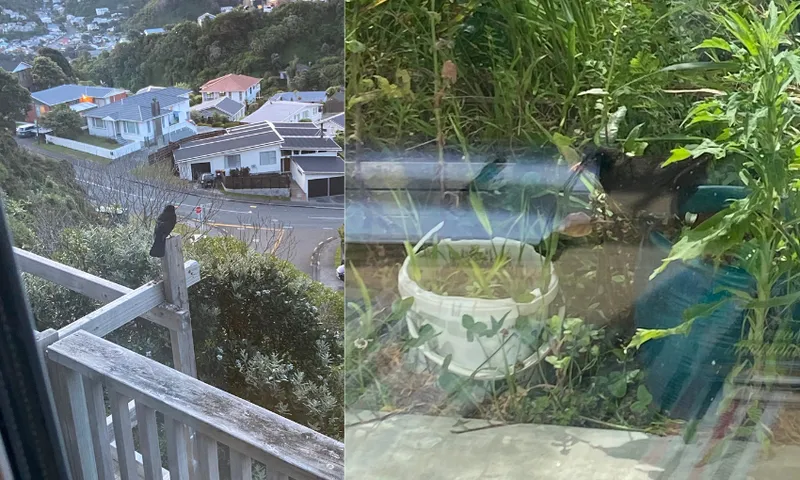
There’s a blackbird I’ve named Lancelot. He has a greying feather on his back, out of reach of his orange-rimmed eyes, so I don’t think he’s aware he looks like he’s flown under a painter’s ladder and caught a splash. I noticed Lancelot about a year ago and didn’t think much of him, other than wonder if his salt and pepper look was usual for a bird with “black” in its name.
Then my son noticed Lancelot. How the blackbird would sit on the scaffolding on the porch outside our bedrooms and survey the world. We watched out for Lancelot from my son’s bed when we read books at night in preparation for sleep. Lancelot hopped up and down, looking over the world below, preaching. We saw how his sharp orange beak opened and closed to the exact music of blackbirds. We knew he was the one making all the noise but his voice sounded beyond a singular bird. Lancelot, we realised, sounded like a chorus of blackbirds – like the blackbird song was in the air all around and Lancelot was merely lip-syncing.
After that, we started to watch Lancelot with conviction. We discovered he sits on the railing surveying and singing the world at dawn and at midday and at dusk. I like him best at dawn (when I am occasionally awake to witness it). He’s a darker shadow than the rest of the shadowy morning. Incredibly vital, delivering blackbird news over the valley.
I have not always been a birdwatcher. In fact I used to worry about turning into one because birdwatching seemed such an old person’s game. My gran, who died a couple of weeks ago, watched birds intently. She had a bird bath in her garden in Tauranga and would regularly run outside to flap away the ample starlings, who she hated, to make way for the thrushes and the blackbirds and the sparrows, who she liked. I was amused by the splashing and the congregation of the winged creatures. But I could never bring myself to be too curious about those ubiquitous everyday birds, so unglamorous compared to our native heroes: the takahē with their expressive spidery feet, the kākāpō with its doggish face; the pīwakawaka’s fairy-like curiosity.
“When we see something all the time, it’s easy to forget that it’s extraordinary,” writes Giselle Clarkson in Omnibird: An Avian Investigator’s Handbook (which she also illustrated). The day I received Omnibird I saw Lancelot hop along the concrete path outside my home office, a worm in his mouth, regarding me as he went by. “Now and then a bold one makes friends with a gardener who throws it worms and caterpillars,” continues Clarkson in her chapter on blackbirds and thrushes (together because “they are like cousins. They’re both in the genus Turdus [unfortunate word!], and they have heaps of similarities.”)
In Omnibird, Clarkson asks us to pay attention to regular, garden variety birds. Your sparrows, gulls, starlings, swans, ducks, thrushes and pigeons. To Aotearoa, these are mostly comfortable imports, inveigling their way into our daily lives over generations. The glamorous birds are in Clarkson’s guide, too – penguins, parrots, flightless birds – but they’re not the focus. This is because, like her award-winning book The Observologist, Omnibird is about paying close attention to the ordinary.
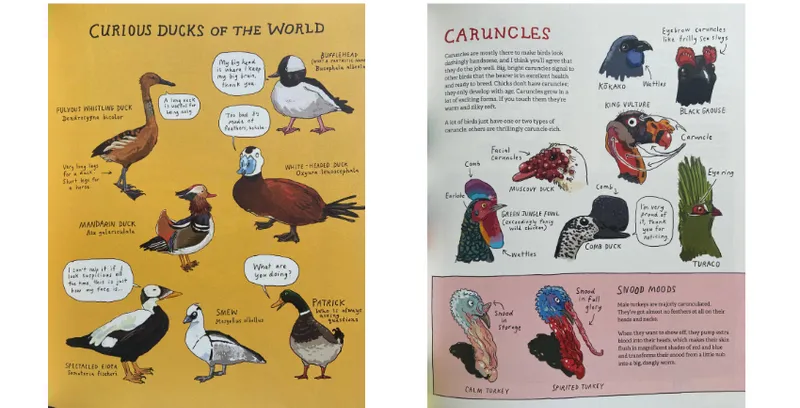
“Mistaking the world for ordinary is a terrible habit that you should always struggle against,” says Clarkson. “It’s much worse than even picking your nose.” Omnibird is aimed at children and the child in every adult. Every page is a spectacular dance between image and text, information and cartoon. Clarkson brings the humble hen into sharp relief; the evil swan (ever since I was chased by one I’ve hated them – would delete the lot and copy-paste takahē in their place) into terrifying scale. My son likes to notice Clarkson’s hands: her people are not quite anatomically correct – they often have three fingers, and always have the most beautiful elfin ears, an upwards slant like their ears are permanently pricked.
In the early part of Omnibird, where Clarkson is laying out the art of investigation, two pages are dedicated to “eavesdropping”. “One of the nicest ways to conduct an investigation is to lie down in the sunshine, close your eyes and open your ears. Birds have a lot to say, so you might as well listen.” I welcome any book that asks me to lie down.
We don’t have a lot of grass around our house, but we do have a lot of trees and bush – a bird haven, I’ve lately realised. The evening my grandmother died I noticed the birds. On the drive home from the rest home where she died in Karori I had to stop the car in the middle of the road to avoid squashing two tūī passionately engaged in some kind of epic battle. They didn’t seem to notice the large metallic tank paused on the cusp of their dark blue bodies. In a daze, I swerved around them. When I got home I disturbed a crowd of blackbirds, male and female, out gathering their dinner. Once in bed I lay down and listened and heard Lancelot singing in the night.
Giselle Clarkson is a modern Merlin. She teaches young and old not through the usual methodologies but by leading us towards viewing the world through the eyes of the nature all around us. In TH White’s spectacularly beautiful, funny novel The Sword in the Stone, Merlyn (White uses a “y’” over an “i”) teaches a young Arthur the ways of the hidden world by turning him into a fish, a wild goose, a badger, an ant. Creatures who inhabit our same ground but entirely by their own laws.
Omnibird shows us nests and beaks, new birds and old birds, feral pigeons and “charming brown birds”. Every page draws us in with Clarkson’s singular style of illustration: accuracy fudged with comedy and grace. Wide open eyes, curious tilts of the head, open beaks with voices pouring out. In Clarkson’s books nature speaks.
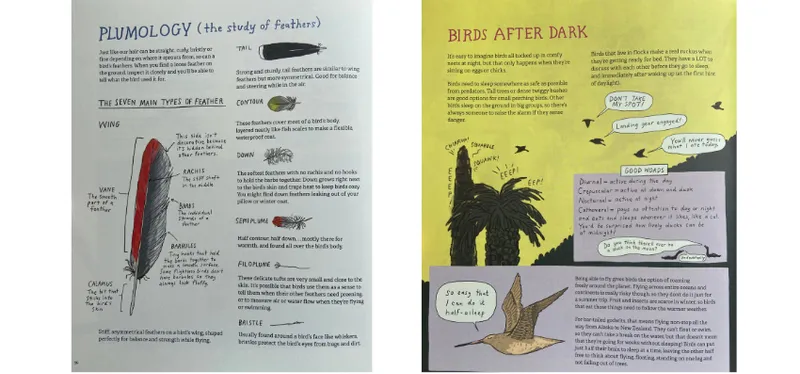
I consider myself now a fully-fledged bird watcher. There’s Lancelot, my be-greyed blackbird; and Tony the bossy tūī; and Arthur, the pīwakawaka who waits for us to empty the compost so she can swoop in and eat the flies that swarm out of the bin every time we lift the lid. Gulls sail too far in the distance to spy on with any detail but we learn from Omnibird that if we ever see a gull slapping its feet on wet sand or mud, it’s teasing little worms and crabs to the surface.
My gran would have loved reading Omnibird. She was a reader up until a week before her death, when she simply ran out of energy. Had I written my review of Omnibird weeks ago, when I intended to, I would have focused on Clarkson’s child’s-eye view – her gift of placing the lens where children are. But then death happened. And I noticed the birds: the omni-ness of them, watching like a great and wise collective, and it makes you wonder about where that energy goes when there is a death. My son likes the idea that Gran is in the birds and that when Lancelot sings from the balcony we are reminded of her.
In Clarkson’s section on “old birds” we discover that Lancelot could live to over 20 years old. So much longer than I had assumed a blackbird might last. My Gran was nearly 99, a great innings, so they say; a properly old bird. I think she would be delighted that she and Clarkson and Lancelot have finally turned my attention to the everyday magic all around us.
Omnibird: An Avian Investigator’s Handbook by Giselle Clarkson ($45, Gecko Press) is available to purchase from Unity Books.
The Spinoff Books section is proudly brought to you by Unity Books and Creative New Zealand. Visit Unity Books online today.

Claire Mabey
Claire Mabey is a children's author of The Raven's Eye Runaways, The Raven's Eye Rebellion, and a picture book Cass and the Beast illustrated by Jill Calder. For a long time Claire worked on literary festivals and is the founder of Verb Wellington. She lives in Te Whanganui-a-Tara with her partner and son.


