Survey points to cost-of-living election 2.0 – and an intriguing immigration result

Chris Hipkins and Christopher Luxon. (Image: Tina Tiller)
As we gear up for an election, here are seven points of interest from the new Ipsos Issues Monitor.
“What’s worrying New Zealanders?” That’s the tagline for the quarterly Ipsos Issues Monitor. Despite the air of fretfulness, it’s about as good as any summary of voting behaviour: what is worrying you, and which lot do reckon would be best at alleviating that worry?
Below, seven findings of interest from the latest survey, published today.
The cost of living supremacy continues
The biggest worry remains the same: the cost of living. That concern (including inflation) is named by 59% as one of the three “most important issues facing New Zealand today”. It has been the issue most cited as a concern in every survey since the end of 2021, when it overtook housing.
The bad news for National and its partners is that Labour is considered the best party to manage the issue. The good news is that it’s plateaued as a concern – still high at 59%, but down a speck from the last two surveys, from August and October last year, when it was 60% and 61%.
And National can take further solace from the fact that it’s closing the gap on this front. In the last Issues Monitor, 36% said Labour were best on cost of living against 24% National. Today that’s 35% Labour to 28% National.
A less cheering data point for the incumbents: rewind three years, to the last February survey in an election year, and with cost of living top of the concern pops on 65%, National – then in opposition – is judged best to deal with it by 34% and Labour 31%.
Government report card nudges up
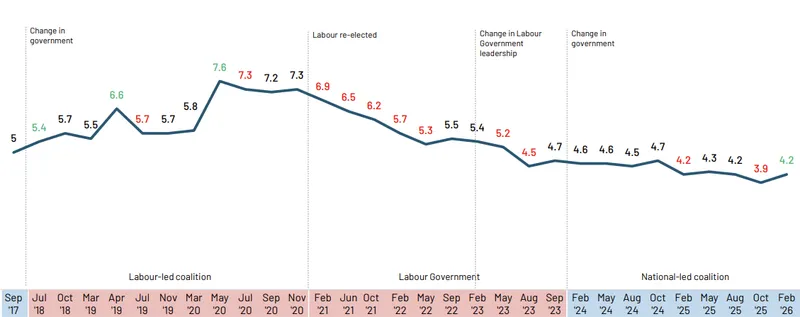
The Ipsos survey asks people to “rate the government for its job in the last six months out of 10, with 0 meaning “abysmal” and 10 “outstanding”. On this score, the government will be relieved to see that the line is moving up, albeit by just 0.3, from 3.9 to 4.2. If 5 is a pass mark, the government hasn’t hit it this entire term, topping out at 4.7 in October 2024.
It’s lower, too, than the last government’s nadir of 4.5, in August 2023, ahead of the election.
Labour leads on most issues
Across the 20 issues that most concern New Zealanders, National wins out on just two counts as the party considered most capable, those being crime/law and order (fifth) and defence/foreign affairs/terrorism (19th). On the economy (third-ranked issue) it’s a dead heat between National and Labour.
The Greens are top on climate change (eighth) and environmental pollution (13th) while Te Pāti Māori leads on issues facing Māori. But for the rest it’s Labour – across 14 issues, plus the tie on the economy.
Law and order less pressing
The issue of crime and law and order has fallen down the list of concerns across the last three years. In the February 2023 survey it was marked as one of the three most-pressing issues by 33% of respondents, making it the second top issue. At the same point in 2026, it’s now ranked fifth, selected by 20%.
Everyone can cheer that, but campaign strategists for National might also feel they’re victims of their own success. No wonder recent weeks have seen a flurry of law and order announcements from the government.
A climate change curiosity
We know that climate change makes severe weather events more frequent and more brutal – so have the storms of the first months of 2026 sent that issue storming up the charts?
No. For the most part across the eight years the Ipsos survey has run, climate change has hovered around the 20% mark, meaning one in five people name it in their trio of biggest concerns. The peak was in February 2023, when it hit 27%. Today, it’s 15%.
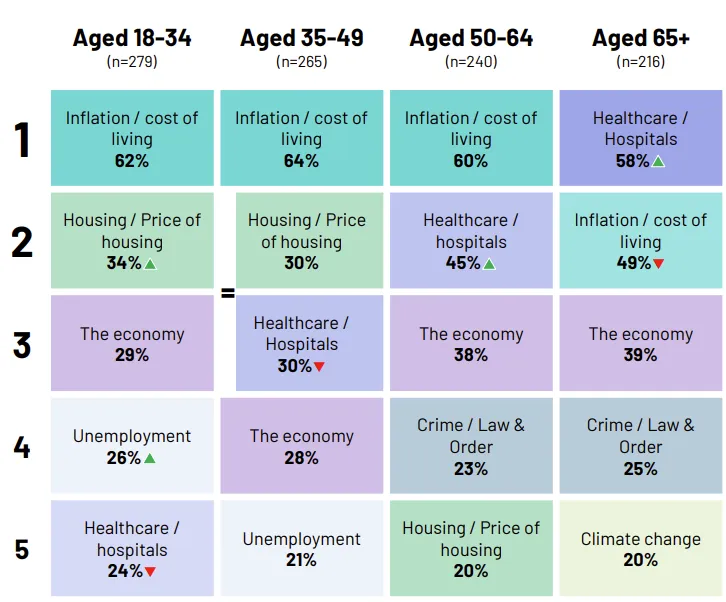
Interestingly, when the top issues are broken down by age of respondent, the only demographic in which climate change breaches the top five is not, as you might guess, 18-34, but 65-plus, where it sits fifth on 20%.
Petrol prices, meanwhile, are a top issue for 9%. The ongoing US-Israeli strikes on Iran, and resulting impacts on supply and transport, are only likely to drive that concern higher.
Health heading up
A growing concern is health, propelled, no doubt, by scenes that include crisis-level overcrowding in emergency departments. In February 2023, it was fourth on the Issues Monitor, with 27% nominating it as a top concern. Today, it’s second on the list, selected by 38%.
It should be noted that’s the lowest since the middle of 2024, and a sizable drop from 42% in October last year. But what also leaps out, as far as an election year is concerned, is that it ranks top of the concerns among people aged 65 and over, where 58% call it one of the three biggest issues. No cohort is more diligent at voting than this.
How about immigration?
Coming in at 11th on the list is immigration, selected by 8% in the survey, equal with education.
It makes for a marked contrast with Australia, where the equivalent Ipsos study puts immigration fifth, selected by 24% of Australians. That contingent, which fuels much of the surge for Pauline Hanson’s One Nation Party, is proportionately three times that on this side of the Tasman.
That may dampen speculation that NZ First might emulate its ideological cousins offshore. And yet: 8% ranking immigration in their top three concerns is a large number compared with three years earlier. Then, it ranked 17th and registered just 3%.

Toby Manhire
Toby Manhire is editor-at-large at The Spinoff. He loves to cast a pod, whether it's Gone By Lunchtime, At Large or Juggernaut. He is a former editor of The Spinoff and has worked as a journalist in NZ and the UK since the last millennium.


