‘Perfect, fully formed little morsels’: No Good by Sophie van Waardenberg, reviewed

No Good is Sophie van Waardenberg’s debut poetry collection.
Made possible by
Ash Davida Jane is satisfied by the ‘crunchy’ qualities of Sophie van Waardenberg’s debut collection, No Good.
When people tell me they don’t understand or know how to read poetry, I usually say to treat it like any other instance of words on a page — it’s not a puzzle or a magic trick. Just read the words in front of you and notice how they make you feel. People read poems for the same reasons we engage with pretty much any other kind of art, like music or movies or video games: to feel things, to get out of ourselves, and to experience seeing the world in different ways. Sometimes you come across a work of art that you click with, that makes you feel more like yourself in ways you can’t explain. For me, No Good is one of those.
In 2019, Auckland University Press revived its AUP New Poets series, now with Anna Jackson at the helm. Eight years after AUP New Poets 4 came the fifth in the series with a heavy hitting line up: Rebecca Hawkes, Carolyn DeCarlo and Sophie van Waardenberg. Of the three, I was least familiar with van Waardenberg’s work, but as soon as I read her section of the book I wanted more. I was eager to see what she could do across a full-length collection, with more room to develop her voice and unravel the throughlines. Now it’s here; No Good is everything I hoped for.
Van Waardenberg’s turns of phrase delight; they roll off the page in perfect, fully formed little morsels. The poems in No Good are fairly simple in form and consistent in length, largely a combination of 14-line sonnets and couplets that fill one page or spill just over. The central section of the book is a sequence of 16 sonnets about the death of the poet’s father, all titled “Cremation sonnet”. Van Waardenberg is unabashed about grief. She describes the physicality of these feelings in a unique and precise way, putting into words the sensations we often can’t describe for ourselves:
Hello the same feeling,
didn’t I wash you off,
you get everywhere, sog up my arms
and droop me.
The words the poet uses are particular in an unpretentious way. She gets us as close to the thing as we can be, whether the thing is an old love that still ticks on, or a new loss, or something as trivial as afternoon light in a photo on a phone screen, “spilt like thick soup”.
As the title points to, the speaker at times applies a kind of childlike lens to the world – that it is either good or bad, with very little to be done either way. In ‘Poem in Which I Am Good’, which opens the collection, she declares: “What do I deserve? / The same as all of us. Everything.” In the final poem, as if each line since has been weighed as a piece of evidence on the scale of goodness, she is instead “rotten and roiled // and no good, truly—truly no good at all.” This motif of black and white morals sits against a nuanced and emotionally intelligent view of the world in all its challenges and complexities. Somewhere in that gap, it seems, is the years since the poet lost her father, described in ‘Self-Portrait as Adolescent Covered in Flour’ as the “last year of childhood, / for obvious reasons,” as she was forced, at 13, to shoulder the emotional weight of such a loss. Through this juxtaposition we see her many selves and the earnest and familiar wish to go back to a simpler time in which good and bad is easy to discern and “[e]verybody [we] love will live forever.”
It’s hard to write about being sad without repeatedly hitting the same note. I often think about something Ashleigh Young said in an interview with Starling in 2019: “sadness just isn’t that interesting – at least, not when it isn’t transformed in some way, not when it isn’t driving something forward, not when there’s nothing else going on.” In No Good, van Waardenberg writes 16 sonnets about grief and in each one we encounter something new. As the sonnets build on each other, we’re reminded that there are hundreds of different ways in which loss is felt. It’s both ordinary, in that it happens to everyone all the time, and singular, because when you’re in the midst of it, it feels like nobody else can understand. In ‘Cremation Sonnet (I’ll stop with all this once I’m granted)’, van Waardenberg writes:
Everyone must feel like this. Must rend.
Must wreck. And yet that can’t be true.
If someone understood, I wouldn’t beg
so much attention.
She captures this feeling as “the rank and perfect / onliness of my loss.” Again, the assonance buffs the edges of the phrase, makes it roll around in our heads. Van Waardenberg leaves us feeling the small joys, even from a book with such a throughline of death. The sweetness in the images and the manner of their expression makes her work a pleasure to read:
On the walk from the station
all the sidewalk dogs were lying flat.
Slough off the old love, they said
and I said Don’t tell me that.
The poet impresses upon us the splendour of the mundane, the mundanity of big things. Moments of loveliness appear in unexpected moments: in the repetition of “my girl” within a single couplet, in the assonance of “[s]hining puddings of permanence toddling down the supermarket aisle,”; in the description of morning as being “like an evening / with hope’s clothes on.” These kernels of joy are essential, especially when we consider the anticlimax of the moments from which we typically expect magnitude. The poems ask, of death and the rituals that follow, “Is that it?” The speaker says matter-of-factly, as if it’s of no significance, “Then you died. Then they burnt you.” The awful trick is that the real splendour lived in the time before, filled with “ant traps” and “curtain pulls”:
This life was for a while
so slack and dull, so infinite
I did not know that it was splendid.
After this, the moments where van Waardenberg dwells on the small things that make up a life carry an extra weight, as we’re reminded of their impermanence.
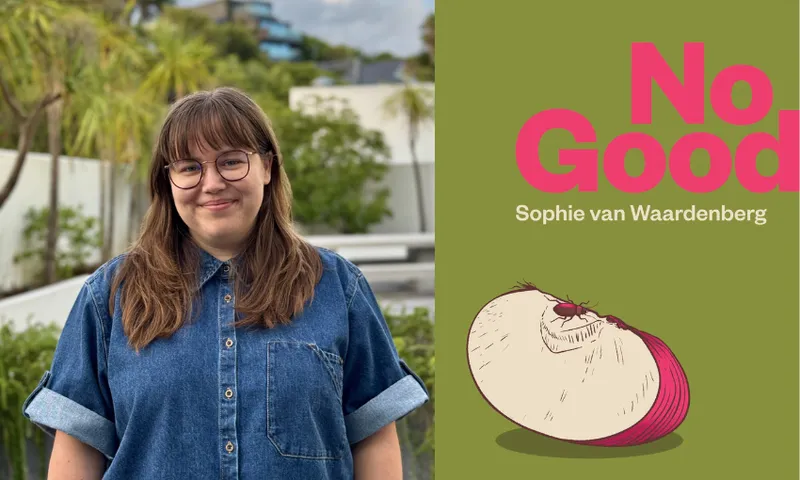
It’s fitting that the cover of No Good features a slice of apple, as all of the metaphors I reach for to describe the poems are to do with food. There is something in this book that fills you up, like a big meal after a long walk. The poems have a hearty crunch to them, and depth as well as sweetness. They’ve left me sated.
Eden
At almost the beginning, I lived unshod
at the bottom of a hill. Water there
washed grey off my body in the evenings.
My legs pimpled with draught, and the sun
left her easy eggs everywhere for me
to burst with my toes. We ignored
our neighbours, though not out of malice.
Best, I was alone so much. I knew nothing
yet of the sublime or its opposite, or
that there was something in between:
an asphalt verge stuck with weeds
where I’d dither forever. I’d tell me,
your happiness continues there.
It’s just as good, I’d tell me, as what’s pretty. / Sophie van Waardenberg
No Good by Sophie van Waardenberg (Auckland University Press, $28) is available to purchase from Unity Books.
The Spinoff Books section is proudly brought to you by Unity Books and Creative New Zealand. Visit Unity Books online today.

Ash Davida Jane
Ash Davida Jane is a writer and editor from Te Whanganui-a-Tara. Their second book How to Live With Mammals (Te Herenga Waka University Press) won second place in the 2021 Laurel Prize. They are a publisher at Tender Press.


