
Why did they make so much more than last year and are we being ripped off?
It’s a good time to be a gentailer. Throughout August, New Zealand’s four major electricity generation and retail companies each reported their full year financial results to shareholders. To briefly summarise hundreds of pages of financial documents and hours of investor presentations: they made heeeaaaaaaaps of money.
What happened?
Contact Energy reported an annual profit of $423 million. Mercury raked in $321m. Meridian picked up $130m. Genesis managed $85m. Combined, the four companies generated $959m in net profit.
That’s more than 1800% higher than last year’s result of $49m in profit across all four companies, though well short of the $1.5b record mark set in 2022. In terms of operating earnings, it was comfortably the most lucrative year the companies had ever seen, bringing in a combined $3.65bn.
In one sense, it’s great for taxpayers, because the government owns a 51% stake in Mercury, Meridian and Genesis. And it’s great for anyone who owns shares in those companies through their KiwiSaver or other investment funds – which, considering they are some of the largest companies on the NZX, is almost everyone.
But those same taxpayers and investors are also the very consumers that these companies made their money off. Average power bills are up about 20% over the last two years according to Consumer NZ, well above the rate of general inflation. Profits this high naturally lead people to wonder if they’re being ripped off.
Why were they so profitable?
The short answer is that it rained a lot. That meant there was plenty of water flowing into the hydrodams and the companies could generate cheaper hydropower rather than buying more expensive power on the wholesale market (which typically means gas or coal power).
In the 2024-25 financial year, it was the exact opposite. There were droughts, low wind and a shortage of gas. Meridian lost $452m that year, mostly because it had to buy extra power at high prices. The supply of electricity got so tight that the gentailers paid the Tiwai Point aluminum smelter to cut its power use at peak times so there would be enough left for everyone else.
Energy is a cyclical industry. In wet years, the cost of production is lower and the companies don’t have to buy as much from the wholesale market, so their margins are much higher. In dry years, their costs are higher and profit is lower. This can lead to wildly different financial results without much actually changing.
Are we being ripped off?
That’s debatable. Contact Energy made a 7.5% return on invested capital last year and an average of 5.9% over the last four years. That’s a good result but not exactly indicative of a company gouging a captive market. (The other three gentailers don’t report this figure).
The bigger problem is the system itself. There is little incentive for the gentailers to build new power plants because the wholesale price of electricity is set based on the most expensive plant running at any given moment. That means that, counter-intuitively, the more coal the Huntly Power Station burns the more profitable it is to run a wind farm.
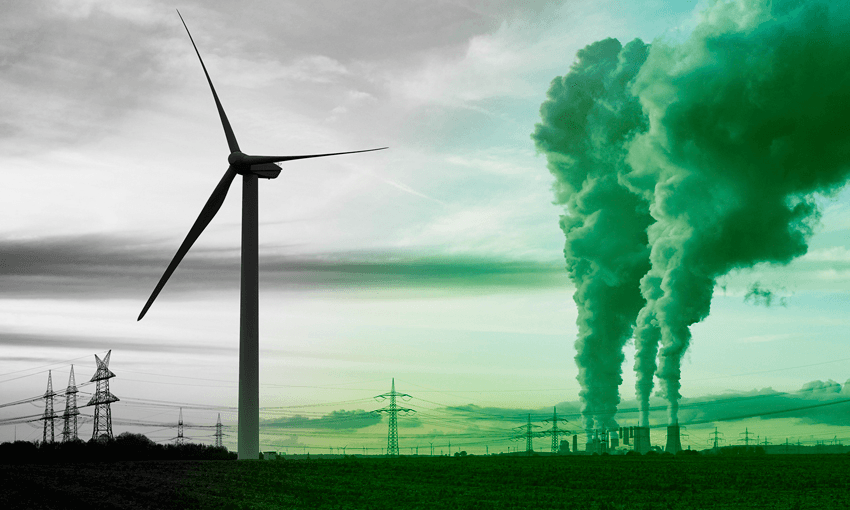
In other words: the power companies make more money when the supply of power is tight. Flooding the market with wind and solar would bring prices down, which is good for consumers but not so good for corporate profits.
Since being partially privatised, the gentailers have been far more focused on paying dividends to their shareholders than reinvesting in new power plants. In the last decade they’ve paid out $10.8bn in dividends over the last decade but invested $4.5bn in new power projects, according to analysis by First Union, 350 Aotearoa and the Council of Trade Unions.
That has started to change in the last couple of years with gentailers committing to some major new renewable power plants, though this is driven largely by expected demand growth from electrification and data centres rather than competitive pressure.
What do the politicians want to do about it?
The price of power has become an election issue and several parties have put forward proposals to reform the gentailers.
The Green Party, New Zealand First, and the Auckland Business Chamber all want to break up the gentailers into separate retail and generation companies (possibly the first time those three organisations have been aligned on anything).
They argue this would open up the market and lead to more competitive pricing. At the moment, independent power companies like Flick or Electric Kiwi have to buy their power from one of the big four gentailers, which are the same companies they are attempting to compete against and undercut in the consumer market. A separate wholesale and retail market would encourage more consumer price competition, though it wouldn’t solve the underlying issues of total power generation during dry winters.
Labour leader Chris Hipkins has floated the idea of breaking up the gentailers but hasn’t taken a firm stance. The Council of Trade Unions is calling for the government to buy back shares in the gentailers until they are fully state-owned again, but Labour hasn’t adopted this idea either.
The National-led government considered a structural separation last year before rejecting the idea. Then energy minister Simon Watts instead opted for “surgical” interventions such as giving the Electricity Authority more regulatory powers and speeding up consenting for new renewable power plants.
Is there anything regular people can do right now about the price of power?
Eek. Idk, wear a jumper?