NZ Inc is going all in on AI data centres

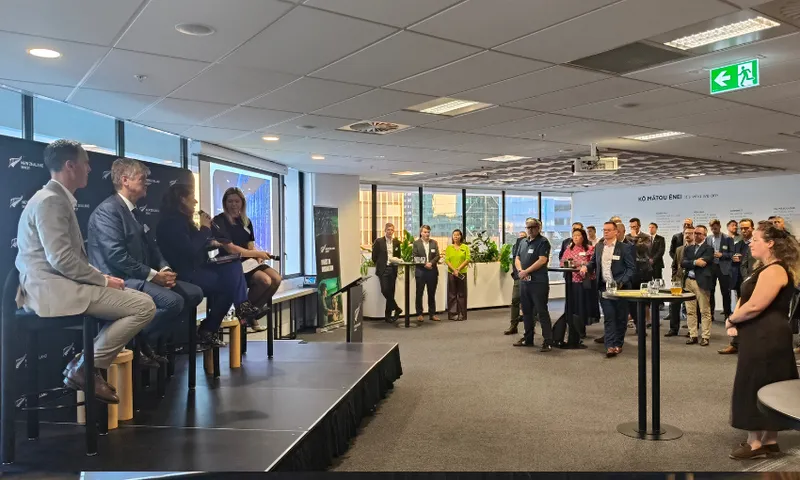
Mercury chief executive Stew Hamilton, Contact Energy chief executive Mike Fuge, tech industry leader Helen Robinson, and BCG’s Kelly Newton. Photo: Joel MacManus
The government wants $25-35 billion in data centre investment, and it just gathered some of the country’s most powerful business leaders to make the case.
Around 100 of the most powerful business leaders in New Zealand met last week on the Auckland waterfront at the offices of Invest New Zealand, the government agency responsible for attracting foreign investment into the country. They sipped wine, ate unidentifiably fancy hors d’oeuvres and wore suits that cost more than my car.
Among them were the CEOs and senior executives of power companies, construction firms, utilities, tech companies, investment banks, Kiwisaver funds and iwi development arms. They were there for what Invest New Zealand CEO Robert Walls described as a “call to arms”. He wanted them all to work together to create a lucrative new national industry of AI data centres.
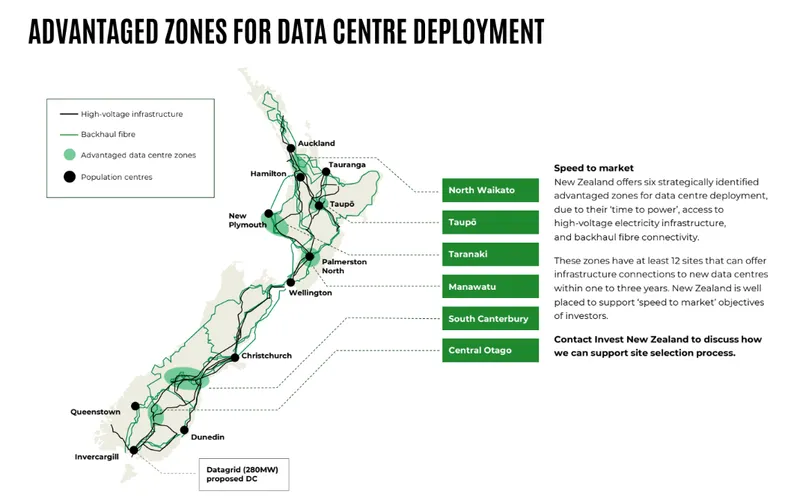
A report provided to every attendee talked up the potential to attract $25–35 billion of private investment in data centres, renewables, fibre and transmission over the next five years. It laid out why data centres might be uniquely well-suited to New Zealand; a cool climate, a stable baseload of power generation from geothermal energy and plenty of room to expand solar, wind and hydro.
After an opening address by Walls, there a panel discussion led by BCG’s Kelly Newton, featuring Contact Energy chief executive Mike Fuge, Mercury chief executive Stew Hamilton, and prolific tech industry leader Helen Robinson.
They pitched a vision for a future where New Zealand capitalises on the AI revolution by building clusters of data centres in rural areas, powered by a vast network of renewable energy made possible by long-term power purchasing agreements from the operators.
Newton said the opportunity was “bigger than anyone expected”. Fuge said it was a “once-in-three-generations opportunity”. He compared it to the invention of frozen meat shipping in the 1870s and the wool boom of the 1950s, situations where technology and global forces presented lucrative opportunities that New Zealand was able to capitalise on. Robinson called it “our greatest opportunity but also our greatest risk”.
Grandiose, optimistic rhetoric about the wonders of AI is nothing new for the C-suite class. Almost every corporate earnings call these days is hyped up with talk of AI miracles that will finally free businesses from the tyranny of workers who demand compensation for their labour. What made this panel discussion different is that there was no discussion of the technology. No debate about the merits or ethics of AI. Just a business opportunity: the global demand for compute is increasing, and we can make a lot of money providing it.
Invest New Zealand wants to get all the key business leaders paddling in the same direction so it can go out and pitch the opportunity to the world. They urged the need to move fast because competition is increasing. The Nordic countries have many of the same geographic advantages with geothermal energy and cool temperatures, and are well ahead of New Zealand when it comes to developing policy and building business relationships with tech infrastructure firms.
The haste may be necessary, but it’s also a convenient selling point for corporations asking the country to absorb an unprecedented amount of construction in mostly undeveloped areas. There was little discussion of the environmental risks this endeavour poses. That’s not necessarily a surprise – this was a sales pitch, not a debate – but some of the concerns were hand-waved away a bit too easily.
The report claims that New Zealand had a stronger social licence for data centres than most of the world. That’s based in part on what it viewed as the mostly positive local reception for the Datagrid data centre development in Southland. However, that claim stands in contrast with the recent Ipsos Issues Monitor poll which found that New Zealanders have more negative views towards AI than comparable countries. Only 35% believe the societal benefits of AI outweigh environmental costs, compared to a 49% global average.
Walls downplayed the concerns about water consumption which have come to define the backlash against data centre developments in the United States. He suggested that New Zealand could focus on closed-loop cooling systems, which circulates the same water through multiple times and therefore consumes less. This is, however, still a developing technology that hasn’t been widely implemented.
Any data centre development that Invest New Zealand manages to attract will be its own story, with the potential for legal, financial and political challenges. But the broader strategy is already in motion. New Zealand is selling itself as a home for data centres, whether the public likes it or not.
The 100 people in that room on the Auckland waterfront will decide a lot over the next five years – where the data centres go, how the water is sourced, how the profits are split. The public will get a say eventually, at resource consent hearings and council meetings, long after the powerful have already made up their minds.

Joel MacManus
Joel MacManus is a senior writer for The Spinoff. He previously worked at RNZ and Stuff, and began his career at Critic Te Ārohi. His writing explores the political, economic and cultural systems that underpin modern New Zealand. He won the 2025 Voyager Media Award for Best Columnist, Opinion or Critique.


