
The NZ-India FTA has finally been inked and released in full. But just how free is this free trade agreement?
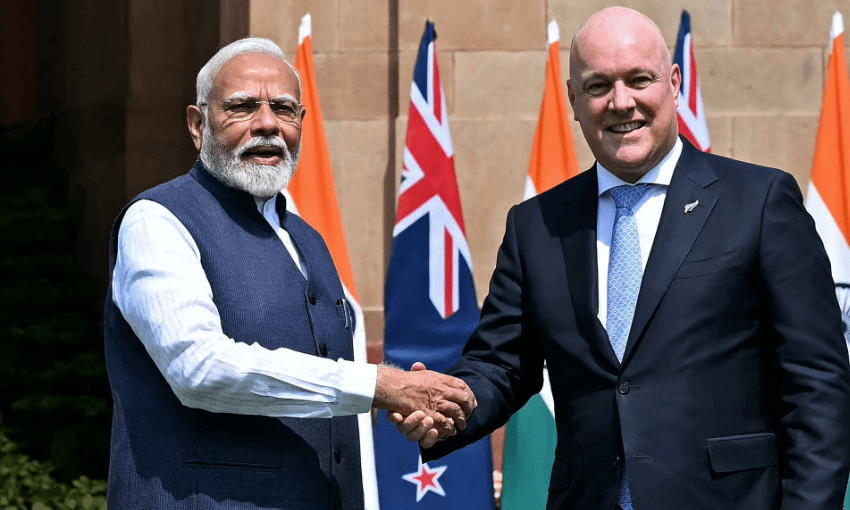
You gotta hand it to prime minister Christopher Luxon, he defied the doubters and delivered a Free Trade Agreement (FTA) with India just as promised in the 2023 election.
But the trade deal signed in New Delhi this week wasn’t that free. It doesn’t include New Zealand’s largest export (dairy) and only partly covers its second largest (red meat).
Market access for apples, kiwifruit, and honey is conditional on New Zealand helping India’s domestic producers become more productive and competitive.
MFAT says 95% of current exports to India will have tariffs reduced or eliminated eventually but only 57% will be duty-free immediately. After 10-years that number rises to 82% but almost a quarter will still face tariffs.
Then there’s the US$20 billion investment which New Zealand businesses are seemingly expected to make as part of the deal, despite that being an unrealistically high number.
Clearly major concessions were made to get an agreement across the line. Which doesn’t mean it is a bad deal — don’t let perfect be the enemy of good.
Plenty of sectors do very well. A 33% tariff on sheep meat will disappear immediately, almost all forestry products will be duty free, and bulk infant formula tariffs will be phased out over seven years.
With India it was always a choice between a limited trade deal or no deal at all.
John Ballingall, a trade economist at Sense Partners, said trade minister Todd McClay and his negotiating team had been dealt a weak hand but played it well.
New Zealand had limited bargaining power as a small economy specialising in products India most protects, compounded by a public commitment to sign a deal before the election.
“I don’t see any material downsides. Much of the political opposition has been mischievous and at times disappointing,” he told The Spinoff.
Small fishhooks, such as the $20bn investment and additional worker visas, had been blown out of proportion with the actual legal text in the agreement.
It is only a commitment to promote investment. If India is unsatisfied with New Zealand’s efforts after 15 years it can begin a consultation process asking our country to try harder, with reimposing tariffs held as an unlikely last resort.

“As for the concerns over visas, well, it is an election year so some histrionic dog-whistling is sadly to be expected,” Ballingall says.
New Zealand will allow up to 5,000 temporary work visa holders from India at any one time, mainly in short-staffed occupations such as construction, health, and IT.
The deal does prevent explicit caps on international student numbers, but New Zealand doesn’t use them anyway and can still limit inflows through eligibility criteria.
The deal should be seen as a foundation to be built upon, Ballingall says. India may not be opening its market fully but it’s wide enough for NZ to get its foot in the door.
India is projected to become the world’s third-largest economy by 2030 with a “middle class” of over 700m people. That’s an enormous market of consumers that may buy New Zealand products in the future.
The trade deal, while less comprehensive than others New Zealand has negotiated, will allow Kiwi businesses to ride the wave of India’s fortune.
MFAT has negotiated a clause in the deal which requires India to offer New Zealand wine sellers the same (or better) access as any other future trade partners. There is a similar commitment to review dairy access if it ever gets included in any other FTAs.
This means market access ought to improve over time.
Even so, New Zealand’s economic gains are expected to be modest. MFAT estimates GDP will be about 0.07% higher by 2027, rising to 0.1% by 2050, than it would be without the FTA.
Trade flows see larger gains, about $842 billion higher by 2036, but much of this comes from existing exports being redirected from other markets.
The impact assessment also estimated real wages would grow an extra 0.07% by that same year, with the benefits concentrated in export sectors.
All of these estimates should be treated cautiously. MFAT projected the China trade deal would lift trade by 20-40%, but more recent research found it roughly tripled.
MFAT itself says the modelling could be conservative as it doesn’t include any benefits from entrepreneurial exporters innovating with new products.
“Experience with New Zealand’s FTA with China, which came into force in 2008, suggests that FTAs with big emerging markets may encourage New Zealand businesses to pivot towards new opportunities in a way that generates higher-than-modelled returns,” it wrote in the assessment.
But economic growth is just one benefit of the India FTA, another is economic security.
New Zealand wants to diversify its trade relationships to avoid being caught in the type of geopolitical fallout that has become common. Access to other markets may mean exporters can survive losing access to China or the United States.
Dhruva Jaishankar, a US-based academic fellow of the Asia New Zealand Foundation, said the NZ-India deal was a risk mitigation strategy more than anything else.
“Concerned about over-dependence on China and the United States as both producers and consumers – and the failure of multilateral trade negotiations at the World Trade Organization—New Delhi and Wellington have opted to bet on each other and bring a modicum of certainty to an uncertain world.”