‘This is the real red pill’: the book Shariff Burke says everyone needs to read

Shariff Burke is the author of short story collection, Childish Palate.
Made possible by

Welcome to The Spinoff Books Confessional, in which we get to know the reading habits of Aotearoa writers, and guests. This week: Shariff Burke, author of Childish Palate.
The book I wish I’d written
Perhaps one very successful commercial fiction book, so it can give me the sufficient platform and support required to write the book I wish I’d written.
The book everyone should read
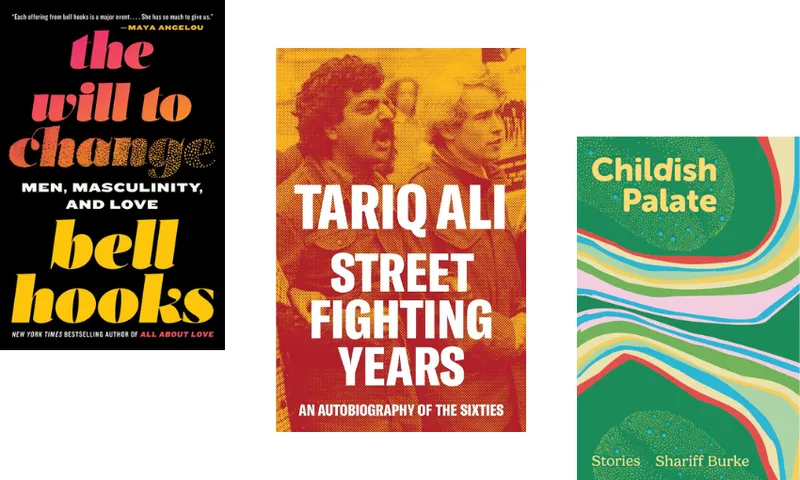
The Will To Change by Bell Hooks. This book gave me the lens to see what I had previously been blind to. Patriarchy is not perpetrated only by “bad” or abusive men. Rather, everyone in society (including women) is to various degrees an agent of patriarchy until we decide not to be. I learned that, as a man, society’s patriarchal education had robbed me of access to experiencing a full suite of complex human emotions. I felt stupid, that up till that point, I had accepted going through life in black and white. I think this easy-to-read book is the real red pill many are searching for.
The book I want to be buried with
My recipe book. With both my grandmothers gone and with no written access to their recipes, their food just lives deep inside me. In some ways, I think they would have liked this for us, so I’ll do the same for others I love (ie: bury my recipes with me so they live on in memory only).
The first book I remember reading by myself
Street Fighting Years by Tariq Ali. I loved crime fiction as a kid, but I don’t remember being moved. I found this book on my grandfather’s bookshelf during the school holidays. Surprisingly, it was an easy-to-read, first-person recounting of real events in the 1960s. Before I knew it, I was plunged into a hotel room, sipping brandy with Malcolm X (he was drinking tea) in Hanoi while the bombs fell, and then grieving the death of Che Guevara. It showed me an alternative world and another way to make sense of things.
Utopia or dystopia
Utopia. I think we’re in a dystopia now: a small part of the world’s population holds the keys and looks on at the rest of the world, convinced that their privileges stem from merit and the possession of a singular truth. Clearly, the world is too complex to be led by such ignorance. It requires from us curiosity, openness, shedding and transformation. Not for its own sake, although that is good too, but so that enough of us can get on with the big tasks ahead. That’s what my book, Childish Palate, is an allegory for. Part of the utopia is that people have changed how they think.
Fiction or non-fiction
The right fiction (for you) can teach you something, make you laugh and cry, and show you hidden parts of yourself. In fiction, the writer is completely free and conflicting truths are held together. There are no objects in their way except the limited formulations of their own presuppositions. It’s an indescribable feeling.
It’s a crime against language to …
- Insist on a correct and incorrect way to write.
- Critique dialogue for being “unrealistic”. People say crazy and random shit for all sorts of reasons. We need to be accepting and open to that.
The book that made me cry
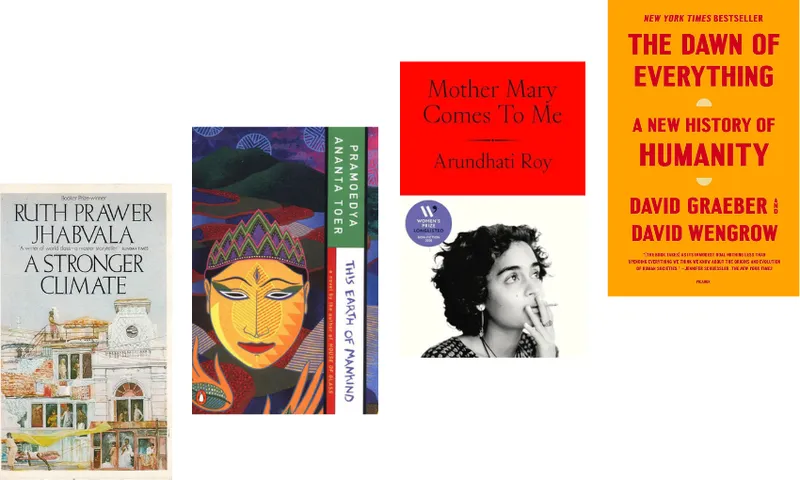
Mother Mary Comes To Me by Arundhati Roy. What else is there left to say about this book?
Nine Yard Sarees by Prasanthi Ram – I really admire this book because it’s a truly intersectional work, and shows how migration within Asia itself is often just as complex and fraught. The book focuses on various women in an extended family through a short story cycle format, moving between Tamil Nadu and Singapore. The stories explore deep longing between spaces, psychic and social change, the fracturing of family bonds and how time makes a fool of us all.
The book that made me laugh
A Stronger Climate by Ruth Prawer Jhabvala. Ruth Prawer Jhabvala is a British writer of Polish-Jewish heritage who later moved to India. Perhaps due to her subject position back then, she was always an outsider. I think that’s how she manages to see things so clearly. She writes about tensions between cultures and has a uniquely detached style that comes out as pitiless, sometimes cruel, but always hilarious and true. I am, of course, a super fan.
If I could only read three books for the rest of my life they would be
The Ministry of Utmost Happiness by Arundhati Roy. A masterpiece. Crime and Punishment by Fyodor Dostoevsky. Buru Quartet by Pramoedya Ananta Toer. I might be cheating because this consists of four novels, but I’ve yet to read the last one (House of Glass), so there’s still something new to look forward to.
The book character I identify with most
In Childish Palate, there’s a character named Khairul Babbington. He’s not a self-insert, but I really relate to the part of him that tries to be something to everyone, only for him to face an existential meltdown. He’s going through the lesson that one should only be a chameleon after they’ve known their true skin.
Most underrated book
The Nutmegs’ Curse by Amitav Ghosh. This beautifully written work of non-fiction quietly suggests that the colonists may have known all along the power of the natural world, and that in part prompted their desire to mechanise it and tear it all down. This book connects the climate catastrophe with our history and our relationship with the environment and, in an intriguing fashion, uses the story of the nutmeg to show us how we’ve ended up in the state we are in today. All while leaving space for wonder and the possibility of magic. I can’t recommend it enough.
The Dawn Of Everything by David Graeber and David Wengrow. This book flips on its head our view of what “natural” human behaviour is and how our received history is merely story telling (someone’s propaganda). It allows us to see objectively how the way we are organised today is not inevitable, and that the possibilities for our world are wide open; ours to make.
Best thing about reading
Reading can stimulate us to think about the world and ourselves differently, which hopefully can enable positive change to come into being.
Childish Palate by Shariff Burke ($32, Tender Press) is available to purchase at Unity Books.
The Spinoff Books section is proudly brought to you by Unity Books and Creative New Zealand. Visit Unity Books online today.

The Spinoff Review of Books
A smorgasbord of books thoughts and formats by The Spinoff.


